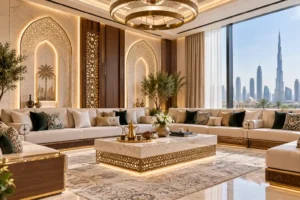
A majlis remains one of the most distinctive spaces in a Dubai home, particularly for homeowners who regularly receive family, friends and guests. When designing or renovating one, the challenge is to preserve the principles of hospitality and cultural identity while creating an interior that feels appropriate to the architecture and the way the household lives today.
For homeowners considering Dubai based interior design companies, the most important starting point is not a particular decorative style but an understanding of how the majlis will be used. Seating, circulation, privacy, lighting, acoustics and material choices all influence whether the room feels comfortable and purposeful.
Start With the Purpose of the Majlis
Unlike a conventional family living room, a majlis is generally planned around receiving guests. This affects everything from the position of the entrance to the arrangement of seating and the relationship between the room and adjacent service areas.
A formal majlis may have its own entrance, allowing guests to be received without moving through private parts of the home. In other properties, particularly apartments or homes without a dedicated reception room, the majlis function can be incorporated into a larger living space through furniture arrangement, changes in materials or subtle architectural definition.
The intended use should also determine the scale of the room. A space designed for larger gatherings requires sufficient circulation between seating areas, while a smaller majlis benefits from careful furniture proportions and a less crowded layout.
Traditional Principles in a Contemporary Setting
A contemporary majlis does not need to abandon traditional spatial principles. Perimeter seating, an open central area and an arrangement that encourages conversation can remain central to the design while the finishes become more restrained.
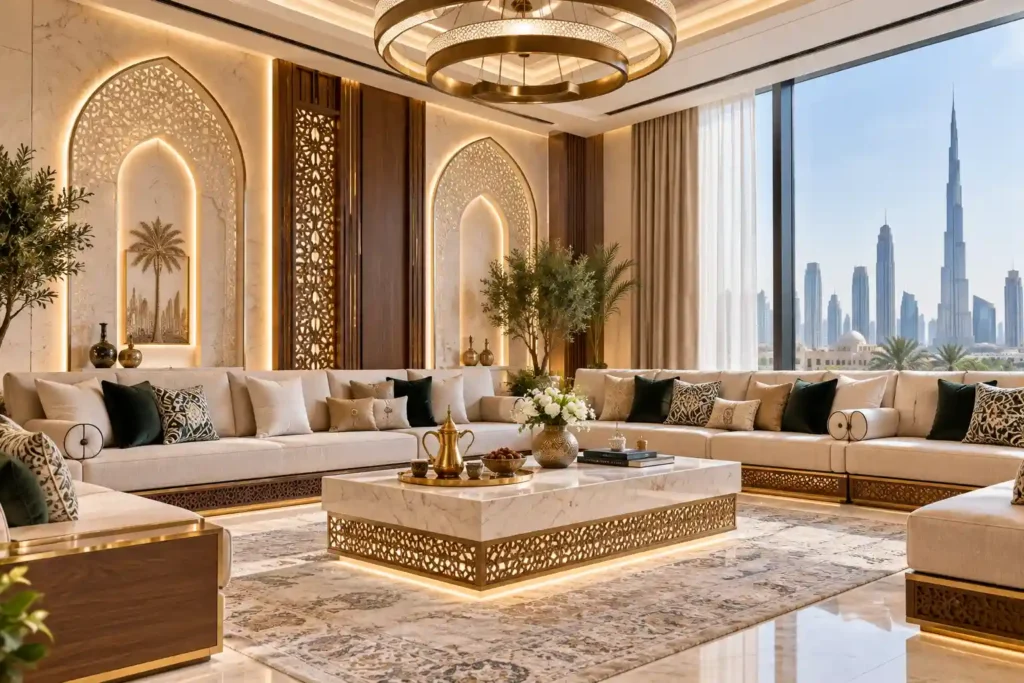
Traditional references can be introduced through architectural details rather than excessive decoration. Geometric patterns inspired by regional design, timber screens, textured plaster, arches, crafted metalwork or carefully selected textiles can provide cultural references without making the room feel overly themed.
This approach is particularly useful in contemporary Dubai villas where the architecture may already feature clean lines, large openings and modern materials. The majlis can acknowledge its cultural purpose while remaining visually connected to the rest of the property.
Choosing Between Traditional and Modern Styles
A traditional majlis often uses richer materials, detailed craftsmanship, patterned textiles and stronger colour contrasts. Timber, brass, stone, decorative plasterwork and upholstered seating can be combined to create a more formal atmosphere.
A modern interpretation may use cleaner lines, fewer decorative elements and a quieter palette. Bespoke seating, natural stone, timber, textured walls and architectural lighting can provide depth without relying on ornate detailing.
There is also a middle ground. A transitional majlis can combine contemporary proportions with a small number of recognisable traditional elements. For example, a restrained room may include an Arabic geometric screen, a crafted ceiling detail or a traditional textile used as an accent rather than covering the entire space.
Plan the Seating Around Conversation
Seating is one of the defining features of a majlis and should be considered before decorative elements are finalised. Continuous or connected seating along the perimeter can make better use of the room while leaving the centre relatively open.
The height and depth of seating also affect the character of the space. Lower seating can reinforce a more traditional arrangement, while contemporary upholstered seating can provide a familiar level of comfort for mixed-age households and international guests.
Furniture should also leave enough space for movement. Over-filling the room with individual sofas and occasional chairs can weaken the sense of openness that makes a majlis suitable for gatherings.
Use Materials That Add Depth Without Excess
Material selection is an opportunity to connect tradition with contemporary design. Natural stone can provide a strong architectural foundation, while timber introduces warmth and can be used for wall panelling, screens or joinery.
Metal details can be used selectively through lighting, furniture frames or decorative elements. Brass, bronze and other warm finishes can reference traditional craftsmanship without requiring elaborate ornamentation.
Textiles are equally important. Upholstery, curtains and rugs contribute to acoustics, comfort and visual softness. Rather than combining numerous patterns, a contemporary majlis can use texture, tonal variation and one or two carefully chosen patterns to create interest.
Consider Lighting and Acoustics Together
Lighting should support different stages of a gathering. General illumination provides practical visibility, while concealed lighting, wall lighting or decorative fixtures can create a softer atmosphere when required.
The position of lighting should be coordinated with the seating plan, ceiling design and architectural features. A decorative pendant or chandelier can act as a focal point, but it should not interfere with sightlines or dominate a room that already has significant architectural detailing.
Acoustics are also important in larger majlis spaces, particularly where hard surfaces such as stone, glass and plaster are used extensively. Upholstery, rugs, curtains, textured wall finishes and appropriate ceiling treatments can help reduce excessive reverberation and make conversation more comfortable.
Balance Privacy With a Sense of Arrival
Privacy can be especially important where the majlis is close to the main entrance or has direct views towards other parts of the home. Screens, partitions and carefully positioned joinery can establish separation without making the room feel enclosed.
A mashrabiya-inspired screen, for example, can provide visual definition while allowing filtered light to pass through. In a contemporary interior, this type of feature can be simplified into a geometric timber or metal panel that performs a practical function while referencing regional design.
The transition into the majlis should also be considered. The entrance sequence, view into the room and first position available to guests can influence the overall sense of arrival.
Adapt the Design to Dubai’s Climate
Material performance matters in Dubai, particularly where the majlis has large windows or direct exposure to strong sunlight. Fabrics, timber finishes, artwork and flooring should be selected with exposure and maintenance in mind.
Window treatments can help control glare and protect sensitive materials without eliminating natural light. Where a majlis connects to an outdoor terrace or garden, the relationship between internal and external materials should also be considered.
For homes with frequent entertaining, finishes should be practical enough to withstand regular use. A beautiful material that requires excessive maintenance may not be appropriate for a room intended to host gatherings throughout the year.
Integrate Technology Without Losing Character
Modern majlis spaces may require integrated audio, television, automated lighting, climate control and shading. These elements should be considered during the design stage rather than added after the room is complete.
Technology can be concealed within joinery or coordinated with wall and ceiling treatments. Speakers, screens and controls should have defined locations that do not compete with architectural features or decorative details.
This is particularly relevant in new villas, where electrical and lighting provisions can sometimes be reviewed before final finishes are installed. Early planning creates more opportunities to conceal equipment and maintain a coherent interior.
Avoid Turning Tradition Into Decoration
One common mistake is to treat cultural identity as a collection of decorative objects. Adding arches, patterns, brass accessories and ornate furniture does not necessarily create a well-designed majlis.
The stronger approach is to begin with the function of the room and then determine which elements of traditional design genuinely support that purpose. Seating arrangements, hospitality, privacy, proportions and spatial hierarchy should establish the character before decorative details are introduced.
A contemporary majlis can therefore feel culturally appropriate without reproducing a historical interior. Its identity can come from proportion, craftsmanship, materials and the way the room is organised.
Create a Majlis That Belongs to the Home
The most successful approach is to consider the majlis as part of the wider architectural language of the property. A highly ornate reception room may feel disconnected from a minimalist villa, just as an extremely restrained room may appear out of place within a home with traditional architectural detailing.
The objective is to find an appropriate relationship between heritage and contemporary living. Traditional principles can remain visible through spatial planning and carefully selected references, while modern materials, technology and furniture provide the comfort expected from a contemporary Dubai residence.
A useful principle when planning a majlis is to decide first how people will enter, sit, converse and move through the room, and only then develop the decorative scheme. When function, cultural context and architecture are resolved together, contemporary luxury can feel considered rather than simply added through expensive finishes.