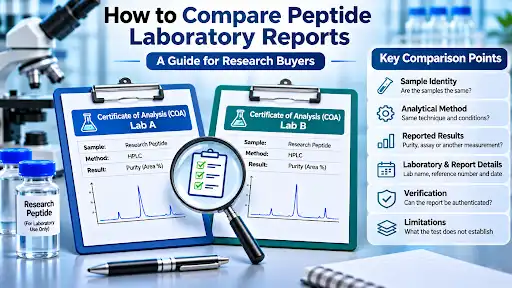
Laboratory reports can help research organisations understand the analytical findings associated with a particular peptide sample. However, comparing reports from different laboratories requires more than placing reported percentages side by side. Differences in sample identification, analytical methods, testing conditions and reporting procedures can affect how findings should be interpreted.
For UAE-based research organisations reviewing documentation from multiple sources, the priority should be establishing whether two reports provide genuinely comparable evidence. Similar product names or matching headline figures do not necessarily mean that the same material or analytical characteristics have been assessed.
Resources such as Remy Research provide access to research documentation and published peptide lab reports, which readers can examine in the context of the information each record contains.
Why Laboratory Reports Are Not Always Directly Comparable
Two laboratory reports may refer to the same named peptide but document different samples, batches or analytical procedures. Even when both reports include an HPLC purity percentage, the figures may have been produced under different analytical conditions.
A meaningful comparison begins by identifying the purpose and scope of each test. Readers should establish what was submitted to each laboratory, which procedure was used and what the reported measurement represents.
Without this information, a higher percentage on one report should not automatically be interpreted as evidence of better or more reliable material.
1. Establish Whether Both Reports Refer to Comparable Samples
Sample identification is the starting point for any report comparison.
Review the sample description, available sample identifier, batch reference and laboratory reference number in each document. Similar product descriptions are not sufficient to establish that two reports relate to the same sample or batch.
A comparison should record:
- Sample description stated in each report.
- Available sample and batch identifiers.
- Laboratory reference or report number.
- Report or testing date.
- Any differences in the submitted sample information.
If the documents relate to different samples, their findings should be treated as separate analytical records.
This is particularly important when reviewing historical documentation. A published report applies to the sample identified in that report. It does not automatically confirm the characteristics of a current shipping lot or another batch associated with the same product name.
Where suppliers associate one report with multiple strengths or formats, that association should not be treated as independent laboratory confirmation that every variation was tested.
2. Compare the Analytical Methods, Not Just Their Names
The analytical method determines what a laboratory result can meaningfully demonstrate.
Different procedures may be designed to assess different characteristics. For example, chromatographic purity assessment, quantitative assay and identity testing are not interchangeable analytical purposes.
Even when two reports mention HPLC, readers should examine the available method details before treating their results as directly comparable. Relevant information may include the chromatographic conditions, detector, sample preparation, reference materials and data-processing approach.
The ICH Q2(R2) guideline on Validation of Analytical Procedures explains analytical validation characteristics such as accuracy, precision, specificity and the reportable range. These principles help explain why the suitability and performance of an analytical procedure must be considered in relation to its intended purpose.
The important question is not simply whether both reports mention the same technique. It is whether the documented methods provide a reasonable basis for comparing the particular measurements being reviewed.
3. Interpret HPLC Purity Percentages Within Their Method
HPLC purity percentages can appear easy to compare because they are presented as numerical results. However, an area-percentage result is method-dependent and should not be treated as a universal measurement of sample purity.
In many chromatographic reports, area percentage describes the relative distribution of detected peak areas included in the calculation. Its interpretation depends on factors such as detector response, chromatographic conditions, sample preparation, peak integration and the method’s suitability for the intended analysis.
An HPLC area-percentage result does not automatically establish weight-based purity or the exact quantity of the target substance in a sample.
It is also important to distinguish purity from assay. An assay is intended to quantify the amount or content of a specified substance using an appropriate analytical procedure. Identity testing and sterility testing address different questions again.
When comparing two reports, record exactly how each result is described. If the method details or calculation basis are unavailable, note that limitation rather than assuming the percentages are equivalent.
The FDA’s Q2(R2) analytical validation guidance provides further context on evaluating analytical procedures according to their intended use.
4. Check Laboratory References and Original Report Records
Laboratory reference systems differ. One organisation may issue a task number and unique verification key, while another may use a report number, sample identifiers and an original PDF record.
Readers should follow the verification process provided by the issuing laboratory. They should not assume that every laboratory uses the same online verification system or reference format.
When reviewing multiple reports, check that the available reference details correspond to the document being examined. Where an official verification facility is provided, use it to assess the authenticity of the relevant record.
Report dates should also be recorded. They help distinguish separate submissions and place findings in chronological context, but a newer date alone does not establish that one analytical result is more accurate or reliable than another.
5. Separate Reported Findings From Unverified Characteristics
A laboratory report should only support conclusions within the scope of the tests documented.
For example, a chemical purity assessment does not automatically establish:
- Complete molecular identity.
- Exact content or assay.
- Sterility or absence of microorganisms.
- Endotoxin levels.
- Stability under storage or transport conditions.
- Safety or suitability for human or veterinary use.
These characteristics require appropriate supporting evidence and, where relevant, specifically designed testing.
Similarly, findings from one tested sample should not be extended to other batches, strengths or formats without supporting documentation. A supplier’s product mapping is not a substitute for independent testing of each associated sample.
6. Use a Consistent Comparison Checklist
A standard review process helps research organisations document differences without making unsupported assumptions.
For each report, record:
- Sample identification: What sample is described?
- Batch information: Which batch or sample identifier is available?
- Laboratory details: Which organisation issued the report?
- Analytical method: What procedure was used and what was it intended to measure?
- Reported results: Are the figures purity, assay, identity findings or another measurement?
- Verification: Is an original document or laboratory verification process available?
- Testing limitations: What characteristics have not been established?
- Comparability: Do the available details support a meaningful comparison?
If important information is missing, record it as unavailable. Do not fill gaps by assuming that two reports are equivalent.
Making More Informed Documentation Comparisons
Comparing peptide laboratory reports requires attention to sample identity, analytical methods, reporting conditions and the scope of each test. A numerical result should never be separated from the method and sample that produced it.
For UAE-based research organisations, a consistent comparison process can make documentation reviews clearer and help distinguish genuine similarities from differences in testing and reporting.
The most reliable comparison is one that explains what each report demonstrates, what cannot be concluded and whether the available evidence supports comparing the two records at all.
Research-use-only notice: This article is provided strictly for informational purposes relating to in-vitro laboratory research documentation. It is not intended for human or veterinary use, administration, diagnosis, treatment or prevention. Laboratory reports do not establish suitability or safety for human or veterinary administration.