
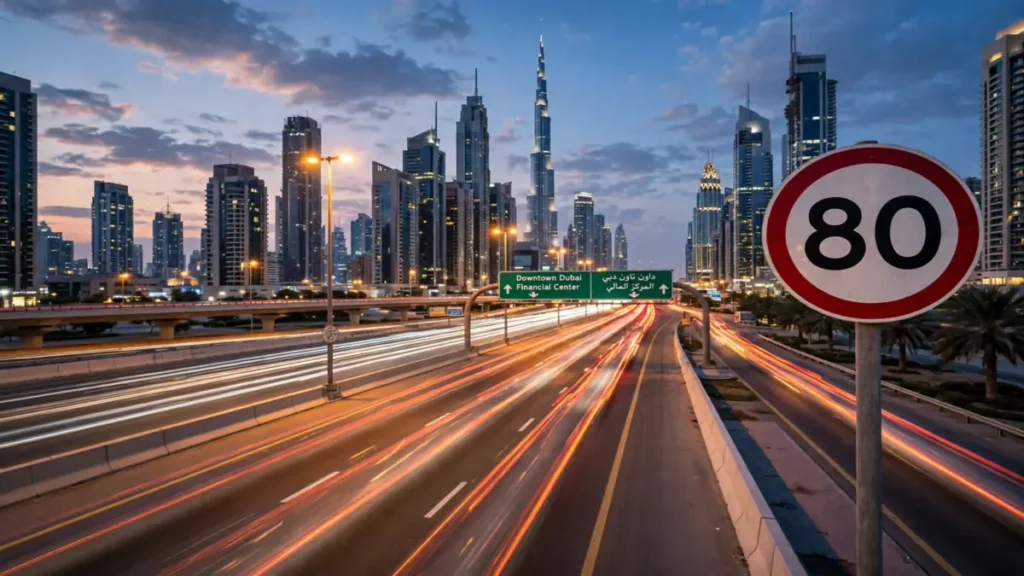
Dubai drivers, take note, because change is coming. From 1 November 2026, the speed limits on five of the emirate’s major roads will change. Three roads will get higher limits, while two will get lower ones. Because the reductions are the ones that can catch you out, this guide walks you through every change street by street, so your driving habits are ready before the new signs take over. This is your complete guide to the Dubai speed limits November 2026 update.
Dubai’s traffic authorities announced the changes this week. Indeed, the Roads and Transport Authority (RTA) and Dubai Police have jointly authorised them. They form part of the Dubai Traffic Safety Strategy, the emirate’s long-running drive to make roads safer and to improve traffic flow as the population keeps growing. Because the new limits start on 1 November, you still have time to learn the numbers and adjust your driving.
Which five roads are getting new speed limits?
The RTA has confirmed five changes. They apply to specified sections of each road in both directions, so read the table carefully. Here is the full list at a glance.
| Road | Section affected | Current limit | New limit from 1 November | Change |
|---|---|---|---|---|
| Al Mustaqbal Street | Between Sheikh Rashid Street and Al Meydan Street | 60 km/h | 70 km/h | Up by 10 |
| Latifa bint Hamdan Street | Between Sheikh Zayed Road and Al Khail Road | 60 km/h | 70 km/h | Up by 10 |
| Al Asayel Street | Between Oud Metha Street and Al Meydan Street | 60 km/h | 80 km/h | Up by 20 |
| Al Rebat Street | Between Marrakech Street and Sheikh Mohamed bin Zayed Road | 100 km/h | 90 km/h | Down by 10 |
| Sheikh Sabah Al Ahmad Al Jaber Al Sabah Street | Between 2nd December Street and Khalid bin Al Waleed Street | 80 km/h | 70 km/h | Down by 10 |
That mix still tells you something important about how Dubai now sets speed limits. Planners judge each road on its own conditions, traffic volumes and safety record, instead of giving one blanket number to the whole emirate.
What is changing on each road?
Below is the street-by-street breakdown with the exact sections you need to memorise, so study it before November. Whether you are commuting to work or driving out to enjoy the things to do in Dubai, these are corridors you have probably driven many times. So give the changes your full attention.
Why is Al Mustaqbal Street going from 60 to 70 km/h?
On Al Mustaqbal Street, the new limit of 70 km/h will apply to the stretch between Sheikh Rashid Street and Al Meydan Street. This is a modest increase of 10 km/h, yet it matters for daily commuters who use this corridor to move between central Dubai and the Meydan area.
The rise therefore suggests that traffic planners are satisfied the road can safely carry faster flows along this section. Still, do not treat the increase as an invitation to relax. Also keep scanning for the new signs once November arrives. Indeed, old habits on a familiar road cause most fines in the first weeks after a change.
Why is Latifa bint Hamdan Street going from 60 to 70 km/h?
The limit on Latifa bint Hamdan Street will rise from 60 to 70 km/h. This covers the stretch between Sheikh Zayed Road and Al Khail Road, so drivers there gain a little extra pace. This short but busy link still sits between two of Dubai’s heaviest traffic arteries. Even a 10 km/h lift should therefore ease merging traffic between them.
Because this street connects major highways, many drivers cross it without ever thinking of its name. If you travel between Sheikh Zayed Road and Al Khail Road, you probably use this road already. From 1 November, you can therefore legally drive it a little faster. That still applies only within the stated section, and only once the new signs are up.
Why is Al Asayel Street getting the biggest increase?
Indeed, Al Asayel Street sees the largest jump of the five. It rises from 60 km/h all the way to 80 km/h, between Oud Metha Street and Al Meydan Street. That extra 20 km/h therefore makes a real difference to journey times along this corridor.
A jump this large therefore tells you the road’s design and traffic conditions support a substantially higher flow than the old limit allowed. Even so, remember that an 80 km/h limit still carries Dubai’s radar enforcement rules, which we explain in detail below. So drive to the new number, not beyond it.
Why is the limit on Al Rebat Street being reduced?
Here, then, is where you need to be most careful. On Al Rebat Street, the limit will therefore drop from 100 km/h to 90 km/h. This applies to the section between Marrakech Street and Sheikh Mohamed bin Zayed Road, so memorise those boundaries. Because many drivers treat this corridor as a 100 km/h road, this reduction will likely generate the most fines in November.
Speed limit reductions usually reflect safety data rather than guesswork. When the authorities lower a limit, they signal that the old speed carried a risk they no longer accept. So take the new 90 km/h seriously from day one, and warn anyone else in your household who drives this route.
What about Sheikh Sabah Al Ahmad Al Jaber Al Sabah Street?
The second reduction, however, affects Sheikh Sabah Al Ahmad Al Jaber Al Sabah Street. It will drop from 80 km/h to 70 km/h between 2nd December Street and Khalid bin Al Waleed Street. This is a central, built-up area, so lower speeds protect pedestrians and side-street traffic there.
Several of these five roads also pass through well-known neighbourhoods. You can still place each of them on the map with our Dubai areas guide. If you are unsure which street is which, check the route on your navigation app before 1 November and also note the exact sections listed in the table above.
Why are Dubai’s speed limits changing at all?
The short answer is still safety and flow. The RTA and Dubai Police say the changes support a major drive to boost road safety and improve traffic flow. They therefore aim to keep pace with the needs of a growing population. Dubai’s roads carry more vehicles every year, so the authorities regularly review limits to match each road’s real-world conditions.
This is not a one-off announcement. The Dubai Traffic Safety Strategy is the framework behind it, and it treats speed management as one of its core tools. When a limit goes up, it usually means the road can safely handle more flow. When a limit goes down, it usually means crash or congestion data pointed to a risk at the old speed. Either way, the message for you stays the same. So trust the sign in front of you, not your memory of the old one.
There is also a practical side to this for the authorities. The RTA has indeed confirmed it will replace speed limit signs and reprogram cameras to reflect the adjustments. That means enforcement switches over to the new numbers, and old signs will not protect you once the change is live.
How much are speeding fines in Dubai?
Federal traffic regulations set the UAE’s speeding penalties, so the rules are consistent nationwide. Indeed, they rise steeply the further you go over the limit. Gulf News confirmed the bands below from the UAE’s traffic regulations, so you can trust the numbers. Authorities measure them against the applicable enforcement limit. That is the speed at which the radar records a violation, so the sign alone does not decide your fine.
| How far over the enforcement limit | Fine | Black points | Vehicle impoundment |
|---|---|---|---|
| Up to 20 km/h over | Dh300 | None | None |
| Up to 30 km/h over | Dh600 | None | None |
| Up to 40 km/h over | Dh700 | None | None |
| Up to 50 km/h over | Dh1,000 | None | None |
| Up to 60 km/h over | Dh1,500 | 6 black points | 15 days |
| More than 60 km/h over | Dh2,000 | 12 black points | 30 days |
| More than 80 km/h over | Dh3,000 | 23 black points | 60 days |
Now look at how quickly the consequences escalate. At the lower end, a small lapse still costs you Dh300, though with no black points. But once you pass 60 km/h over the enforcement limit, you face Dh1,500 and six black points. Police will also impound your car for 15 days. Go beyond 80 km/h over, and the penalty therefore becomes Dh3,000, 23 black points and a 60-day impoundment.
Black points matter because they accumulate on your licence. If you collect enough of them, you risk losing your licence altogether. So a single moment of speeding on a road whose limit you misremembered can follow you for months. If you think you may already have a violation on your record, you can check your RTA fines by plate number before the new limits take effect. So clear any surprises early.
How does Dubai’s radar grace limit work?
This is indeed the part of the story that confuses even experienced drivers. However, Dubai Police distinguish between two different numbers: the posted speed limit and the radar control speed. Understanding the difference can save you from a fine, so learn both numbers now.
The posted limit is the number you see on the road sign. The radar control speed is the threshold at which a speed camera actually records a speeding violation. On many major Dubai roads, that radar threshold is typically 20 km/h above the posted limit. For example, an 80 km/h road may have a radar activation threshold of 101 km/h, according to Gulf News.
Here is the critical warning, straight from the authorities’ own guidance: do not treat this buffer as permission to exceed the posted limit. Motorists should therefore always follow the road signs. Think of it this way, then. The grace threshold exists to keep enforcement fair and consistent, not to give you a free 20 km/h.
Think of it this way. If you drive at exactly the posted limit, you are completely safe from cameras on every road. If you drive inside the buffer, you are relying on a tolerance that could change. And if you drive past the radar threshold, the fine bands in the table above apply. Still, authorities calculate them against the enforcement limit, not the sign.
What happens to the cameras on 1 November?
There is still one more reason to stay well inside the posted limit. The RTA has indeed confirmed it will reprogram cameras to the new limits from 1 November. So on Al Rebat Street, where the posted limit drops from 100 to 90 km/h, the radar threshold will drop with it. Anyone who keeps the old 100 km/h habit could therefore trigger a camera in the very first week. The same goes for anyone who treats the buffer as a bonus.
When will the new signs and cameras be ready?
The RTA has indeed confirmed it will replace speed limit signs and reprogram cameras to reflect the adjustments. The RTA therefore links that work to the 1 November effective date. Expect new signage on all five roads as the date approaches.
Until the new signs are in place and the date arrives, the current posted limits remain the ones in force. So do not drive the new numbers early on roads where limits are rising. Instead, do not keep driving the old numbers late on roads where limits are falling. The safest rule is therefore simple: always obey the sign you can actually see in front of you.
Also watch for the changeover period carefully. In the first days of November, technicians may reprogram some cameras slightly before or after crews swap individual signs. During that window, drive to the lower of the two numbers you might be facing, because that is the posture that can never produce a fine, so it is the safest choice.
What should you do before 1 November?
You have just over a week to prepare, and a little preparation now will save you money and stress later. Work through this checklist before the new limits take effect.
1. Which two reductions must you memorise?
The increases are easy, because nobody gets fined for driving slower than allowed. The reductions, however, are the danger zones. Memorise these two. Meanwhile, Al Rebat Street drops from 100 to 90 km/h between Marrakech Street and Sheikh Mohamed bin Zayed Road. Sheikh Sabah Al Ahmad Al Jaber Al Sabah Street drops from 80 to 70 km/h between 2nd December Street and Khalid bin Al Waleed Street. If you drive either route regularly, say the new numbers out loud until they feel natural.
2. What should you watch for on the roads?
The RTA is replacing speed limit signs on all five roads. When you see a fresh sign, trust it over your memory. Road signs are the legal posted limit. Your memory of the old number, however, counts for nothing in a dispute.
3. Why check your dashboard and navigation settings?
Many cars and navigation apps still display the speed limit they think applies to your road. Those databases update at their own pace, so your dashboard may show the old number for weeks. Until your app catches up, rely on the physical signs and your own knowledge of the new limits.
4. Who else needs to know about the changes?
If your spouse, children or driver use your car on these roads, tell them about the changes now. Fines follow the vehicle’s plate, and black points follow the licence — so a family member’s mistake can become your problem. Company fleet managers should circulate the new limits to all drivers now. Delivery and service vehicles cross these corridors constantly, so the message matters even more for fleets.
5. How should you reset your cruise control habits?
Many drivers still set cruise control above the posted limit. They assume the radar buffer will protect them, but that assumption is now risky. With the limits changing, especially downward on two roads, reset those habits now. Set cruise to the posted number itself, and you will never have to wonder whether the camera was reprogrammed yet.
6. Why clear your existing fines now?
There is indeed no better moment for a clean slate. You can check your RTA fines by plate number online, so do it today. You can also manage other RTA services through the government portals online that residents use every day. Starting November with zero pending fines therefore means one less thing competing for your attention.
What is Dubai Police doing about road safety right now?
The speed limit changes arrive in the middle of a wider enforcement push, so expect no leniency. Dubai Police have been tightening their grip on dangerous driving throughout 2026, and the numbers show it.
During the first nine months of this year, Dubai Police issued 7,735 traffic fines. They also impounded 1,630 vehicles for excessive noise and unauthorised modifications. The total includes 2,045 breaches for excessive vehicle noise; 333 vehicles were impounded as a result. It also includes 5,690 breaches for illegal engine or chassis modifications, with 1,297 vehicles impounded.
How harsh are the penalties for noisy and modified cars?
The penalties are indeed severe. Still, under UAE traffic regulations, driving a noisy vehicle carries a Dh2,000 fine and 12 black points. Illegal modifications to a vehicle’s engine or chassis carry a Dh1,000 fine, 12 black points and 30 days of impoundment.
Brigadier Juma Salem bin Suwaidan directs the traffic department at Dubai Police. He said loud vehicles — particularly cars and motorcycles with modified engines or exhaust systems — concern residents. “Excessive noise can disturb residential neighbourhoods, especially at night. It affects public well-being,” he said. “Sudden or unusually loud sounds can also distract drivers and other road users, increasing the risk of accidents.”
How is Dubai Police catching offenders?
Enforcement is also getting smarter. Dubai Police are now expanding devices that detect and measure vehicle noise. They are also using AI-enhanced cameras that document offences whenever the noise limit is crossed. The force had already announced last November that it would expand radar capacity to catch noisy vehicles. In 2024 alone, police issued 12,019 fines for unauthorised modifications causing excessive noise or significant engine and chassis changes.
The message is consistent across every part of this campaign: Dubai is serious about calmer, safer roads. The new speed limits are one piece of that strategy, while the noise crackdown is another. Drivers can therefore expect strict enforcement on both fronts. Traffic penalties also sit alongside other fines every resident should know. The UAE social media fine rules, for example, punish online insults with jail time and heavy penalties.
How can you avoid a speeding fine under the new limits?
Fines are avoidable, and the drivers who get them usually make one of a handful of predictable mistakes. Here is how to stay out of trouble.
What is the single safest habit?
Above all, drive to the sign, not the buffer. The radar grace threshold is a tolerance, not a target. If you aim for the posted limit itself, camera reprogramming schedules and sign-swap timings can never hurt you.
Which roads deserve extra caution?
Also give yourself extra margin on the two reduced roads. On Al Rebat Street and Sheikh Sabah Al Ahmad Al Jaber Al Sabah Street, your old speeds now exceed the limit. Slow down a week early, and the new numbers will soon feel normal.
What else keeps you fine-free?
Still, stay alert in changing conditions. Road conditions can still shift with fog or sudden rain. Poor visibility indeed makes any speed riskier, whatever the sign says. Check the UAE weather today before long drives. Poor visibility makes any speed riskier, whatever the sign says.
Also plan around busy periods. Traffic volumes still rise around long weekends and celebrations. Check the next public holiday in the UAE, and expect heavier flows on major corridors during those times.
Also keep your car legal in every other way. Dubai Police impounded 1,630 vehicles in nine months over noise and modifications, so take note. A loud exhaust or an engine tweak can therefore cost you Dh2,000, twelve black points or your car for a month. A fully compliant car therefore removes one more reason for police to look twice at you.
Finally, remember that enforcement is increasingly automated. Reprogrammed speed cameras, AI noise detection and expanded radar coverage are now everywhere. The chances of a violation going unnoticed still shrink every year. The cheapest strategy has always been the simplest one: obey the posted limit.
What do drivers ask most about the new limits?
Which roads are affected by the new Dubai speed limits?
The changes affect five roads from 1 November 2026, so mark the date. They are Al Mustaqbal Street, Latifa bint Hamdan Street, Al Asayel Street, Al Rebat Street and Sheikh Sabah Al Ahmad Al Jaber Al Sabah Street. The changes apply to specified sections of each road in both directions, as listed in the table above. Always check the physical sign on your exact section, since limits can differ between sections of the same road.
Are the speed limits going up or down?
Both. However, three limits are rising. Al Mustaqbal Street and Latifa bint Hamdan Street go from 60 to 70 km/h, while Al Asayel Street jumps from 60 to 80 km/h. Meanwhile, two limits are falling. Al Rebat Street drops from 100 to 90 km/h, while Sheikh Sabah Al Ahmad Al Jaber Al Sabah Street drops from 80 to 70 km/h. Because reductions generate the fines, watch Al Rebat Street and Sheikh Sabah Al Ahmad Al Jaber Al Sabah Street most closely.
What is the radar grace limit in Dubai?
Dubai Police distinguish the posted speed limit on the sign from the radar control speed. The radar speed is the point at which a camera records a violation. On many major roads, the radar threshold still sits typically 20 km/h above the posted limit. For example, an 80 km/h road may carry a radar activation threshold of 101 km/h. However, do not treat this buffer as permission to exceed the posted limit. Always follow the road signs.
When do the new speed limits take effect?
The new limits take effect from 1 November 2026, so the countdown is on. The RTA has confirmed that crews will replace the speed limit signs and reprogram the cameras to reflect the adjustments. Until the changeover is complete, obey the sign you can see in front of you. If you feel unsure during the transition, drive to the lower number.
How much is the fine for speeding in Dubai?
Under UAE traffic regulations, fines start at Dh300 for up to 20 km/h over the enforcement limit. They therefore rise to Dh600, Dh700 and Dh1,000 for larger excesses. Beyond 60 km/h over the limit, you face Dh1,500, six black points and 15-day impoundment. Beyond 80 km/h over, the penalty reaches Dh3,000, 23 black points and 60-day impoundment. Black points accumulate on your licence, so repeated offences can cost you your right to drive.
Will I be fined if I drive the old speed in the first week of November?
On the two roads where limits are reduced, driving at the old speed after 1 November means exceeding the new posted limit. That counts as a speeding offence once the change is live. On Al Rebat Street, for example, continuing at 100 km/h after the limit drops to 90 km/h puts you 10 km/h over. Adjust your habits before the deadline, because technicians will reprogram the cameras to the new numbers.
How can I check whether I already have traffic fines?
You can check your RTA fines by plate number through our step-by-step guide, so use it soon. It walks you through the official RTA channels. Do it before 1 November. You will then start the new speed limit era with a clean record and full attention on the road. It is worth doing before 1 November, so you start the new speed limit era with a clean record and full attention on the road.
The bottom line is simple. Dubai is now adjusting its speed limits road by road. Its safety strategy rewards careful drivers and punishes careless ones, so compliance pays. So learn the five changes and respect the two reductions. Drive to the sign rather than the radar buffer. Then November will pass without a single fine landing on your plate. This story is part of a busy week for Dubai news, from the Dubai gold price dropping below Dh500 to this latest move by the RTA and Dubai Police. We will keep updating you on the Dubai speed limits November 2026 rollout as the new signs go up.