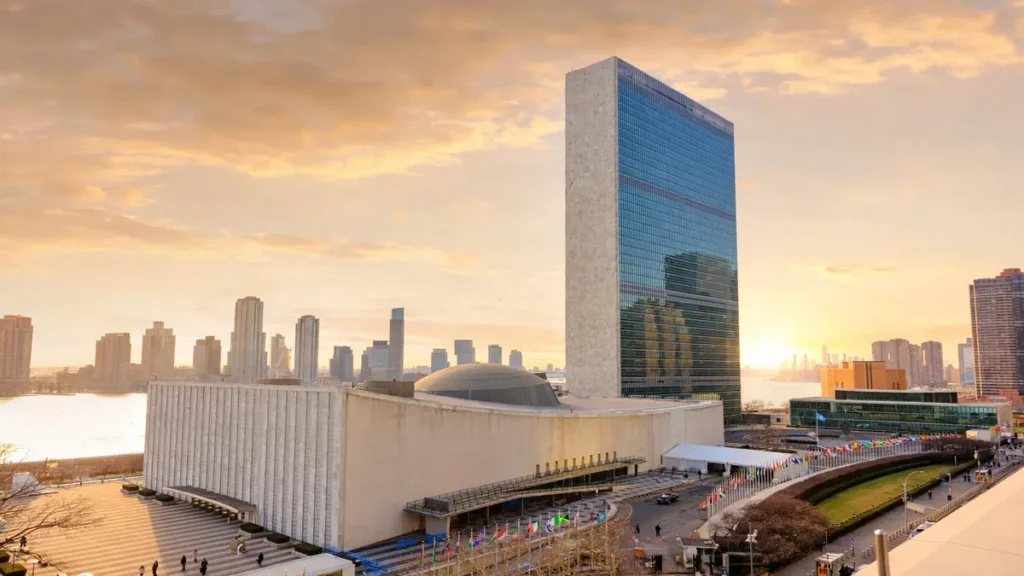
History may indeed be about to be made at the United Nations. On Wednesday, 21 October 2026, the UAE’s Lana Nusseibeh finally announced her candidacy for UN Secretary-General. As a result, the race for the world’s top diplomatic job suddenly looks very different.
Her formal nomination came directly from President Sheikh Mohamed bin Zayed Al Nahyan, and it changes everything. He addressed his letter to the presidents of both the UN General Assembly and the Security Council. And if she wins, she would become the first woman to lead the United Nations since its founding in 1945.
So why does this matter to you in the UAE? Yet this is not just a diplomatic story from New York. Instead, it is a story about the country’s place in the world. And it could end with an Emirati voice leading the world’s most important international organisation. Here is everything you need to know, then, as of Thursday, 22 October 2026.
Who is Lana Nusseibeh?
Lana Nusseibeh is the UAE’s Minister of State and Envoy to the UN and the European Union. She is also one of the most experienced multilateral diplomats of her generation. Her career spans, in fact, more than a decade at the heart of the United Nations.
She served as the UAE’s Permanent Representative to the United Nations from 2013 to 2024. During that time she led the country’s participation in a major role too. For example, the UAE served its 2022–2023 term as an elected member of the UN Security Council. And she twice served as President of the Council itself.
She has also served as a Vice-President of the UN General Assembly. And she has served as President of the Executive Board of UN Women. Her portfolio has covered peace and security, humanitarian diplomacy and sustainable development. It has also covered women, peace and security, human rights and multilateral reform.
She has also worked on efforts to reform the Security Council and revitalise the General Assembly. In December 2023, for instance, she led a visit with a clear purpose. Current and incoming Security Council members travelled to the Rafah border crossing. The goal, above all, was to draw attention to the humanitarian situation. She also played a key role in securing the adoption of Resolution 2720. That resolution specifically aimed at facilitating humanitarian aid deliveries to Gaza.
Announcing the nomination, the Emirates News Agency (WAM) also reported the President’s praise. He highlighted her extensive experience at the UN and her judgement in addressing international challenges. WAM also noted her record of constructive work. She has now taken a leave of absence from her UAE Government responsibilities. Her full focus is now on the candidacy.
What does a presidential nomination actually mean?
Still, a UN Secretary-General cannot simply declare a candidacy and hope for the best. Instead, every contender needs the formal backing of a member state. The UAE has now put its full weight behind Nusseibeh. President Sheikh Mohamed then submitted her nomination in a letter. It was addressed to the presidents of the UN General Assembly and the Security Council. WAM too reported the move.
That letter matters because it turns a personal ambition into an official national candidacy. It signals to every member state, for instance, that the UAE stands behind her. And it formally enters her name into the selection process. For the latest official announcements from the UAE leadership, you can also follow official UAE government portals alongside WAM.
Her decision to take a leave of absence is still equally significant. In her vision statement, she indeed said the move reflected the independence required of the Secretary-General under the UN Charter. In her own words:
“I wish to offer myself to this office as I would serve it: speaking frankly with every government and answering to none. There will be no exemptions for friends and no grudges against critics.”
Indeed, it is a striking promise. She is also telling governments in advance that she would not play favourites. And she would hold even her supporters to the same standard as everyone else.
Where does the race for UN Secretary-General stand right now?
To understand why her entry matters, you need to know how stuck this race has been. The contest will choose a successor to António Guterres. His second five-year term ends, after all, on 31 December 2026. Yet the Security Council has held six rounds of informal straw polling. None has yet produced a candidate acceptable to all five permanent members. Those members are the United States, Russia, China, Britain and France.
In the latest poll on 16 October, former Costa Rican Vice-President Rebeca Grynspan narrowly led the field. But every one of the seven contenders received at least two opposing votes from permanent members. So the contest still has no clear winner. That deadlock is exactly what has now opened the door for new candidates.
However, the rules of the contest are strict. The next Secretary-General must still be recommended by the 15-member Security Council. Then the General Assembly appoints them. A candidate needs at least nine votes in the Council. And they must avoid a veto by any of the five permanent members. The position still carries a five-year term. The winner then takes office on 1 January 2027.
Two big unwritten expectations still hang over the race. Many have indeed long called for a woman to lead the UN for the first time. An informal tradition of regional rotation has also prompted expectations of a candidate from Latin America. But neither consideration is a formal requirement under the UN Charter. So the field stays open.
What is the timeline from here?
Here are the key dates, confirmed so far:
- 16 October 2026 – The Security Council holds yet another straw poll. Rebeca Grynspan narrowly leads, but no contender wins consensus.
- 21 October 2026 – Lana Nusseibeh finally announces her candidacy. Indeed, President Sheikh Mohamed bin Zayed Al Nahyan formally nominates her.
- 22 October 2026 – UAE media then publish full details of her vision statement, A United Nations for the Next Eighty Years.
- 31 December 2026 – António Guterres’s second term as Secretary-General finally ends.
- 1 January 2027 – The next Secretary-General takes office as planned.
Keep these dates in mind, just as many residents watch the UAE public holiday calendar. The decision still has to land before the end of the year. And every straw poll from here on could shift the outcome.
What is in her vision statement?
Her full vision statement is indeed titled A United Nations for the Next Eighty Years. You can also read it at www.lananusseibeh.org. It puts peace and security at the centre of her programme, above all. The argument is clear: the UN must become more active in preventing conflict now. It must also preserve channels for diplomacy. And it must help divided parties find practical points of agreement.
Launching her candidacy, she reflected on both what diplomacy can achieve and what it costs when it fails:
“I have spent much of my professional life working in and around the United Nations, and I have seen first-hand what determined diplomacy can achieve – countries with profound differences finding common ground, and agreement where people said agreement was impossible.”
“But I have also seen the cost when diplomacy falls short. When the distance between what we promise and what we deliver grows, trust erodes, and so does our ability to act. I am standing to be Secretary-General because I believe this is a moment to act with greater urgency: to act earlier, bring people together across difference, and drive the work forward until it produces concrete results. That is how we rebuild trust in the United Nations and ensure it delivers meaningful change for the people it exists to serve.”
Here is how that vision breaks down, section by section.
How would she handle peace and security?
Nusseibeh says the United Nations should instead use quiet diplomacy to keep disputes from escalating. Instead of waiting for wars to explode, she wants the UN to step in earlier. The goal is practical agreements that reduce suffering now. Those deals can then create space for wider political settlements later.
Her statement indeed prioritises achievable “first agreements”. These are concrete and limited deals. Examples include securing humanitarian access and exchanging prisoners. Local truces are yet another example. Each would still be backed by persistent diplomacy. And each would include verification to make sure agreements actually hold. It is a deliberately practical approach, too. Start with what is possible, prove it works, and build from there.
She also puts “first actors” at the centre of peace efforts. These are, above all, the people closest to conflicts. They include regional organisations and mediators trusted by the parties involved. In her view, the UN need not lead every negotiation, however. But it should work with whoever is best placed to make progress. And it should be present in every room where it can add value.
Her approach is indeed rooted in bridge-building with a purpose. The goal is still not dialogue for its own sake. Instead, it is about finding common ground across geopolitical divides. That common ground must produce an agreement, secure access or reduce violence. Or it must create the conditions for a broader peace. As she puts it:
“I will judge my own work by the impact it produces, not by what it proclaims.”
For ordinary people, this focus on humanitarian access is indeed the part that hits home. When she speaks of getting aid through, she means food, shelter and medicine reaching civilians. It is the same kind of essential supplies travellers think about too. So before a trip, many check the UAE’s rules on bringing in medicines.
How would she reform the UN itself?
Nusseibeh argues that stronger diplomacy still needs an organisation capable of backing it up. Her reform programme would make the UN faster and more focused. It would also make it more accountable. The aim is effective delivery across three pillars: peace and security, development and human rights.
The programme above all calls for clearer priorities. Leadership and resources should move closer to the problems the UN exists to solve. Accountability for results must also grow stronger. Duplication across the system must shrink too. And people in the field should be empowered to act and deliver, rather than waiting on distant headquarters.
She also proposes a simple test of value for money. For example, every major Secretariat programme should report what it achieved against what it cost. Large bureaucracies still often avoid that question. Officials would get clearer purpose, and results would be rewarded. She would also build a senior team chosen for excellence. That team would reflect the world it serves and the principles the UN upholds.
Her summary of the philosophy is crisp and memorable. A more focused United Nations should instead do less where others can deliver. And it should do more where only it can. It is indeed an argument for a UN that knows its limits. Then it concentrates its energy where no one else can act.
What does she promise on development?
On development, Nusseibeh says the UN system must now respond to a changing world. Progress on the 2030 Agenda for Sustainable Development still remains deeply uneven. Countries affected by conflict and fragility have fallen furthest behind, however. Aid still remains essential where it is needed. But the UN must also help countries pursue nationally determined priorities. And it must help them build durable prosperity.
Her programme would also focus development cooperation on national priorities. Jobs, for example, would sit at the centre of the effort. Development opportunities in fragile settings would expand too. The programme would also address the mispricing of risk. That mispricing still keeps investment away from the places that need it most. And it would champion fairer solutions to the debt burdens crushing many developing economies.
She would also build new partnerships with philanthropy and the private sector. That would bring fresh money and ideas into development work. As member states prepare to negotiate the successor to the 2030 Sustainable Development Goals, she would use the Secretary-General’s convening role. The aim is commitments that governments can also explain to their citizens. And promises the world can actually keep.
What about human rights and tomorrow’s challenges?
Nusseibeh says human rights, peace and development are indeed mutually reinforcing. None of them can succeed without the others, however. She argues that the UN’s credibility on human rights still depends on consistency. The Charter, international law and universal human rights must be applied evenly. And they must be applied without double standards.
That last phrase still carries weight. It signals she would hold powerful and weak states to the same rules. The echo is deliberate: “no exemptions for friends and no grudges against critics.”
She also looks ahead to challenges the UN’s founders never imagined. On artificial intelligence and biotechnology, she proposes practical international cooperation too. That cooperation must be built before divisions harden. Ideas include voluntary incident reporting, for instance. And countries that live with these technologies but do not build them should get a bigger voice. She further calls for the UN to help member states anticipate climate change. The goal is stronger resilience, above all, where fragility is greatest.
What would her election mean for history?
If successful, Nusseibeh would become the first woman to lead the United Nations since 1945. After 80 years and nine Secretaries-General, all men, that would be a landmark the whole world would notice.
She would also become only the second Secretary-General from the Arab world. The first was Egypt’s Boutros Boutros-Ghali, who indeed held the position from 1992 to 1996. For the Arab world, that symbolism still runs deep. The region has indeed often felt underrepresented at the top table of global institutions.
But the significance goes beyond symbolism. Her pledge sets a tone of independence that the role demands, after all. The Secretary-General is meant to be the world’s chief diplomat above all. They are not any one country’s messenger, however. And her leave of absence from the UAE Government is designed to prove she understands that.
It also fits the UAE’s wider story. The country has indeed pushed hard to put women into top leadership roles. At home, that drive is backed by UAE labour law protections and a national agenda on gender balance. A successful bid would be the most visible proof yet of that strategy on the world stage.
Why should this matter to you in the UAE?
You might still wonder what a New York selection process has to do with your daily life. Quite a lot, as it turns out. The UAE’s influence in the world shapes everything from its economy to its reputation, for instance. Think, for example, of Dubai gold price movements that make global headlines. Or think of its seat at the Security Council table.
Dubai and Abu Dhabi have spent years building themselves into neutral meeting grounds. World leaders gather here for summits, expos and quiet back-channel talks. If you have ever hosted visiting friends or family, you know the city’s pull. Our guide to things to do in Dubai barely scratches the surface of why the world keeps coming.
A UN Secretary-General from the UAE would indeed take that standing to another level. The country’s perspective would then sit at the head of the table where global decisions get made. That perspective is shaped by this region’s conflicts, its trade routes and its development story. For the millions who have checked their UAE visa status and built a life here, that is a source of genuine pride.
What happens next in the race?
The contest now moves into its decisive phase. Nusseibeh will need to win over the Security Council’s permanent and elected members alike. These are the same world powers whose divisions have indeed often made international agreement so difficult. She still needs at least nine votes. And she must avoid a single veto.
The sources still do not give a fixed date for the decision. But the calendar sets its own deadline. The Council must agree on a candidate before Guterres’s term ends on 31 December 2026. Then the General Assembly must appoint them. Expect more informal straw polling in the coming weeks, too. That is still how members test where support really lies.
The news indeed travelled fast on social media within hours of the announcement. If you share it, share it responsibly. The UAE’s social media rules are strict, and unverified claims can land you in serious trouble. Stick to confirmed facts from WAM and established outlets instead.
What are people asking about her candidacy?
Who is Lana Nusseibeh?
She is the UAE’s Minister of State and Envoy to the UN and the European Union. She is now on a leave of absence to run for UN Secretary-General. From 2013 to 2024, for instance, she served as the UAE’s Permanent Representative to the UN. She led the country’s 2022–2023 Security Council term and twice served as Council President. Her record also includes a stint as Vice-President of the General Assembly and as President of the Executive Board of UN Women.
How is the UN Secretary-General actually chosen?
The 15-member Security Council recommends a candidate. The General Assembly then appoints them. A contender still needs at least nine Council votes. And they must avoid a veto from any of the five permanent members. Those are the US, Russia, China, Britain and France. Before the formal vote, the Council holds informal straw polls to test support. Six rounds so far have still failed to produce a consensus candidate.
When will we know who won?
The sources still do not name a fixed decision date. But the deadline is certain. António Guterres’s second term ends on 31 December 2026, however. The next Secretary-General then takes office on 1 January 2027. So the Council and the Assembly must settle the contest before the year is out.
Who else is in the race?
In the latest straw poll on 16 October, for example, former Costa Rican Vice-President Rebeca Grynspan narrowly led the field. The field still holds seven contenders in total. But every candidate received at least two opposing votes from permanent members. So the race still has no clear winner. That deadlock is precisely why new candidates like Nusseibeh can still enter.
Has a woman ever led the UN before?
No. Since the United Nations was established in 1945, all nine Secretaries-General have been men. Nusseibeh would indeed be the first woman to hold the office. She would also be only the second Secretary-General from the Arab world. The first was Egypt’s Boutros Boutros-Ghali, who served from 1992 to 1996.
What would her win mean for the UAE?
It would indeed put an Emirati voice at the head of the world’s most important international organisation. The country’s perspective on peace, development and humanitarian issues would be amplified. It would also cap years of growing UAE influence at the UN. That journey runs from its 2022–2023 Security Council term to this bid for the top job itself, after all.
Where can I read her full vision statement?
Her complete vision statement is indeed titled A United Nations for the Next Eighty Years. It is also published at www.lananusseibeh.org. The quotes and proposals in this article are drawn from that statement. They were reported by Khaleej Times, Gulf News and Emirates 24/7 on 22 October 2026.
| Fact | Detail |
|---|---|
| Candidacy announced | Wednesday, 21 October 2026 |
| Nominated by | President Sheikh Mohamed bin Zayed Al Nahyan |
| Nomination sent to | Presidents of the UN General Assembly and Security Council |
| Current status | On leave of absence from the UAE Government |
| Would succeed | António Guterres, whose term ends 31 December 2026 |
| Term of office | Five years, starting 1 January 2027 |
| How chosen | Recommended by the Security Council, appointed by the General Assembly |