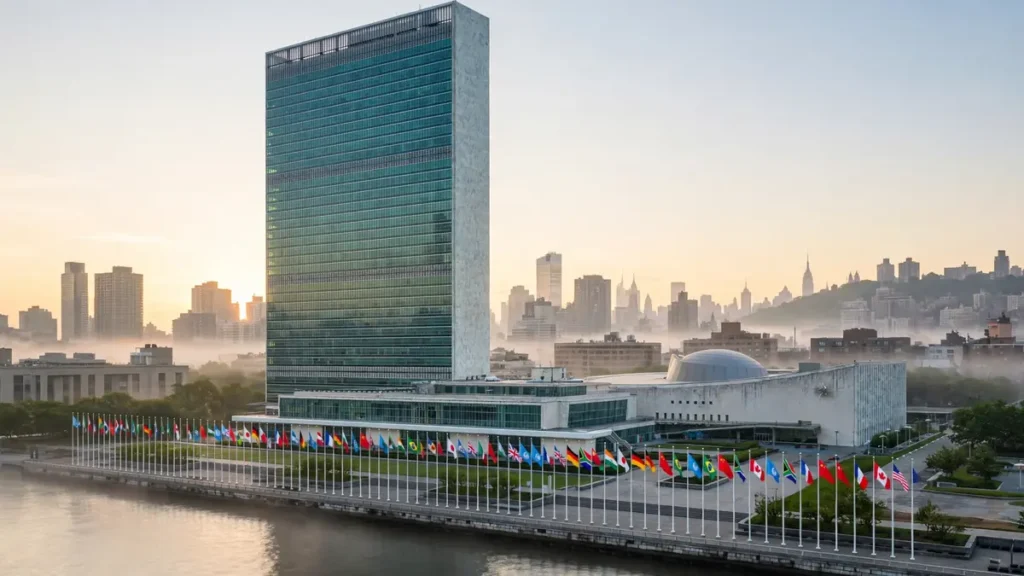
Eight decades have passed, and one fact still stands out sharply. No woman has ever led the United Nations. Consequently, the search for a first woman UN Secretary-General has become one of the defining stories of the 2026 race.
The numbers explain the frustration behind that search. Nine secretaries-general have held the job since 1946, and voters chose a man every single time. Meanwhile, campaigners now ask a simple question with fresh urgency. Why has the glass ceiling at the United Nations survived for 81 years?
This analysis follows the data rather than the slogans. For example, it traces the shrinking pipeline, the near-miss of 2016 and the formal changes since then. Readers who want the candidacy itself can read our main report on Lana Nusseibeh’s bid for UN Secretary-General first. This piece, by contrast, asks why the top job has stayed closed for so long.
What does the 81-year record actually show?
The stark record comes from the Women in Multilateralism report 2026, and scholars cite it widely. That report counts 48 men and only 8 women among all known official candidacies since 1945. In other words, women have entered the contest rarely, and voters have never elected one.
History makes the gap even clearer. For the first six decades, states did not even formally consider a woman for the role. Latvia’s President Vaira Vīķe-Freiberga, the Vaira Vike-Freiberga first woman candidate 2006 story, entered only in that year. Her candidacy therefore arrived a full 60 years after the UN began work.
| Measure? | Figure? | Source? |
|---|---|---|
| Secretaries-general since 1946 | 9, all men | Women in Multilateralism report 2026, via Gulf News op-ed by Dr Sara Chehab |
| Known official candidacies since 1945 | 48 men and 8 women | Women in Multilateralism report 2026 |
| Women elected Secretary-General | 0 | Women in Multilateralism report 2026 |
| First woman formally considered | Vaira Vīķe-Freiberga, 2006 | Women in Multilateralism report 2026 |
Dr Sara Chehab of the Anwar Gargash Diplomatic Academy laid out this record in a Gulf News op-ed on 21 October 2026. She presented the data as a structural problem, not a run of bad luck. Indeed, the pattern repeats across decades, regions and political systems.
Timing matters here as well. António Guterres ends his second term on 31 December 2026, and the winner takes office on 1 January 2027. The General Assembly appoints the Secretary-General on the Security Council’s recommendation under Article 97 of the UN Charter. The Council submits one name only, so early filtering decides almost everything.
How does the pipeline thin out long before the final vote?
Candidates rarely reach the final vote without senior multilateral experience. Diplomats usually build that experience as ambassadors, agency heads and ministers first. So analysts study the whole ladder, not just the last rung.
The ladder narrows at every step, however. The Women in Multilateralism report 2026 tracks 54 international organisations for its long view. Across those bodies, leaders have appointed 540 people since 1945, and only 70 appointees were women. That share shapes who gains the record that selectors later demand.
What do the numbers across global organisations reveal?
Recent progress looks real, yet the report urges readers to read it carefully. Women now lead 46% of the 62 organisations that the 2026 report examined in its current snapshot. Women also hold, on average, 29% of governing-body seats across those organisations. Progress at agency level, therefore, has moved much faster than progress at the very top of the UN itself.
Representation in New York tells a slower story. Women hold only 23% of Permanent Representative posts in New York, according to the same report. Shockingly, 72 countries have never sent a woman to that role at all. A thin ambassadorial pipeline thus limits the pool long before any straw poll begins.
| Pipeline measure? | Figure? | Source? |
|---|---|---|
| Leaders appointed across 54 organisations since 1945 | 540 leaders, only 70 women | Women in Multilateralism report 2026 |
| Women heads in the last five decades of the 20th century | 3.7% on average, never above 10% | Women in Multilateralism report 2026 |
| Organisations currently led by women | 46% of 62 organisations examined | Women in Multilateralism report 2026 |
| Governing-body seats held by women | 29% on average | Women in Multilateralism report 2026 |
| Permanent Representative posts in New York held by women | 23% | Women in Multilateralism report 2026 |
| Countries that have never sent a woman Permanent Representative | 72 | Women in Multilateralism report 2026 |
| Ambassador and Permanent Representative posts held by women worldwide | 22.5% | Women in Diplomacy Index 2025 |
What does the global ambassador picture add?
The Women in Diplomacy Index 2025 reaches a similar conclusion from a different angle. That index finds that women hold 22.5% of ambassador and permanent representative posts worldwide. Diplomacy has opened up, clearly, but men still hold more than three quarters of its top overseas posts.
One UN example, though, shows that deliberate decisions change numbers fast. UN Secretariat senior leadership now splits equally between women and men, and the report credits deliberate policy for that result. In short, gender parity in UN leadership advanced inside the Secretariat because leaders set a policy and enforced it. The top job simply never received the same treatment.
Why did the 2016 race become a near-miss instead of a breakthrough?
Many observers still treat 2016 as the great missed chance. Organisers ran the most open selection in UN history that year, with public dialogues for candidates. Organisers also explicitly invited states to nominate women. Expectations rose accordingly, and the female UN chief campaign gained real momentum.
What happened to the seven women who stood in 2016?
States formally nominated seven women, a record field for the 2016 UN Secretary-General women candidates. The list included Helen Clark, the former New Zealand prime minister who headed the UN Development Programme. The Helen Clark Irina Bokova 2016 race also featured Irina Bokova, the director-general of UNESCO. Susana Malcorra, Christiana Figueres and Kristalina Georgieva completed a notably strong group of nominees.
Early results disappointed campaigners, however. In the early straw polls, women crowded the bottom five places despite their senior records. Voters therefore questioned whether experience alone explained the rankings. The pattern suggested that selectors judged identical careers through different lenses.
A split then damaged the strongest push further. Bulgaria withdrew its backing from Bokova mid-race and nominated Georgieva as a late entrant instead. That switch divided support between two candidates from the same country. António Guterres ultimately won the contest after six straw polls, and the wait continued for another decade.
Malcorra later framed the lesson in precise terms. She argued that the real question is whether merit has been “defined and recognised fairly”, a quote that the Gulf News op-ed by Dr Sara Chehab cited. Her point targets the criteria themselves, not just the final count. If selectors define merit around paths that men dominate, then the definition itself filters women out early.
What has formally changed since 2016?
Institutions have since written the concern into formal texts. In September 2025, the UN General Assembly resolution 79/327 strengthened the call for states to nominate a woman. The resolution acted while “noting with regret” that no woman has ever held the post. That phrase matters because the Assembly placed its regret on the official record.
Civil society has organised around the same demand. The 1 for 8 Billion campaign, backed by groups such as CIVICUS, calls for a transparent, accountable and inclusive process. CIVICUS made that call publicly on 8 September 2026, and partner groups repeated it throughout this cycle.
Jesselina Rana, UN Advisor at CIVICUS, stated the demand bluntly. She said: “It’s high time we elect a feminist woman Secretary-General at the UN.” Campaigners use such language to keep pressure on nominating states, not just on voters. They argue, for instance, that states must nominate strong women before any fair vote can happen.
How fast has state support grown since 2025?
Support for that position has grown quickly, according to campaign tracking. Government support for a woman Secretary-General rose from 46 states by mid-2025 to 112 by March 2026. The Global Network of Women Peacebuilders, NYU’s Center for Global Affairs and 1 for 8 Billion tracked that rise, and The News reported the figures. A majority of states now backs the principle publicly, although public backing does not bind any Security Council vote.
An older text still anchors the wider agenda. Security Council resolution 1325, adopted in 2000, established the Women, Peace and Security agenda. Supporters link the women peace and security resolution 1325 to representation at the top because peace talks need women in decision rooms. They argue, similarly, that an institution preaching inclusion should model inclusion in its own highest office.
Process reforms add another layer of change. A joint letter from the General Assembly and Security Council presidents formally opened this cycle with pledges of transparency and inclusivity. Candidates now provide a vision statement, present it publicly and publish it on a dedicated UN web page. Readers can follow those statements through official government portals and UN channels alike. Candidates also disclose funding sources under the September 2025 rules.
Why does this cycle look different from the cycles before it?
Composition gives this cycle a genuinely different feel. Five of the eight people who entered the contest were women, according to The News. The eight entrants were Carolyn Rodrigues-Birkett, Rafael Grossi, Rebeca Grynspan, Macky Sall, Ivonne Baki, Michelle Bachelet, María Fernanda Espinosa and Olara Otunnu. Women therefore formed a majority of the original field for the first time.
Experience strengthens that field further. Bachelet previously served as President of Chile, as UN High Commissioner for Human Rights and as the first head of UN Women. Grynspan served as Vice-President of Costa Rica and as Secretary-General of UNCTAD. Rodrigues-Birkett serves as Guyana’s ambassador to the UN after work as foreign minister. Critics can hardly describe this pool as thin.
What do the straw polls tell us this time?
Polling has also broken the old pattern, at least so far. Rebeca Grynspan has led the polling in this cycle, and Reuters reported that she led five of the six straw polls. The sixth poll, held on 16 October, used colour-coded ballots that distinguished permanent members’ votes for the first time. Grynspan recorded 9 encourage votes, 5 discourage votes and 1 no opinion in that round, according to Reuters reporting.
Deadlock, nevertheless, still defines the race. Top candidates each drew two discourages from permanent members, and a permanent-member discourage signals a likely veto. Seven candidates contested the straw polls, then Macky Sall withdrew after the 16 October poll. Six candidates remained at that point, and Nusseibeh’s entry now makes seven active candidates.
Regional expectations point in an interesting direction too. An informal rotation expectation favours a Latin American candidate this time, and Grynspan comes from Costa Rica. Neither that expectation nor the call for a woman is a formal Charter requirement, however. Both forces shape politics around the vote, yet neither force controls the vote itself.
Where does Lana Nusseibeh stand in this longer story?
Nusseibeh entered this race late, on 21 October 2026, after formal nomination by President Sheikh Mohamed bin Zayed Al Nahyan. She serves as UAE Minister of State and Envoy to the UN and the European Union. She also represented the UAE as Permanent Representative to the UN from 2013 to 2024. Diplomats in New York describe her as a respected and competent manager, according to Reuters.
Her own words on gender deserve close attention. She told reporters: “I think it would be great if the next secretary-general was a woman, but I’m not running because I’m a woman; I’m running because I am stubbornly optimistic about the future of the United Nations and I believe we need someone who is relentless in the pursuit of diplomacy to open doors.”
That framing separates identity from argument carefully. She welcomes a historic outcome, yet she grounds her candidacy in optimism and relentless diplomacy. She also told reporters: “It’s recognized today that we need someone who offers generational change for the organisation.” Generational change, in her telling, concerns energy and method as much as biography.
Context from home adds another line to her story. She said: “I come from a country that is younger than the United Nations, but our region has been facing severe challenges.” Earlier, her team led the UAE’s successful campaign for election to the Security Council, and she presided over the Council twice during the UAE’s 2022–2023 term. Back in 2016–17, she also co-chaired a General Assembly working group that changed how secretaries-general are selected. Few candidates know the selection machinery from inside as directly as she does.
What has changed for women diplomats in the UAE itself?
The UAE data shows movement, albeit from a low base. Women’s share of UAE ambassadorships rose from 7% in 2018 to 13% in 2025, according to the Women in Diplomacy Index 2025. That rise mirrors wider shifts in Emirati public life and in workplaces shaped by UAE labour law and national talent policy. Progress looks steady, though the share still sits below the global average of 22.5%.
Two recent appointments show the direction clearly. Shaikha Al Nuwais became the first woman Secretary-General of UN Tourism in early 2026. Razan Al Mubarak has served as President of the International Union for Conservation of Nature since 2021. Both women now lead global bodies, so Emirati women already hold top multilateral jobs beyond New York. Travellers who browse things to do in Dubai see the tourism side of that story at home every day.
What would a first woman Secretary-General change — and what would she not change?
A first woman in the job would change the symbol immediately. Girls who watch UN debates would finally see a woman in the chair that nine men have occupied. Staff across the system would also read the appointment as proof that parity reaches the summit. Symbols shape ambition, and ambition shapes future pipelines.
A first appointment would change some practice too, probably. Leaders bring their networks, priorities and management habits into the Secretariat from day one. A Secretary-General sets senior appointments, convenes mediators and chooses which crises receive personal attention. Those choices affect peace talks, humanitarian access and agency coordination in concrete ways.
Limits would remain firm, however. The Secretary-General cannot override a Security Council veto or order member states to fund programmes. The Charter calls the role the chief administrative officer, and the UN describes it as equal parts diplomat and advocate, civil servant and chief executive. Five permanent members still guard their veto, so any winner must persuade governments that retain full sovereignty.
Honest analysis must also note the scrutiny point. Campaign debate now plays out in public and online, where the UAE’s own rules, including its social media fine rules, remind readers that words carry legal weight. Every candidate faces hard questions about war, funding cuts and the UN’s declining political relevance, according to Reuters. A woman winner would inherit those crises on the same terms as any man.
What should readers in the UAE watch next?
Council members are negotiating whether to hold another straw poll on Friday 23 October 2026 or at a later stage, according to Reuters via Aaj TV. Watch the discourage counts closely, because they reveal veto risk better than encourage totals do. A candidate needs at least nine Council votes and no permanent-member veto for a recommendation.
Timing will then tighten quickly. The winner serves a five-year term and starts work on the day many residents check the UAE public holiday calendar for New Year plans. Between now and 31 December, nominating states will lobby, withdraw or consolidate behind compromise names. Nusseibeh’s late entry only makes sense in that fluid phase, because deadlocked fields often reward a fresh consensus option.
Readers should therefore judge the coming weeks by movement, not noise. Does Grynspan keep her lead without collecting new veto signals? Does support consolidate behind one woman, or does the field split that support again as in 2016? Answers to those questions will decide whether 2026 ends an 81-year wait or extends it.
Frequently asked questions?
Has any woman ever served as UN Secretary-General?
No woman has ever served in the role. Nine secretaries-general have held the job since 1946, and all nine were men. The Women in Multilateralism report 2026 records that fact as the starting point for its wider analysis.
How many women have officially run for the job since 1945?
Only eight women have stood as known official candidates since 1945, against 48 men. The Women in Multilateralism report 2026 compiled those candidacy figures. States did not formally consider any woman during the first six decades.
Who was the first woman candidate for Secretary-General?
Latvia’s President Vaira Vīķe-Freiberga became the first woman candidate in 2006. Her entry ended six decades without a single formal female candidacy. Campaigners still cite her run as the moment the question became impossible to ignore.
What did General Assembly resolution 79/327 actually say?
The resolution, adopted in September 2025, strengthened the call for states to nominate a woman. It acted while “noting with regret” that no woman has ever held the post. The Assembly therefore placed both the fact and its regret into the formal record.
What is the 1 for 8 Billion campaign asking for?
The campaign calls for a transparent, accountable and inclusive selection process and for the first woman Secretary-General. CIVICUS supports the campaign and promoted its demands on 8 September 2026. Tracking by partner groups counted 112 supporting states by March 2026.
Why does Lana Nusseibeh say she is not running because she is a woman?
Her explanation to reporters stressed stubborn optimism about the UN’s future. Diplomacy, she also said, must stay relentless and keep opening doors. A woman winner would still be great in her view, so she separates her motive from the historic outcome.
When will the next Secretary-General take office?
The winner takes office on 1 January 2027 for a five-year term. António Guterres ends his second term on 31 December 2026. The Security Council must first recommend one name, and the General Assembly must then appoint that person.