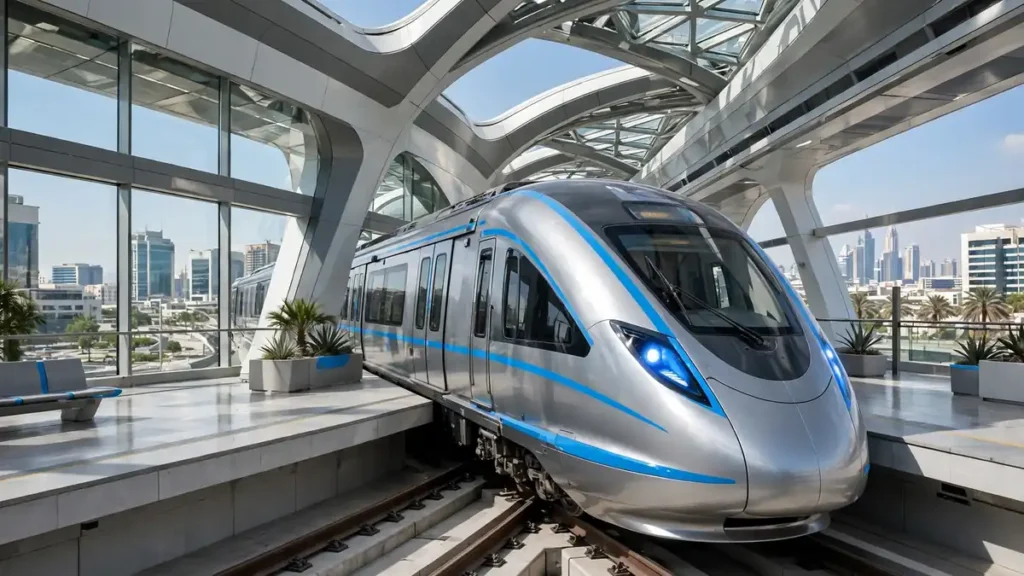
Dubai has just given residents a clear look at the future of travel in the city. The Dubai Metro Blue Line new trains were unveiled on Sunday 22 November 2026. The reveal came with fresh details on the cabins, the smart technology on board, and the progress of the line itself. If you live in Dubai, this story will shape your daily journeys for years to come.
Sheikh Hamdan bin Mohammed bin Rashid Al Maktoum reviewed the new train design and the project progress during a visit to the Blue Line worksite at Dubai Festival City. The visit took place on Sunday 22 November 2026. Sheikh Hamdan serves as Crown Prince of Dubai, Deputy Prime Minister and Minister of Defence. WAM, the official news agency of the United Arab Emirates, reported the visit. Khaleej Times, Gulf News and The National also covered the news.
This article brings together everything confirmed about the new trains and the Blue Line so far. You will find the opening date, the capacity of the trains, and the features of Gold Class and Silver Class. You will also find the areas the line will serve and the latest construction figures. Every fact here comes from official announcements and reports published on 22 and 23 November 2026.
What Did Sheikh Hamdan Review at Dubai Festival City?
The visit to the Blue Line worksite at Dubai Festival City put the spotlight on a neighbourhood that will soon have a Metro station. Sheikh Hamdan reviewed the design of the new trains and the progress of the construction work. The Dubai Media Office shared details of the visit. The update gave residents a firm opening date and a clear picture of the trains they will ride.
A visit like this matters for you as a resident. It signals that the project has moved from plans on paper to a physical railway taking shape across the city. Senior leadership reviewed the project in person. That act shows public confidence in the timeline and the design.
The reveal of the train design was the centrepiece of the day. Until now, much of the public talk about the Blue Line has focused on the route and the construction. The unveiling shifts the focus to the passenger experience. You can now picture the cabins you will sit in and the screens you will look at. That is a big step for a project that will not open until 2029.
Who Joined the Visit at the Worksite?
Mattar Al Tayer received Sheikh Hamdan at the worksite. Al Tayer serves as Director-General of the Roads and Transport Authority, known as the RTA. Officials from the RTA also attended the visit. Officials from the MAPA–LIMAK–CRRC consortium joined them. The consortium delivers the project, and its presence shows how much the work depends on close teamwork between the transport authority and the builders.
When Will the Dubai Metro Blue Line Open?
The Blue Line will open on 9 September 2029. The RTA confirmed that date in the project update shared during the visit on 22 November 2026. Construction will continue for several years, but residents now have a firm date to plan around.
The date carries extra meaning for Dubai. 9 September 2029 is a Sunday. It marks the 20th anniversary of the Dubai Metro launch. The Metro first opened on 9 September 2009. The Blue Line will start carrying passengers exactly twenty years after the network first started running.
Overall completion stands at 29 percent. Officials described that figure as nearly 30 percent. That number covers the whole project, from underground stations and tunnels to elevated stations and bridges. Progress updates will follow as each stage of construction moves forward.
Why Does the Opening Date Matter for You?
If you plan a move, a job change, or a longer-term choice about where to live, keep the 2029 date in mind. Areas along the Blue Line will gain a direct Metro connection. That change will shape how easy it is to reach work, school, and leisure spots without a car. Property choices, school choices, and business plans in these areas already reflect the coming line.
How Big Is the Blue Line Project?
The Blue Line is a major addition to the Dubai Metro network. The project cost is Dh20.5 billion. The scale of the work reflects that investment. The line will have 14 new stations and 30 km of track. Of that track, 15.5 km will run underground. More than half of the line will run beneath the city, and the rest will run on elevated sections and bridges.
When the Blue Line is complete, the Metro network will reach 131 km in length. It will have 78 stations, and 168 trains will serve those stations. Those figures show how much the network will grow with this one line. The Blue Line adds new stations, new trains, and new connections. It extends the reach of the Metro into areas that have never had a station before.
For you, the size of the project means a simple benefit. A longer network with more stations puts more of the city within reach of the Metro. The Blue Line is not a small extension. It is a full new line with its own trains, its own stations, and its own identity.
How Far Along Is Construction Right Now?
WAM shared a detailed breakdown of progress across the project. Underground stations stand at 32 percent complete. Tunnel excavation stands at 55 percent complete. Elevated stations stand at 16 percent complete. Bridge works stand at 17 percent complete. Bridge piers stand at 62 percent complete. These figures give a clear picture of the work in late November 2026.
Tunnel excavation at 55 percent is one of the most advanced parts of the project. More than half of the tunnelling work is done. That matters because tunnelling is often one of the slowest and most complex stages of building a Metro line. Bridge piers at 62 percent are also well advanced. The piers will support the elevated sections and bridges of the line.
Underground stations at 32 percent and elevated stations at 16 percent show that station building is still in progress. Bridge works at 17 percent show that the bridge structures are at an earlier stage than the piers that support them. Together, these figures describe a project moving steadily through its construction phases. Different parts of the work sit at different stages.
The workforce behind these figures is striking. More than 14,000 workers, engineers and supervisors have clocked over 33 million working hours on the project. That is a large team working to keep the project on schedule for the September 2029 opening. When you see building activity along the route, it forms part of this effort.
What Does the 1.3 km Creek Bridge Mean for Dubai?
One feature of the Blue Line stands out. A 1.3 km bridge will cross Dubai Creek. It will form the Dubai Metro’s first crossing over the Creek. Until the Blue Line opens, the Metro has never crossed the Creek. This bridge will create a new link between the two sides of the waterway.
The bridge is a major engineering structure. Bridge piers are already 62 percent complete, so the foundations of the crossing are well advanced. Bridge works overall are 17 percent complete, so the structure itself is still taking shape. When builders finish it, the bridge will carry Metro trains across the water. Passengers will enjoy a view of the Creek as they travel.
For you, the Creek crossing means a new way to travel between areas on either side of the water. The line connects Dubai Festival City and Dubai Creek Harbour, and both sit near the Creek. The bridge is the link that makes that connection possible. It is a practical piece of infrastructure, and it also shows how the Metro network is growing beyond its current routes.
What Do the New Blue Line Trains Look Like Inside?
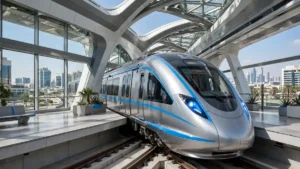
The new trains put the passenger experience at the centre. The exterior has an aerodynamic design with large panoramic windows. Every cabin has motorised sliding doors. The panoramic windows will shape the journey, giving you wide views of the city as the train moves along elevated sections and across the Creek bridge.
Inside, the trains offer three cabin types. You can choose Gold Class, Silver Class, or a dedicated carriage for women and children. Each cabin has its own features, colours, and seating. The design capacity of each train is 675 passengers. Total capacity reaches up to 1,246 passengers per journey. Those figures show that the trains can carry large numbers of people at peak times, when the Metro is at its busiest.
The motorised sliding doors open and close smoothly. The design of the train makes boarding and leaving straightforward. The aerodynamic shape is not only about looks. It forms part of a modern train design shaped for the Dubai Metro network and the conditions it will run in.
The large panoramic windows deserve a special mention. On the current Metro lines, the view from the train is already one of the pleasures of the journey, especially on elevated sections. The Blue Line trains take that further with windows that give you a wide view of the city. As the train crosses the Creek bridge, those windows will frame a view that no Metro passenger has had before.
What Makes Gold Class Different?
Gold Class is the premium option on the Blue Line. It offers premium seating, and the cabin has features that set it apart from the rest of the train. If you travel in Gold Class today on the current lines, you will recognise the idea. The Blue Line version takes it further with new technology and new design details.
One of the most practical features in Gold Class is wireless charging between seats. You can charge your phone without a cable, simply by placing it in the charging area between the seats. That small detail makes a real difference on a daily commute, when your phone battery often runs low by the end of the day. Charging points are also in the cabin, along with rotatable armrests that let you adjust your seating position.
Gold Class also has smart lighting that adapts to ambient conditions. The lighting in the cabin changes with the light around you, so the cabin feels comfortable at different times of day. Digital screens in Gold Class show the time, the date, and the temperature outside. That information helps you as you step out into the Dubai heat or plan the rest of your day, and it sits where you can see it from your seat.
Premium seating, wireless charging, smart lighting, digital screens, rotatable armrests, and charging points all define the Gold Class cabin. The RTA has thought carefully about what premium means in practice. The result shows in the details you will use on every journey, not only in the look of the cabin.
What Can You Expect in Silver Class?
Silver Class is the cabin most passengers will use. Its design focuses on space, light, and easy movement. Silver Class has large windows, so the cabin feels open and bright. Digital screens in Silver Class show the route, so you can follow where the train is going and see the stations ahead. Regular Metro users will value that feature, especially when travelling to a station they have not visited before.
The design of Silver Class uses contrasting colours to guide passenger flow. The colours help you see where to walk, where to stand, and where the doors are, without signs at every step. That kind of design makes boarding and leaving the train smoother. It also helps the train keep to its schedule at busy stations. Foldable seat separators are another practical feature, giving you a little more definition to your seat when the train is busy.
Silver Class also provides two-tone priority seating. Priority seating serves passengers who need it most, and the two-tone design makes it easy to spot. That matters for older passengers, pregnant passengers, and anyone who finds standing difficult. The design makes the seating clear, so passengers can offer their seat with confidence and the people who need it can find it fast.
Silver Class shows that the RTA planned the Blue Line trains for the everyday journey, not only for the premium cabin. Large windows, route screens, colours that guide you through the cabin, foldable seat separators, and clear priority seating all add up to a practical and comfortable cabin. If you use the Metro regularly, these are the details you will notice on your first journey and rely on every day after that.
How Is the Women and Children Carriage Designed?
The Blue Line trains include a dedicated carriage for women and children. The carriage has soft blush tones on the seats and doors, giving it a distinct look and feel within the train. The soft blush tones set the carriage apart, so you can recognise it easily on the platform and inside the train.
A dedicated carriage gives women and children a space of their own on the train. The design uses colour and tone to create a calm and welcoming atmosphere. The carriage forms part of the three cabin types on the train, alongside Gold Class and Silver Class. It reflects the way Dubai Metro trains serve all passengers.
If you travel with children, a dedicated carriage can make the journey more relaxed. The carriage suits families, and its distinct look helps you find the right part of the train before you board. For women travelling alone, it offers a comfortable choice on every journey. The design is simple and thoughtful, and it shows that the new trains meet the needs of different passengers.
What Smart Technology Is Built Into the New Trains?
The Blue Line trains carry a range of smart technology. Some of it works behind the scenes, and some of it sits right in front of you. Screens inside the trains show the current station and the next station, along with the date and time. That information helps you follow your journey without checking your phone. It proves especially useful when you travel to a new area or meet someone at a station.
The screens form part of the wider use of digital displays across the train. Gold Class screens show the time, date and outside temperature. Silver Class screens show the route. Together, they keep you informed from the moment you board until the moment you step off.
How Does the Technology Keep Passengers Safe?
Advanced cameras detect obstacles on the track, which helps keep the railway safe. Intelligent cameras count passengers and monitor occupancy, so the RTA can see how busy each train is and how full each carriage has become. Real-time image and data processing supports these systems. It turns what the cameras see into information that teams can use straight away.
For you as a passenger, this technology should mean a smoother and safer journey. Cameras that detect obstacles and systems that track how busy the train is all work in the background. The screens keep you informed, and the safety systems keep watch on the track ahead.
How Does Smart Climate Control Save Energy?
Smart climate control is another feature of the new trains. The system saves up to 20 percent of heating, ventilation and air conditioning energy, known as HVAC energy. In a city where air conditioning runs for much of the year, that saving matters for the running cost of the network and for the energy each train uses. The smart climate control adjusts to conditions inside the train, so the cabin stays comfortable while using less energy.
The RTA is also setting up an advanced research and development centre and innovation laboratory with CASCO Signal. The centre will house the Middle East’s first train systems development laboratory, and it will focus on the systems that keep the trains running. Teams use artificial intelligence and robotics for railway inspection and maintenance. That means the technology on the Blue Line goes beyond the trains themselves. It covers the way teams check, maintain, and improve the railway over time.
Which Areas Will the Blue Line Serve?
The Blue Line will serve a string of established and growing communities across Dubai. The official announcements name Mirdif, Al Warqa’a, International City, Dubai Silicon Oasis, Dubai Academic City, Dubai Festival City, and Dubai Creek Harbour. If you live in one of these areas, the Blue Line will bring a Metro station closer to your home. If you work or study in one of them, it will change how you reach your destination each day.
Mirdif and Al Warqa’a are long-established residential areas, and a Metro connection will give residents there a direct link to the wider network. International City is a large residential community, and Dubai Silicon Oasis and Dubai Academic City host businesses, offices, and education institutions. Dubai Festival City is a major retail and leisure destination, and Dubai Creek Harbour is a growing waterfront community. Together, these areas cover a wide part of the city, and the line connects them in a single route.
The line will have 14 stations, and the stations follow five distinctive architectural concepts. That means the stations will not all look the same. Each concept gives a group of stations its own character, shaped by the area it serves. For you, that means the station you use every day will have its own look, and the journey will feel different as you pass through different parts of the city.
Getting around these areas today often means driving, taking a bus, or using a taxi. The Blue Line will give you another option, and for many journeys it will be the simplest one. You will board the Metro near your home and travel across the city without worrying about traffic or parking. That is the practical promise of the line.
What Makes Emaar Properties Station Special?
One station stands out in the announcements. Emaar Properties Station at Dubai Creek Harbour will be the highest metro station in the world at 74 metres. That height makes it a landmark in its own right, and its design draws inspiration from a crossing gateway. The station will sit at Dubai Creek Harbour, one of the key destinations on the line.
A station 74 metres high will give you a striking view as you arrive and depart. The height forms part of the architectural ambition of the Blue Line. It shows that the stations serve as landmarks, not only as places to board a train. Emaar Properties Station will be the most distinctive station on the line, and it is likely to become one of the most photographed parts of the network.
For Dubai Creek Harbour, the station is a major connection. The area is growing as a waterfront community, and a Metro station at its heart will make it easier to reach from across the city. The station design, inspired by a crossing gateway, fits the location near the Creek, where the line crosses the water on its 1.3 km bridge. Together, the station and the bridge will define the Creek Harbour end of the line.
How Will the Blue Line Connect With the Rest of the Metro?
The Blue Line connects with the existing Red and Green lines, so it is not a standalone route. When you board a Blue Line train, you can change to the Red Line or the Green Line and continue your journey across the network. That connection turns the Blue Line from a single route into part of a wider system.
When complete, the Metro network will reach 131 km in length, with 78 stations and 168 trains serving the network. The Blue Line adds 14 stations to that network. Its links to the Red and Green lines mean that passengers in the areas it serves can reach stations across Dubai. You will not need to drive to a Red Line or Green Line station. You can start your journey on the Blue Line and change lines as needed.
What Changes for Regular Metro Users?
For regular Metro users, the connections are the key to the value of the line. A new line is most useful when it links smoothly with the lines that already exist, and the RTA planned the Blue Line to do exactly that. The interchange stations will be the points where the network comes together, and they will shape how you plan journeys that cross the city.
If you already use the Metro, the Blue Line will give you new options for journeys you make today. Areas that are hard to reach by Metro now will join the network, and the links to the Red and Green lines will keep your current journeys simple. The network will be larger, better connected, and easier to use for more of the city.
What Does This Mean for Your Daily Commute?
The Blue Line will change the daily commute for thousands of people. If you live in Mirdif, Al Warqa’a, International City, Dubai Silicon Oasis, Dubai Academic City, Dubai Festival City, or Dubai Creek Harbour, you will have a Metro station on your doorstep when the line opens. That means you can leave the car at home, avoid the traffic on the roads, and travel by train instead.
Your commute will also become more predictable. Metro trains run to a timetable, and you can plan your journey around the stations and the links to the Red and Green lines. The digital screens on the Blue Line trains show the current station and the next station, along with the date and time, so you can follow your journey as you travel. The route screens in Silver Class help you see where you are going, and that makes the journey easier, especially in the early days of using a new line.
How Should You Prepare for Your First Blue Line Journey?
Before you travel, keep your Nol card balance topped up so you can tap in without delay at the station. The Nol card is the way you pay for Metro travel in Dubai, and a quick balance check before you leave home saves time at the gate. That small habit makes the start of your journey smoother, whether you head to work, to Dubai Academic City for a class, or to Dubai Festival City for a day out.
Driving will still be part of life in Dubai for many people, and the roads will still be busy. If you do drive, stay aware of the new speed limits in Dubai and the rules that apply on the routes you use. A Metro journey can be a useful alternative on days when the roads are busy, and the Blue Line gives you that choice for more journeys across the city. You can also keep an eye on UAE petrol prices when you weigh the cost of driving against the ease of taking the train.
How Will the Line Help Families and Leisure Trips?
The new line will also make leisure journeys easier. A trip to Dubai Festival City or Dubai Creek Harbour by Metro means you can enjoy the destination without thinking about parking, and you can plan your visit around the train times. If you need ideas for a day out, our guide to things to do in Dubai in December covers activities across the city, and the Blue Line will make more of them reachable by public transport once it opens.
Big public events are another time when the Metro proves its value. If you head to a large event, the train can be the simplest way to get there and back, and the Blue Line will add new options for events in the areas it serves. Our Dubai Run 2026 guide shows how major events bring the city together, and the Metro is often the best way to reach them. The same thinking applies to national celebrations, and our coverage of Eid Al Etihad 2026 celebrations includes the events and activities taking place across the UAE.
Families will feel the benefit too. School journeys, weekend trips, and visits to relatives all become simpler when a Metro station is nearby. If your children have time off school, our guide to Dubai private school holidays for Eid Al Etihad can help you plan the break, and the Blue Line will make it easier to reach family activities across the city when it opens. The dedicated carriage for women and children on the new trains is part of the same thinking, giving families a comfortable space on every journey.
What Is Next for the Blue Line Project?
Construction will continue over the coming years, with the opening set for 9 September 2029. Overall completion is at 29 percent, and the detailed progress figures show where the work stands. Tunnel excavation is 55 percent complete and bridge piers are 62 percent complete, while underground stations are 32 percent complete, elevated stations are 16 percent complete, and bridge works are 17 percent complete. Each of those figures will move as the project advances, and further updates will follow as new stages are reached.
The next stages will see the stations take shape, the bridge across the Creek rise, and the track laid along the full 30 km route. Teams will test the trains and prepare them for service, and they will check the smart technology on board as part of that process. The research and development centre and innovation laboratory with CASCO Signal will support that work, and teams will keep using artificial intelligence and robotics for railway inspection and maintenance as the line moves towards opening.
What Will the Opening Day Mean for Dubai?
For you, the next step is simply to keep the date in mind. 9 September 2029 is the day the Blue Line opens, and it marks the 20th anniversary of the Dubai Metro launch. Between now and then, construction will continue across the areas the line serves, and the stations will rise in Mirdif, Al Warqa’a, International City, Dubai Silicon Oasis, Dubai Academic City, Dubai Festival City, and Dubai Creek Harbour. The trains revealed on 22 November 2026 are the trains you will ride when that day arrives, with Gold Class, Silver Class, and a dedicated carriage for women and children, smart technology throughout, and panoramic windows framing the city as you travel.
The Blue Line is a long-term project, and the reveal of the new trains is a milestone along the way. It shows the design, the capacity, and the technology that will define the line, and it gives residents a clear picture of what to expect. As construction continues, the project will move from the worksite at Dubai Festival City to a full railway across the city, and the opening in September 2029 will be the moment it all comes together.
Frequently Asked Questions About the Dubai Metro Blue Line New Trains?
When will the Dubai Metro Blue Line open?
The Dubai Metro Blue Line is on track to open on 9 September 2029, which is a Sunday and marks the 20th anniversary of the Dubai Metro launch. Overall completion of the project stands at 29 percent, described as nearly 30 percent, and the RTA confirmed the opening date in the project update shared on 22 November 2026.
How many passengers can the new Blue Line trains carry?
Each new Blue Line train has a design capacity of 675 passengers, and total capacity reaches up to 1,246 passengers per journey. The trains can carry large numbers of people, which matters at peak times when the Metro is at its busiest.
What classes are available on the Blue Line trains?
The new trains have three cabin types. Gold Class offers premium seating and wireless charging, Silver Class offers large windows and route screens, and a dedicated carriage for women and children has soft blush tones on the seats and doors.
How many stations will the Blue Line have?
The Blue Line will have 14 new stations along 30 km of track, with 15.5 km of the track running underground. When complete, the Metro network will reach 131 km in length, with 78 stations and 168 trains serving the network.
Which areas will the Blue Line serve?
The Blue Line will serve Mirdif, Al Warqa’a, International City, Dubai Silicon Oasis, Dubai Academic City, Dubai Festival City, and Dubai Creek Harbour. The line connects with the existing Red and Green lines, and its 1.3 km bridge across Dubai Creek will be the Dubai Metro’s first crossing over the Creek.
Who reviewed the new Blue Line train design?
Sheikh Hamdan bin Mohammed bin Rashid Al Maktoum reviewed the new train design and project progress during a visit to the Blue Line worksite at Dubai Festival City on Sunday 22 November 2026. Sheikh Hamdan serves as Crown Prince of Dubai, Deputy Prime Minister and Minister of Defence, and Mattar Al Tayer, Director-General of the RTA, received him at the worksite.