
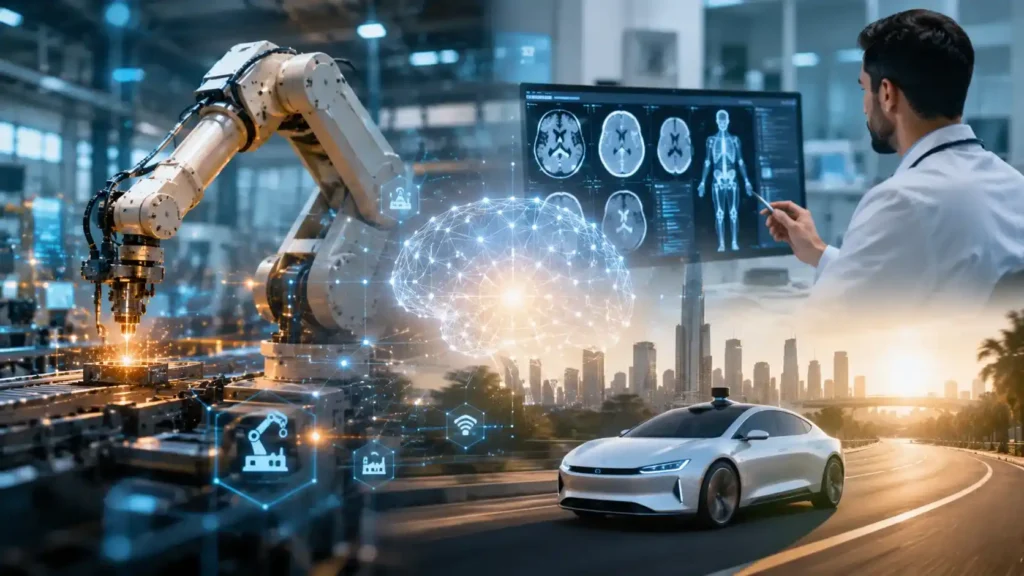
It is one thing to talk about artificial intelligence in theory, and quite another to see it working in the real world. Once you start looking, the applications of artificial intelligence appear almost everywhere, from the phone in your pocket to the factories that build our goods. AI has quietly moved out of research labs and into daily life, transforming how industries operate and how we go about our days. In this guide, we will explore the many practical ways AI is being used, in language that keeps things clear and grounded rather than technical.
From Idea to Everyday Tool
For a long time, AI lived mostly in the imagination of scientists and storytellers. What changed is that computers grew powerful enough, and data plentiful enough, to make the old dreams practical. Today, AI is not a single gadget but a flexible tool applied to countless problems across every field.
That is what makes it so interesting. The same core ideas can help a doctor read a scan, a shop recommend a product, and a car sense the road ahead. If you would like a refresher on the basics first, our main guide on artificial intelligence and its uses sets the foundation before we explore these real-world examples.
AI in Healthcare
Few areas show the promise of AI as clearly as healthcare. AI systems can help doctors analyse medical images, spotting tiny details that might be easy to miss. They can assist in diagnosing conditions earlier, supporting better treatment and outcomes for patients.
Beyond diagnosis, AI helps manage hospital records, predict patient needs, and even speed up the discovery of new medicines. It does not replace the human care and judgement of doctors, but it gives them powerful support. This blend of human expertise and smart technology is helping make healthcare more accurate, efficient, and accessible for many people.
AI in Business and Customer Service
Businesses everywhere have found practical uses for AI. Perhaps the most visible is customer service, where chatbots and smart assistants answer questions and solve simple problems at any hour. This gives customers faster help while freeing staff for more complex tasks.
Behind the scenes, AI helps companies understand their customers, predict demand, and make smarter decisions. It can sift through mountains of data to find patterns a human might never spot. From marketing to logistics, these tools help businesses work more efficiently. Our guide on artificial intelligence in the UAE shows how local companies are embracing exactly this kind of change.
Engineering Applications of AI
Engineering is a field where AI truly shines, quietly powering progress in many directions. Engineers use AI to design better products, test ideas faster, and predict when machines might fail before they actually do. This saves time, money, and a great deal of trouble.
In manufacturing, AI helps run smart factories where systems monitor themselves and adjust automatically. In construction and infrastructure, it supports safer, smarter planning. These engineering applications of artificial intelligence are often invisible to the public, yet they make the products and structures we rely on better and more reliable. It is AI working hard behind the scenes.
AI in Transport and Mobility
Getting people and goods from place to place is a huge challenge, and AI is helping solve it. Smart traffic systems ease congestion by adjusting signals in real time. Navigation apps use AI to find the fastest routes, learning from live conditions as you travel.
Perhaps the most talked-about example is self-driving technology, where AI helps vehicles sense their surroundings and make decisions. While fully autonomous cars are still developing, many modern vehicles already use AI for safety features and assistance. Transport is a clear area where AI is steadily making journeys smoother, safer, and more efficient for everyone.
Smart Technology and Smart Systems
The phrase “smart technology” pops up everywhere, and AI is usually the reason something earns that label. Smart systems can sense their environment, learn from it, and respond helpfully. Think of a smart home that adjusts lighting and temperature, or a device that learns your habits over time.
These smart systems bring convenience and efficiency to daily life. They quietly handle small decisions so you do not have to. As more everyday objects become connected and intelligent, this trend keeps growing. To explore this further, our guide on smart technology and smart systems looks at how these clever tools are shaping modern living.
AI in Finance and Banking
The world of money has embraced AI enthusiastically. Banks use it to spot unusual activity and protect customers from fraud, often catching problems in real time. AI also helps assess risk, speed up applications, and offer more personalised services.
For customers, this can mean safer accounts, quicker decisions, and smarter tools for managing money. Behind the scenes, AI processes vast amounts of financial data far faster than any human could. This makes the financial system more efficient and, in many cases, more secure. It is a strong example of AI handling complex, high-stakes tasks reliably.
AI in Everyday Life
You do not need to work in a special industry to benefit from AI, because it is woven into ordinary life. Your phone uses it to improve photos and predict text. Streaming services use it to suggest shows you might enjoy. Voice assistants use it to understand and answer you.
Even email relies on AI to filter out spam. These small conveniences add up to a big presence, making daily tasks smoother without any effort on your part. This quiet helpfulness is perhaps the most common application of all. Most people use AI many times a day without ever stopping to think about it.
AI in Agriculture and Environment
AI is even helping grow our food and protect the planet. In farming, smart systems can monitor crops, predict weather effects, and use water and resources more efficiently. This helps farmers produce more while wasting less, which matters greatly as populations grow.
In environmental work, AI helps track wildlife, monitor pollution, and model climate patterns. These insights support better decisions about protecting nature. It is a reminder that AI is not only about business and gadgets. It can also be a powerful tool for tackling some of the biggest challenges facing our world today.
The Role of the Automation Engineer
Behind many of these applications are skilled people who make them work. An automation engineer, for example, designs systems that can run tasks automatically, often powered by AI. They help factories, businesses, and services operate smoothly with less manual effort.
These roles are growing quickly as more industries adopt smart technology. They combine creativity with technical skill, turning clever ideas into working systems. If the careers behind AI interest you, our guide on machine learning and AI careers explores the kinds of jobs that are in high demand as automation continues to spread.
AI in Retail and Shopping
Shopping has quietly become one of the most AI-driven experiences around. When an online store suggests products you might like, AI is studying patterns to make those guesses. It also helps manage stock, predict what will sell, and personalise offers for each customer.
In physical shops too, AI supports everything from smart checkouts to better store layouts. For shoppers, this means a smoother, more tailored experience. For businesses, it means less waste and happier customers. It is a everyday example of how AI turns huge amounts of data into small, helpful improvements we barely notice but genuinely enjoy.
AI in Education and Learning
Education is another field being gently reshaped by AI. Smart learning tools can adapt to each student, offering extra help where it is needed and moving faster where it is not. This personal touch can make learning more effective and less frustrating.
AI also helps teachers by handling routine tasks, freeing them to focus on their students. From language apps to study assistants, these tools are opening up new ways to learn at any age. Used wisely, AI in education supports human teachers rather than replacing them, making quality learning more accessible to more people.
AI in Security and Safety
Keeping people and places safe is another area where AI quietly helps. Smart security systems can spot unusual activity, alert people to problems, and support faster responses. In digital spaces, AI helps protect accounts and detect threats before they cause harm.
This kind of protection works best when it supports human judgement rather than replacing it. AI can watch and warn tirelessly, but people make the important decisions. From protecting homes to guarding online data, these applications show how AI can add a valuable extra layer of safety to modern life without getting in the way.
AI in Entertainment and Media
Entertainment has been transformed by AI in ways we often take for granted. Streaming platforms use it to suggest films and music suited to your taste. Games use it to create smarter, more responsive characters. Creative tools now use AI to help edit photos, videos, and sound.
The result is a richer, more personal experience for audiences. For creators, AI offers powerful new tools to bring ideas to life more easily. While it raises interesting questions about creativity, there is no doubt it has opened up fresh possibilities. It is one of the most visible and enjoyable applications of AI in daily life.
How Businesses Can Start Using AI?
For businesses curious about AI, the good news is that starting does not have to be daunting. Many practical tools are already available, from customer service chatbots to data analysis software. The key is to begin with a clear problem you want to solve, rather than adopting technology for its own sake.
Small steps often work best. Try one tool, measure the results, and build from there. Over time, these small wins add up to real advantages. With a thoughtful, gradual approach, even smaller businesses can enjoy the benefits of AI that once seemed reserved for large companies alone.
Benefits and Considerations
The benefits of these applications are easy to see. AI saves time, improves accuracy, handles boring tasks, and helps people make better decisions. It works tirelessly and can process information at a scale no human could match. Across industries, it is boosting both efficiency and quality.
At the same time, it is wise to keep balance in mind. Questions about jobs, privacy, and fairness matter whenever AI is used. The goal is to apply it responsibly, so it supports people rather than replacing what makes us human. Used thoughtfully, AI’s many applications become a genuine force for good in the world.
The Future of AI Applications
As impressive as today’s uses are, they are only the beginning. AI applications will keep growing more capable and spreading into areas we have not even imagined yet. Fields like medicine, energy, and science are likely to see especially exciting breakthroughs in the years ahead.
What stays constant is the pattern: AI takes a difficult, data-heavy task and makes it faster, smarter, or more accurate. Keeping an eye on these developments helps you spot opportunities early. The story of AI applications is far from over, and the most useful chapters may well be the ones still to come.
Conclusion: AI at Work All Around Us
The applications of artificial intelligence stretch far and wide, touching healthcare, business, engineering, transport, finance, farming, and everyday life. What once lived only in imagination is now a practical tool solving real problems across nearly every industry. Seeing these examples makes it clear just how deeply AI has woven itself into the modern world.
The key takeaway is that AI is not one thing but a flexible technology applied in countless ways, usually working quietly to make life better. As it continues to spread, understanding its uses helps you appreciate the world around you and spot new opportunities. To keep learning, explore our main guide on artificial intelligence, our simple explainer on what AI is, and more articles on the Gulf Lights blog and our full technology section. And whenever you need advice, feel free to contact our team for personalised support.