Buying your first used car in Dubai feels exciting, and it can also feel a little overwhelming. The market is huge, the choice is endless, and the paperwork follows rules that are unique to the UAE. Yet thousands of first-time buyers complete the process every month without trouble, because the steps are clear once you know them.
Today is Thursday 12 November 2026, and this guide walks you through the whole journey in order. You will learn where to search and how to check a car history. You will also learn what the inspection covers, how the RTA ownership transfer works, what insurance you need, and how to pay safely. Every fee figure in this guide comes from UAE guides checked on 12 November 2026. Each figure carries the label approximate, because official fees can change. Where a figure could not be confirmed from a current source, this guide says so plainly instead of guessing.
Before you start, keep one rule in mind. Never pay for a car before you have seen it, inspected it, and checked its papers. A patient buyer in Dubai almost always gets a better car at a better price than a rushed one. The sections below show you how to be that patient buyer.
What should you know before you buy a used car in Dubai?
First, understand what makes Dubai different from most other used car markets. Every car here carries a registration card called a Mulkiya. The car is not legally yours until the Roads and Transport Authority, known as the RTA, issues a new Mulkiya in your name. Until that transfer happens, fines and Salik toll charges keep landing on the seller record, even after you have taken the keys.
Second, every ownership change in Dubai requires a vehicle inspection at an RTA approved testing centre. The test checks roadworthiness, safety and emissions, and the result goes straight into the RTA system. So the inspection is not an optional extra. It is a legal step in every used car sale, and you should plan your day around it.
Third, you need car insurance in your own name before the transfer can happen. The RTA will not process the change of ownership without it. So arrange your policy before you arrive at the testing centre, not after. Most UAE insurers issue a policy on the same day, yet you should still sort it in advance to avoid a wasted trip.
Finally, remember that the buyer must be at least 18 years old and must hold a valid UAE driving licence for the vehicle class. You also need a valid Emirates ID and a traffic file. If you are new to the UAE, open your traffic file first, because the transfer cannot proceed without it.
Where should you start your search for a used car in Dubai?
Start online, because that is where most of the market lives. Dubizzle is the largest classifieds platform in the UAE, with thousands of used car listings from private sellers and dealers. You can filter by price, brand, year, mileage and location, which makes it a strong starting point for learning real market prices. Yet Dubizzle is an open marketplace, so you must vet every seller and every car yourself.
YallaMotor is another large platform, and it lists new and used cars with comparison tools and inspection reports. The platform says it carries more than 50,000 listings across the UAE, with verified sellers and financing options. Use it to compare similar cars side by side, because that comparison quickly shows you which listings are priced fairly and which ones are not.
CarSwitch works differently from the open classifieds. It acts as a middleman between buyers and sellers, and it adds a third party inspection to the deal. That extra layer of checking suits first-time buyers who want more protection, although the choice of cars is smaller than on the open platforms. Facebook Marketplace also carries many private seller listings, yet it offers no buyer protection at all, so treat it with extra care.
What about physical car markets and certified pre-owned dealers?
For a hands-on search, visit the physical car markets. Ras Al Khor, often called Al Aweer market, is the largest used car market in Dubai, and it suits buyers who want to see many cars in one place and negotiate face to face. Certified pre-owned programmes are the other end of the scale. Official dealers such as Al Tayer Motors, Al-Futtaim Automall, Nissan certified pre-owned and INFINITI certified pre-owned sell inspected cars with warranties and help with the paperwork. You pay more for that peace of mind, yet many first-time buyers find it worth the cost.
Whichever channel you choose, compare at least five similar cars before you shortlist one. Note the year, mileage, specification and asking price of each. That small exercise protects you from overpaying, because it shows you the real market range instead of one seller claim.
How much should you budget beyond the asking price?
Many first-time buyers plan for the asking price only, and then feel caught out by the extra costs. So set your full budget before you start searching. The purchase price is the biggest cost, yet insurance, transfer fees, inspection fees and running costs all sit on top of it.
The table below shows the main one-off costs of buying a used car in Dubai. The figures are approximate, based on UAE guides checked on 12 November 2026, and they can change. Check the RTA website or app for the exact amount on the day you buy.
| Cost | Approximate amount | Notes |
|---|---|---|
| RTA ownership transfer fee | Around AED 350 | Paid at transfer for a private light vehicle |
| RTA vehicle inspection fee | Around AED 170 | Required for every ownership change in Dubai |
| Pre-purchase inspection | Around AED 150 to AED 800 | Independent check before you pay, price varies by workshop |
| Car insurance | Varies widely | Depends on car value, driver age and cover type |
| New number plates | Varies | Only if you need new plates at transfer |
On top of the one-off costs, plan for the running costs that follow. Insurance renews every year, the Mulkiya renews every 12 months, and Salik toll charges apply on tolled roads. A realistic car maintenance budget matters too, because an older car needs servicing, tyres and brakes sooner than a newer one. If the car you like needs new tyres or a major service within months, add that cost to your offer maths before you agree a price.
How do you check a used car history in Dubai?
Start with the documents, because they tell you whether the seller has the legal right to sell the car. Ask for the original Mulkiya and match the name on it against the seller Emirates ID. If the person selling the car is acting for someone else, they need a legal power of attorney. Without that, walk away.
Next, check the 17-digit vehicle identification number, known as the VIN. You will find it on the Mulkiya, on the dashboard plate visible through the windscreen, on the driver side door frame, and on the engine bay firewall. All three places on the car must match the Mulkiya exactly. A mismatch is a serious red flag, so do not ignore it.
Then check the accident and ownership history.
How do you check fines, loans and accident history?
For a Dubai registered car, use the RTA portal or the RTA Dubai app, the Emirates Vehicle Gate, known as EVG, or the Ministry of Interior app. These official channels show the accident record, ownership history and whether the car has any outstanding matter on its file. Ask the seller for the full service history as well, and call the service centre named in the records to confirm it. A stamped service book on its own proves little, because sellers can fake stamps. A phone call to the workshop that supposedly did the work tells you far more.
Also check for unpaid fines and Salik tolls before you agree anything. In the UAE, fines stay with the vehicle rather than the driver, and unpaid fines block the ownership transfer completely. You can check through the RTA app, the Dubai Police app or website, or at an RTA customer service centre. Our guide explains how to check fines by plate number in detail. Do this check early, because it is the most common reason transfers fail on the day.
Finally, confirm that no bank loan is tied to the car. If a bank still finances the car, the seller must settle the loan and get the bank to release the mortgage in the RTA system before the transfer can proceed. Ask the seller directly, and check the RTA system as well. The RTA cannot transfer a car with an unpaid loan, no matter how good the price looks.
What should you check about the car specification?
One more check matters in the UAE market. Ask the seller plainly whether the car is GCC specification. Manufacturers build GCC spec cars for Gulf conditions, with stronger cooling and dust protection. Some imported cars carry a darker past. Insurers abroad wrote them off as total loss vehicles, then workshops repaired them and sold them here. A VIN check on an international database can reveal that past, so run it for any car that is not GCC spec.
What should you check during a physical inspection?
Inspect the car in daylight, never at night and never in the rain. Poor light hides paint damage, rust and poor repairs. Walk around the car slowly and look for mismatched paint, uneven panel gaps and overspray on rubber seals. Each of those signs points to accident repair work, and a car with heavy repair work deserves a much lower price or a firm no.
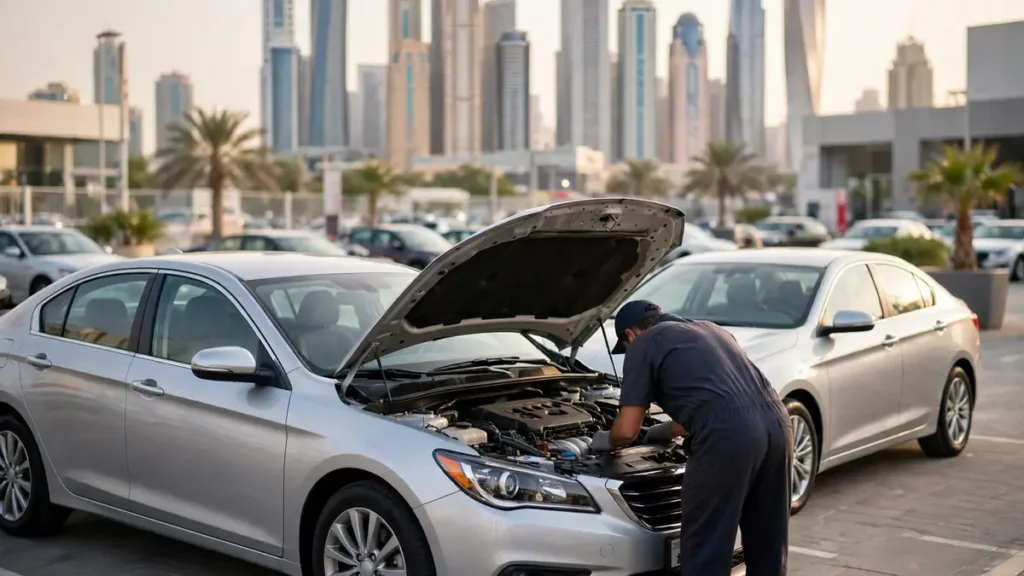
Open the bonnet and check the engine bay. Look for oil leaks, frayed belts, corroded battery terminals and coolant at the right level. Pull the dipstick and check the oil colour. Dark, gritty oil suggests missed services. Then check the tyres, including the spare. Uneven wear can point to suspension or alignment problems, and a full set of new tyres is a real cost you should factor into your offer.
Inside the car, check wear against the claimed mileage. A car showing 40,000 kilometres should not have a worn steering wheel, sagging driver seat and shiny pedals. If the wear looks far heavier than the mileage suggests, someone may have tampered with the odometer. Test every switch, window, light and button, because small electrical faults can cost a lot to fix.
Above all, test the air conditioning for at least ten minutes. Dubai heat punishes a weak cooling system, and an air conditioning repair is one of the most expensive fixes on a used car here. If the air feels weak at idle and only cools at speed, treat that as a warning sign. Also check for warning lights on the dashboard. A seller who has cleared a warning light without fixing the fault is hiding a problem, so a diagnostic scan by a mechanic is worth the cost.
Why should you book a pre-purchase inspection before you pay?
The RTA test checks roadworthiness only. It does not look for hidden accident damage, flood damage or salvage history. So a car can pass the RTA test and still hide an expensive problem. That gap is exactly what a pre-purchase inspection fills.
A pre-purchase inspection, often called a PPI, is a detailed check by an independent mechanic or a specialist workshop. The mechanic puts the car on a lift and checks the underbody, suspension, brakes and leaks. Then the mechanic scans the computer for fault codes and tests the gearbox and engine under load. Prices vary by workshop, and UAE guides put the typical range at around AED 150 to AED 800. Against the price of a car, that is a small cost for real protection.
If you are not confident judging a car yourself, bring a qualified mechanic to the viewing or pay for a full inspection service. A good auto mechanic in Dubai can spot a repaired chassis, a replaced airbag or a tired gearbox in minutes. Ask the seller to agree to the inspection before you pay any deposit. A genuine seller will agree without fuss, while a seller who refuses is telling you something important.
How does the test drive reveal hidden problems?
Never buy a car you have not driven. A test drive of 20 to 30 minutes tells you more than an hour of looking at a parked car. Drive on smooth roads and rough roads, at low speed and at highway speed, because different faults appear in different conditions.
First, listen. Knocking over bumps points to suspension wear, grinding under braking points to worn pads or discs, and whining from the gearbox points to trouble ahead. Then feel the steering. It should track straight on a level road without pulling to one side, and it should feel smooth through a full turn. Next, test the brakes firmly at a safe speed. The car should stop in a straight line without vibration or pulling.
Also test the car from cold if you can. A cold start reveals battery weakness, rough idling and smoke from the exhaust that a warm engine hides. Watch the temperature gauge throughout the drive, because overheating in Dubai traffic is a serious fault. If the seller insists on a short drive around the block only, treat that as a warning sign and ask for a proper drive. A seller with nothing to hide will not rush you.
How does the RTA ownership transfer work in Dubai?
The transfer is the legal heart of the deal, so understand it before you meet the seller. Both parties usually need to attend in person at an RTA approved testing centre or an RTA Customer Happiness Centre. Several UAE guides checked in November 2026 report that the final step still needs both parties physically present. You can still pay fines and book appointments in advance through the RTA app or website. If one party genuinely cannot attend, a notarised power of attorney allows someone else to complete the transfer on their behalf.
The process runs in a clear order. First, the seller clears all outstanding traffic fines and Salik tolls, because the RTA system blocks any transfer with unpaid fines. Second, you arrange car insurance in your own name, because the RTA will not process the transfer without it. Third, the car goes through the RTA inspection at an approved testing centre, and the centre sends the result to the RTA system electronically.
Where do you go for the inspection and transfer?
Approved centres in Dubai include Tasjeel in Al Qusais, Al Barsha and Umm Ramool, plus Shamil in Al Quoz. Wasel serves several locations, Mumayaz has branches across Dubai, and selected EPPCO and ENOC stations also offer testing. The inspection usually takes around 30 to 45 minutes.
Fourth, both parties attend the centre together with their documents. Staff at the centre process the transfer, you pay the fees, and the RTA issues a new Mulkiya in your name. The Mulkiya is digital today, and it lives in the RTA Dubai app, as well as in Apple Wallet and Samsung Wallet. You can also get a printed copy at the centre if you prefer one. Most straightforward transfers finish on the same day.
Remember to renew the Mulkiya every 12 months. Cars older than three years need a passed technical inspection before renewal, while new cars skip testing for the first three years. Keep that cycle in mind when you buy, because a car with a Mulkiya close to expiry will need renewal and possibly a test soon after you buy it.
What documents do you need for the transfer?
Prepare your documents before the transfer day, because a missing paper sends you home empty-handed. The table below lists what each side needs, based on RTA guidance reported by UAE guides checked on 12 November 2026. Bring originals, not photocopies, because the RTA checks originals at the counter.
| Person | Documents needed | Notes |
|---|---|---|
| Buyer | Original Emirates ID, valid UAE driving licence, car insurance in your name, traffic file | Insurance must be arranged before you arrive |
| Seller | Original Emirates ID, original Mulkiya, valid insurance in their name, proof of cleared fines | All fines and Salik tolls must be paid first |
| Either side | Notarised power of attorney if attending for someone else | The authorised person brings their own Emirates ID too |
| Car | Passed RTA inspection certificate, valid within 30 days | Result is sent to the RTA system electronically |
If the car has a bank loan, the seller must also bring a bank clearance letter or no objection certificate, known as an NOC. The bank releases the mortgage in the RTA system electronically, and the transfer cannot proceed until that release shows up. So ask the seller to confirm the loan position in writing before you set a transfer date.
Why do you need car insurance before the transfer?
Insurance is not an afterthought in Dubai. It is a legal requirement for the transfer itself. The RTA will not change the ownership of a car into your name unless a valid insurance policy already exists in your name. So buy the policy before you go to the testing centre, and bring the certificate with you.
Third party insurance is the legal minimum, and it covers damage you cause to other people and their property. Comprehensive cover costs more, yet it also covers damage to your own car, including theft and accident damage. For a used car, comprehensive cover is worth serious thought, because repair costs in Dubai can be high and a single accident can wipe out your savings. Compare quotes from several insurers, because prices vary widely for the same car and the same driver. Check what each policy excludes, not just the price, because the cheapest policy can leave you exposed when you need it most.
How should you pay safely for a used car in Dubai?
Pay only when the RTA system shows the car is clear for transfer. Complete the payment and the transfer on the same day at the testing centre. That single habit cuts your risk more than any other step in this guide. Never pay in full before you have seen the car, met the seller in person, and checked the documents.
Use a traceable payment method, such as a bank transfer or a manager cheque, also called a demand draft. A traceable payment leaves a record that protects you if anything goes wrong. Avoid large cash payments, because cash leaves no trail and gives you no proof of what you paid. If the seller insists on cash only, treat that as a warning sign and reconsider the deal.
Be careful with deposits too. Never pay a deposit until after a pre-purchase inspection. If you must pay one, get a written receipt that states clearly that the deposit is fully refundable if the car fails inspection or if the bank does not approve your finance. Read the receipt before you sign it, because some sellers use fine print to make deposits non-refundable.
Which used car scams should you watch out for in Dubai?
Dubai has a large and mostly honest used car market, yet scams do exist, and first-time buyers are the usual target. The most common trick is odometer tampering, where sellers wind the mileage back to make the car look newer and less used. Service history, wear on the interior, and the mileage recorded at past RTA renewals all help you catch it, so check them all.
Another common trick is the advance payment scam. A seller asks you to deposit the full amount before you have seen the car, then disappears. Sometimes sellers show the same car to several buyers at once, and each one pays. Never pay in advance, and never finalise a deal over the phone. Meet the seller in person, see the car, and check the documents before any money moves.
Watch out for fake service history, fake warranty claims and cars sold with no test drive allowed. A seller who blocks a test drive is hiding a fault that a drive would reveal.
What other tricks should you watch for?
Also watch for deals that look too good to be true, because they usually are. If a seller prices a car far below similar listings, they may be using a low price to lure you into a rushed payment. Compare the price against at least five similar cars, and walk away from any deal that pressures you to decide in minutes. If you need car repair in Dubai after a bad purchase, the bill can easily exceed the saving you thought you made.
Finally, never leave paperwork for later. Some buyers pay for a car and agree to transfer the ownership next week, only to find someone stole the car or the seller has vanished. Complete the transfer on the same day as the payment, at the RTA centre, with both parties present. That is the only way the car becomes legally yours.
What should you do after the transfer is complete?
Once the Mulkiya is in your name, a few small steps finish the job properly. First, check that the digital Mulkiya shows correctly in the RTA Dubai app, and save a copy of the insurance policy and the transfer receipt with your car documents. Then update your Salik account so toll charges go to you, not to the previous owner.
Next, book a full service with a trusted workshop, even if the seller claims a workshop just serviced the car. Fresh oil, filters and a brake check give you a clean starting point, and they reveal any small issue before it becomes a big one. Follow the service intervals in your car handbook, and keep every receipt, because a full service record protects the resale value later. Also learn the UAE traffic rules if you are new to driving here, because fines for common mistakes can add up fast. Then enjoy the car. A well chosen used car in Dubai can serve you for years, and the freedom it brings is worth the careful process that got you there.
Finally, explore your new home on wheels. Once the paperwork is done, the whole city opens up, from the beaches and the Creek to the desert roads beyond the city. Our list of things to do in Dubai is a good place to start planning your first drives. And if you are still settling into the city, our guide to Dubai neighbourhoods helps you learn which areas suit your daily routes best.
What else do first-time buyers ask about buying a used car in Dubai?
Can a tourist buy a used car in Dubai?
No, a tourist cannot register a car in their own name in Dubai. You need a valid UAE residency visa, an Emirates ID, a UAE driving licence and a traffic file before the RTA will transfer ownership to you. Visitors who need a car should use a rental service instead.
How long does the RTA ownership transfer take?
A straightforward transfer often finishes on the same day, once the car passes inspection, you clear the fines and you hold valid insurance. The inspection itself usually takes around 30 to 45 minutes. Delays usually come from unpaid fines, a bank loan the seller has not cleared, or a missing document, so prepare everything in advance.
Does every used car need an RTA inspection before sale?
Yes, every ownership change in Dubai requires a vehicle inspection at an RTA approved testing centre, even for a nearly new car. The inspection certificate is valid for 30 days, so the transfer must happen within that window. Renewals need an inspection only once the car is older than three years.
What is the difference between third party and comprehensive car insurance in Dubai?
Third party insurance is the legal minimum, and it covers damage you cause to other people and their property. Comprehensive insurance costs more, yet it also covers damage to your own car, including theft and accident damage. The RTA accepts either type for the transfer, as long as the policy is valid and in the buyer name.
Is it safe to buy a used car from a private seller in Dubai?
Yes, it can be safe, as long as you follow the checks in this guide. Meet the seller in person and match the Mulkiya to their Emirates ID. Check the fines and the accident history, book a pre-purchase inspection, and complete the payment and the transfer on the same day at an RTA centre. Private sellers often offer lower prices than dealers, yet the protection is entirely up to you.
Should I buy a GCC spec car or an imported car in Dubai?
A GCC spec car is usually the safer choice for a first-time buyer. Manufacturers built it for Gulf heat, dust and driving conditions. Imported cars can be good value, yet insurers abroad wrote some of them off as total loss vehicles, then workshops repaired them and sold them here. Always run a VIN history check on an imported car, and ask the seller directly about its origin before you agree a price.