If you drive in Dubai, you will meet Salik sooner or later. The system covers the busiest roads in the city, and most regular drivers pass under a Salik gantry every single day. This guide explains how the Salik toll gates in Dubai work, what each crossing costs in 2026, when you can cross for free, and how to avoid fines. Read it once, set up your account properly, and the tolls become a small routine cost instead of a nasty surprise.
Salik is simple once you understand the basics. There are no booths, no barriers, and no queues at the gates. An overhead gantry reads a small tag on your windscreen and takes the toll from your prepaid account automatically. You do not stop, you do not pay cash, and you do not need to do anything while you drive. The only work happens before you get behind the wheel, when you buy the tag, fit it correctly, and keep the balance topped up.
What Is Salik and How Does It Work?
Salik is Dubai’s automatic road toll system. It runs on the busiest routes across the city, including Sheikh Zayed Road, Al Khail Road, and Al Ittihad Road. Salik Company PJSC operates the system. The company is a listed company that was spun off from the Roads and Transport Authority, known as the RTA.
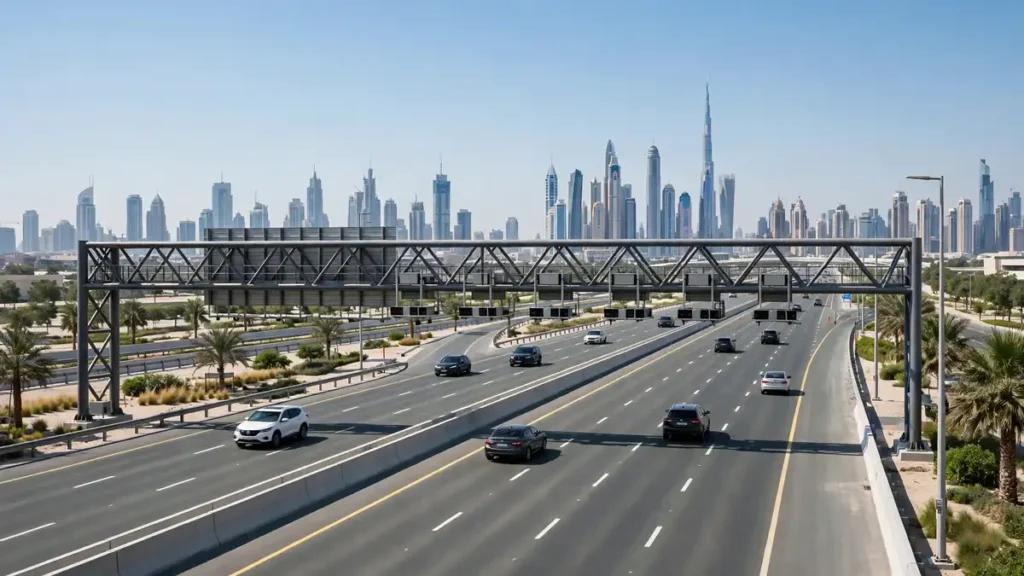
The system is fully electronic. Overhead gantries sit above the road at ten points around Dubai. Each gantry reads the RFID tag stuck to your windscreen as you pass underneath. The toll then comes out of your prepaid Salik account straight away. There is no cash option and no manual payment at the gate. If your account holds enough credit, the crossing simply registers and you carry on driving.
Salik charges per crossing, not per journey. Every time you pass under a gantry, that counts as one crossing. Drive under three gates on one trip and you pay three times. There is no daily cap, so ten crossings in a day cost ten times the rate for each crossing. That detail matters when you plan a route, because a slightly longer drive that avoids a gate can sometimes save you money.
Where Are the Salik Gates Located?
Dubai has ten Salik gates. Eight of them sit on the three main north-south routes, and two sit on the crossings over Dubai Creek. Here is the full list, with the road for each gate.
- Al Barsha, on Sheikh Zayed Road, near Mall of the Emirates
- Jebel Ali, on Sheikh Zayed Road, near Ibn Battuta Mall
- Al Safa North, on Sheikh Zayed Road
- Al Safa South, on Sheikh Zayed Road
- Business Bay Crossing, on Al Khail Road
- Al Garhoud Bridge, on Sheikh Rashid Road
- Al Maktoum Bridge, on Umm Hurair Road
- Airport Tunnel, on Beirut Street
- Al Mamzar North, on Al Ittihad Road
- Al Mamzar South, on Al Ittihad Road
Business Bay Crossing and Al Safa South are the newest gates in the network. Both switched on in November 2024, with 24 November 2024 given as the switch-on date in one source. They joined the system to ease pressure on the older gates nearby. If you drive on Al Khail Road or the southern stretch of Sheikh Zayed Road, you now pass through one of these newer gates.
How Does the Salik Tag Work?
The Salik tag is a small RFID sticker that sits on the inside of your windscreen, beneath the rear-view mirror. The gantry reads it as you drive under, and the toll leaves your account. The tag belongs to your number plate, not to you as a driver. That link matters a lot, so keep it in mind when you change cars.
One Salik account can hold several tags. A family with two cars can run both tags from one account, for example. Each tag stays linked to one plate, though. Moving a tag to another car generates fines, because the plate the gantry sees will not match the plate on the account. Always buy a separate tag for each car, and always fit the tag on the windscreen of the car it belongs to.
How Much Does Salik Cost in 2026?
Salik moved to variable pricing on 31 January 2025. Before that date, every crossing cost a flat AED 4, whatever the time of day. The variable system charges more at busy times and less at quiet times, and it costs nothing at all in the small hours of the morning.
The base rates are AED 6 at peak times and AED 4 at off-peak times. On top of that, 5% VAT applies to toll usage from 1 June 2026. That takes the price you actually pay to AED 6.30 for a peak crossing and AED 4.20 for an off-peak crossing. The figures in this guide include VAT, so they match what leaves your account. Toll rates can change, though, so check the current figure on salik.ae before you rely on it for a budget.
Your fuel bill sits next to your toll bill in the monthly cost of driving in Dubai. Our guide to UAE petrol prices for December 2026 tracks the monthly fuel rates, so you can plan both costs together.
What Are the Salik Peak Hours?
Peak hours run from Monday to Saturday, in two windows. The morning peak runs from 6am to 10am. The evening peak runs from 4pm to 8pm. Cross a gate inside either window and you pay the peak rate of AED 6.30.
Those windows match the morning and evening rush. Traffic builds up on Sheikh Zayed Road from around 6am, and the evening rush runs through to 8pm. The higher peak price aims to push some drivers to travel earlier, later, or by another route. If your working hours allow it, shifting a regular trip by an hour can cut the toll on every crossing.
What counts is the moment you pass under the gantry. Cross at 9:59am and you pay the peak rate. Cross at 10:01am and you pay the off-peak rate. The clock on the gantry decides, not the time you started your trip.
When Can You Cross a Salik Gate for Free?
Salik is free every day between 1am and 6am. Cross a gate in that window and you pay nothing at all. The free window applies seven days a week, including Sundays and public holidays.
Off-peak hours cover the rest of the day outside the two peak windows. From Monday to Saturday, off-peak runs from 10am to 4pm and then again from 8pm to 1am. Crossings in those hours cost AED 4.20 each. That gives you a simple picture of the day. Early morning is free, the rush costs the most, the middle of the day and the late evening cost less, and the deep night is free again.
How Much Does Salik Cost on Sundays?
Sunday works differently. There is no peak premium on a Sunday. Every crossing between 6am and 1am costs a flat AED 4.20. Cross between 1am and 6am and the crossing is free, just like any other day.
That flat Sunday rate makes weekend driving cheaper than a weekday rush-hour trip. A family drive to the mall on a Sunday afternoon costs AED 4.20 per gate, while the same trip on a Monday morning would cost AED 6.30 per gate. Keep the difference in mind if you can move a regular trip to the weekend.
Public holidays follow the normal weekday peak and off-peak rates, not the Sunday flat rate. Salik also treats major event days differently. During Eid, for example, it has applied full weekday variable pricing even on a Sunday. That can catch drivers out, so check salik.ae before a public holiday or a major event day if you want to know the exact rate for that day.
How Does Salik Work During Ramadan?
Salik runs special hours during Ramadan. The Ramadan 2026 schedule worked like this. From Monday to Saturday, peak hours ran from 9am to 5pm. Off-peak hours ran from 7am to 9am and from 5pm to 2am. Crossings were free from 2am to 7am. On Sundays during Ramadan, crossings outside the 2am to 7am free window cost AED 4.20 each.
Ramadan hours shift each year, because the holy month moves with the lunar calendar and the daily routine changes with it. Do not rely on last year’s schedule. Check the current Ramadan schedule on salik.ae when Ramadan approaches, and plan your trips around the published hours for that year.
What Is the Paired Gate Rule?
Two pairs of gates follow a special rule. Pass both Al Safa gates, or both Al Mamzar gates, in the same direction within one hour, and you are charged once. The second crossing in the pair costs nothing.
The rule exists because the two gates in each pair sit close together on the same road. Without it, drivers would pay twice for what is really one stretch of road. The key detail is the one-hour window and the same direction. Pass the pair in opposite directions, or more than an hour apart, and each crossing counts separately.
How Do You Get a Salik Tag and Set Up an Account?
You need a tag before you drive under a Salik gate. The tag costs AED 100 at activation. That figure breaks down as AED 50 for the device and AED 50 of toll credit already loaded on the account. VAT applies to the activation fee, so the total you pay may sit slightly above AED 100. Treat AED 100 as an approximate figure and check the current total on salik.ae before you buy.
You can buy a tag in two ways. Order it on the Salik website and it arrives by delivery, which costs a further AED 20. Buy it over the counter at an Emarat, EPPCO, ENOC, or ADNOC petrol station and there is no delivery charge. The station option suits drivers who want the tag straight away, while the website option suits drivers who prefer to sort it out from home.
How Much Does a Salik Tag Cost?
The headline figure is AED 100, made up of AED 50 for the tag itself and AED 50 of credit. The AED 50 credit means your first crossings are already paid for. You are not buying an empty tag, you are buying a tag with money on it.
Replacement tags cost AED 50. You need one if your tag is damaged, lost, or stops working. The replacement fee covers the new device, and you can link it to the same account and plate. Keep the receipt and the tag number somewhere safe, because you will need the details if you ever have to query a crossing or a fine.
Where Can You Buy a Salik Tag?
Buy a tag on the Salik website, or over the counter at Emarat, EPPCO, ENOC, or ADNOC petrol stations across the UAE. The stations are the fastest option, since you walk out with the tag in your hand. The website option adds a delivery charge of AED 20, so it costs a little more in total.
Whichever route you choose, fit the tag as soon as you have it. Stick it on the inside of the windscreen, beneath the rear-view mirror. That spot gives the gantry a clear read. A tag fitted in the wrong place may not register, and a missed read can lead to a fine even when your account holds plenty of credit.
How Do You Activate a Salik Tag?
Activation depends on where you bought the tag. Tags ordered on the Salik website are activated automatically, so they work as soon as they arrive and you fit them. Station-bought tags need activation first. Activate the tag through the Salik website or the Smart Salik app, through the RTA Dubai app, or through the Salik call centre.
Do not drive under a gantry with an unactivated tag. That counts as having no tag at all, and it can lead to a fine. Activate the tag, fit it on the windscreen, and then drive through a gate. The first crossing should register normally and the toll should leave your account. Check the crossing shows up in your account history to confirm the tag works.
Dubai keeps moving government services online, and a single digital identity now sits behind many of them. Our UAE Pass guide explains how that digital identity works, and our guide to Mira, the UAE AI government assistant, covers the newest way to handle government services in one chat.
How Do You Check Your Salik Balance and Top Up?
You can check your balance and top up in several ways. Use the Salik website or the Smart Salik app, the RTA Dubai app, the DubaiNow app, or the Dubai Drive app. You can also top up through online banking with most UAE banks, or buy a Salik recharge card with cash and enter the code. The Salik call centre on 800 72545 can help too.
Pick the method that fits your routine. App users can check the balance in seconds before a trip. Bank users can set up a transfer and top up without opening another app. Cash users can grab a recharge card at a station and enter the code at home. The important thing is to check the balance often, because the system will not stop you at the gate when the money runs out. It will simply record the crossing and fine you later.
Auto-recharge is also available. Set it up once, and the system tops up your account automatically when the balance falls. That removes the risk of forgetting a manual top-up during a busy week. Check the auto-recharge settings on salik.ae or in the Smart Salik app to set it up for your account.
What Happens When Your Salik Balance Runs Low?
Low-balance SMS alerts go only to the number registered on the account. Keep that number up to date. If you changed your mobile number and never updated Salik, the warnings go to an old number and you will never see them.
Top up as soon as you get a low-balance warning. The warning gives you time to act, but the clock keeps running on your crossings. Every gate you pass while the balance sits too low adds to the problem, so do not ignore the alert for days and hope it goes away.
Public transport users face the same habit of checking a balance before travel. Our guide to the Nol card balance check online shows how to check the balance on a Dubai Metro and bus card in the same quick way.
What Are the Salik Fines and How Do You Avoid Them?
Salik fines are easy to avoid once you know the rules. Most fines come from two causes. Drivers run out of balance, or drivers cross a gate without a working tag. Both causes are simple to fix before they cost you money. Keep the tag fitted and active, keep the balance topped up, and check your account after any change, such as a new car or a new phone number.
The fines below come from Salik’s published violations list. The amounts are the ones in force for 2026. Toll rates and fine rules can change, so check the current figure on salik.ae if you ever need to confirm an amount before you pay it.
What Happens If Your Balance Is Too Low?
Cross a gate with too little money in your account and you get a fine of AED 50 per day. Salik applies a maximum of one fine per vehicle per day, so several crossings on the same day still mean one fine for that day. That limit helps, but the fine can still repeat day after day if you keep driving without topping up.
You get five working days to recharge after the crossing before the fine applies. Top up inside that window and the crossing settles at the normal rate, with no penalty at all. The grace period is generous, so use it. A quick top-up on the same day you cross costs you nothing extra.
If you miss the window, the fine stands. Pay it promptly and top the account up at the same time. Driving on with an empty account only adds more fines, and the total can grow fast across a working week.
What Happens If You Drive Without a Tag?
Drive under a gate with no tag, or with a plate that is not registered, and the rules are stricter. You get ten working days from the first trip to buy, activate, and fit a tag. Sort it out inside that window and you avoid the fine.
Miss the window and the fines start. The first offence costs AED 100. The second costs AED 200. Each offence after that costs AED 400. Salik applies a maximum of one fine per vehicle per day here too, but the amounts climb quickly. A driver who ignores the problem for a week can face a bill far bigger than the cost of the tag itself.
Tampering with a tag or damaging Salik property carries a fine of AED 10,000. Do not peel a tag off one car and stick it on another, and do not interfere with a gantry or any Salik equipment. The penalty reflects the seriousness of the offence, and it sits far above the ordinary fines for low balance or a missing tag.
Total Salik violations are capped at AED 10,000 per vehicle per calendar year. The cap limits the damage in a worst-case year, but it is not a safety net to rely on. A bill anywhere near that figure means months of ignored fines, and the stress and admin that come with it.
Traffic fines sit alongside Salik fines in the cost of driving in Dubai. Our guide to the RTA fine check by plate number shows how to look up any RTA fine against your plate, so you can catch both kinds of penalty in one routine check.
Can a Salik Fine Block Your Vehicle Registration?
Yes, an unpaid Salik balance can block your vehicle registration renewal. The mulkiya renewal at the RTA will not go through while Salik money is outstanding. That turns a small unpaid toll into a much bigger problem on renewal day, when you need the car legal and on the road.
Check your Salik account before your renewal date. Clear any fines and top the balance up. A five-minute check saves a wasted trip to the testing centre and a delay while you sort out a balance you could have cleared at home.
How Long Do You Have to Dispute a Salik Fine?
You have 13 months from the date a violation was added to the traffic file to dispute it. That is a long window, so you have time to gather evidence if you believe a fine is wrong. Check the violation details in your Salik account first, and note the date, the gate, and the amount.
Raise the dispute through the Salik website, the Smart Salik app, or the call centre on 800 72545. Keep any proof that supports your case, such as a top-up receipt or a tag activation record. A clear record makes a dispute far easier to resolve than a vague memory of what happened months ago.
How Does Salik Work in a Rental Car?
Rental cars in Dubai come pre-equipped with a Salik tag. You do not need to buy one or fit one yourself. The rental agency bills you for the crossings you make during the hire, and the toll comes off your final bill.
Agencies may add their own handling charge on top of the toll. That charge varies from one agency to another, and it can add up across a long hire. Read the rental terms before you sign, and ask the agency how it bills Salik crossings. A quick question at the counter can save an argument over the final bill later.
Tourists and new residents often hire a car for the first weeks in Dubai. Plan your driving around the toll gates in that period, and keep an eye on how many gates each trip crosses. Short hires can still rack up several crossings a day if you drive between Dubai Marina, Downtown, and the airport.
How Does Salik Compare With Darb in Abu Dhabi?
Dubai and Abu Dhabi run separate toll systems. Salik covers Dubai, while Darb covers Abu Dhabi. Darb has its own gates, its own account, and its own rules. A Salik tag does not work on Darb gates, and a Darb tag does not work on Salik gates.
Drive from Dubai to Abu Dhabi and you leave one system behind and enter another. Set up both accounts if you drive between the two emirates often. Do not assume a toll paid in one emirate covers the other, because the two systems do not share accounts or balances.
How Can You Keep Your Salik Costs Down?
Small habits cut your Salik bill more than any single trick.
How Can You Time Your Trips to Pay Less?
Start with the clock. Shift a regular trip out of the peak windows and each crossing drops from AED 6.30 to AED 4.20. Move a trip to a Sunday and the same crossing costs AED 4.20 with no peak premium at all. Drive between 1am and 6am and the crossing costs nothing, though that window suits very few drivers.
Look at the route next. The paired gate rule already saves you money on Al Safa and Al Mamzar, but a different route can avoid a gate entirely. A road without a gantry costs nothing in tolls, even if it adds a few minutes to the trip. Try the alternative once and compare the time, because a small detour can be worth it on a daily commute.
Consider the Metro for some trips. The Dubai Metro has no tolls, and the network keeps growing. Our guide to the Dubai Metro Blue Line new trains for 2026 covers the newest part of the network. A Metro trip for a solo journey into a busy area can cost less than the tolls and parking for the same trip by car.
What Other Habits Cut Your Salik Bill?
Keep the admin tight as well. Check the balance every week, keep your mobile number up to date, and set up auto-recharge if you drive every day. An account with no tolls, payments, or top-ups for five years becomes inactive under Salik’s terms, and the remaining balance is forfeited. That rule rarely bites daily drivers, but it matters if you leave Dubai for years and come back to an old account.
December brings extra traffic around events and celebrations, so plan for busier roads and higher toll use in that month. Our guide to things to do in Dubai in December 2026 covers the season, and the Dubai Run 2026 guide explains the road closures around one of the biggest running events of the year. Big event days can change traffic patterns across the city, so check salik.ae and the event details before you drive.
Frequently Asked Questions About Salik in Dubai?
How Many Salik Gates Are There in Dubai?
Dubai has ten Salik gates. They sit on Sheikh Zayed Road, Al Khail Road, Sheikh Rashid Road, Umm Hurair Road, Beirut Street, and Al Ittihad Road. The newest two, Business Bay Crossing and Al Safa South, both switched on in November 2024.
How Much Is a Salik Crossing in 2026?
A peak crossing costs AED 6.30, including 5% VAT. An off-peak crossing costs AED 4.20, including VAT. Crossings between 1am and 6am are free. Toll rates can change, so check the current figure on salik.ae before you rely on it.
Is Salik Free at Night?
Salik is free every day between 1am and 6am. That free window applies seven days a week. Off-peak rates apply from 8pm to 1am, so late evening crossings cost AED 4.20 each.
Do You Pay Salik on Sundays?
Yes, you pay on Sundays, but there is no peak premium. Every crossing between 6am and 1am costs a flat AED 4.20. Crossings between 1am and 6am are free. Public holidays and major event days can follow weekday rates instead, so check salik.ae on those days.
What Happens If You Pass a Salik Gate Without a Tag?
You get ten working days from the first trip to buy, activate, and fit a tag. Miss that window and the first offence costs AED 100, the second costs AED 200, and each offence after that costs AED 400. Salik applies a maximum of one fine per vehicle per day. Sort the tag out inside the ten days and you avoid the fine entirely.
How Do You Check Your Salik Balance?
Check your balance on the Salik website or the Smart Salik app. You can also use the RTA Dubai app, the DubaiNow app, or the Dubai Drive app. Online banking with most UAE banks also shows the balance, and the call centre on 800 72545 can help. Low-balance SMS alerts go only to the number registered on the account, so keep that number up to date.
Can One Salik Account Cover More Than One Car?
Yes, one account can hold several tags, so a household can run more than one car from a single account. Each tag stays linked to one number plate, though. Moving a tag to another car generates fines, so buy a separate tag for each car and fit each tag on the car it belongs to.
Does Salik Work in Abu Dhabi?
No, Salik covers Dubai only. Abu Dhabi runs its own system, called Darb, with its own gates and its own account. A Salik tag does not work on Darb gates. Set up both accounts if you drive between the two emirates often.