
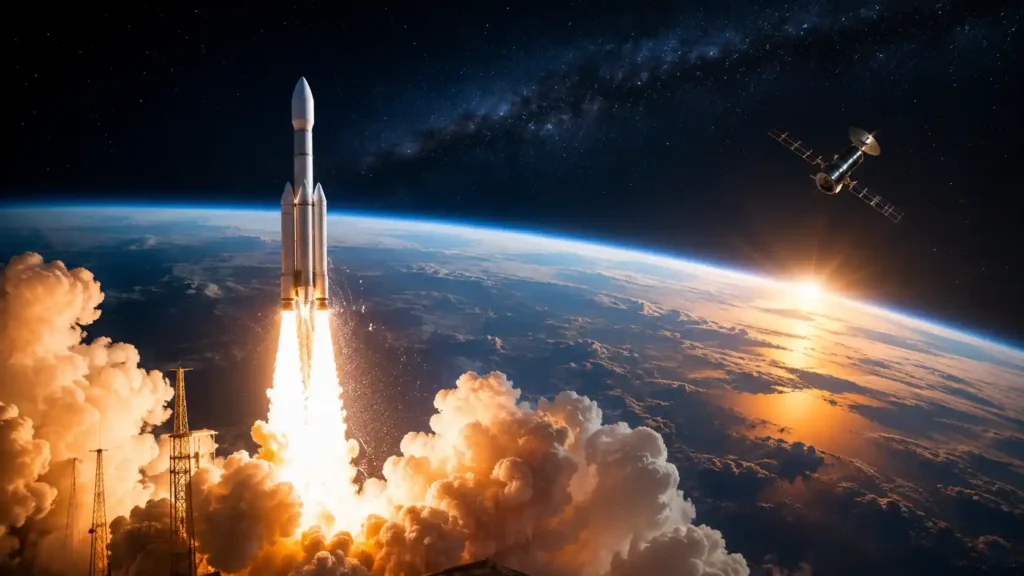
Look up at the night sky and it is easy to feel small. Yet almost everything you rely on during an ordinary day — the weather forecast on your phone, the map that guides you through Dubai traffic, the video call that connects you to family abroad — depends on machines quietly orbiting hundreds of kilometres above your head. That invisible web of satellites, rockets, and ground stations is the beating heart of space technology, and it shapes modern life far more than most of us realise.
Space technology used to feel like the exclusive playground of a couple of superpowers. That has changed dramatically. Today, private companies launch rockets on a regular schedule, small nations run their own space programmes, and the UAE has sent a probe to Mars and an astronaut to the International Space Station. In this guide, we will walk through what space technology actually means, how it works, why it matters to your daily life, and where this fast-moving field is heading next. No physics degree required — just curiosity.
What Is Space Technology?
Space technology is the collection of tools, machines, and systems designed to work in or explore outer space. That covers a huge range of things: the rockets that push through Earth’s atmosphere, the satellites that circle the planet, the telescopes that peer into distant galaxies, and the spacecraft that carry humans and robots to other worlds. It also includes the ground-based equipment — control centres, antennas, and software — that keeps everything running smoothly from here on Earth.
What makes this field so demanding is the environment itself. Space is brutally unforgiving. There is no air, temperatures swing from scorching to freezing, and radiation constantly bombards anything that ventures beyond our atmosphere. Every piece of equipment has to survive conditions that would destroy ordinary machines in moments. That is why space engineering pushes materials, electronics, and design to their absolute limits, and why breakthroughs here often ripple outward into the wider world of emerging technology.
It helps to think of space technology as three connected parts. First, there is getting to space — the launch vehicles and rockets. Second, there is operating in space — the satellites, stations, and probes that do the actual work. Third, there is the ground segment — everything on Earth that controls, tracks, and communicates with those distant machines. All three have to work together perfectly, or the whole mission fails.
How Rockets and Launch Systems Work
Getting anything into space starts with one enormous challenge: escaping Earth’s gravity. Our planet pulls everything toward its centre, and to break free you need tremendous speed and power. This is the job of the rocket, arguably the most dramatic piece of space technology ever built.
A rocket works on a simple principle you can feel yourself. Let go of an inflated balloon and it zips around the room as air rushes out the back. A rocket does the same thing on a massive scale, burning fuel to blast hot gas downward, which pushes the rocket upward. The faster and harder it expels that gas, the more thrust it generates. To reach orbit, a rocket has to accelerate to roughly 28,000 kilometres per hour — fast enough that as it falls back toward Earth, it keeps missing and instead circles around.
A modern space launch system is usually built in stages. The lower stages carry the heavy fuel needed to lift off, then drop away once empty to shed weight. This staged design is why rockets look like they shed pieces as they climb. One of the biggest recent shifts has been reusable rockets — boosters that fly back and land upright so they can be used again. This has slashed the cost of reaching orbit and opened the door to far more frequent launches. Lighter, stronger materials help too, and this is where advances in nanotechnology are quietly making a difference, producing components that are both feather-light and remarkably strong.
Satellites: The Machines That Run Your Day
If rockets are the flashy headline act, satellites are the tireless workers that make space technology genuinely useful. There are thousands of them orbiting right now, and they touch nearly every part of modern life. Yet most people never think about them at all.
Here is a quick tour of what satellites do for you every single day:
- Navigation: GPS and similar systems rely on satellites to pinpoint your location, powering maps, ride-hailing apps, and delivery tracking.
- Communication: Satellites relay phone calls, internet data, and television signals across oceans and continents.
- Weather forecasting: Orbiting sensors watch storms form and track climate patterns, giving us the forecasts we check each morning.
- Earth observation: Satellites monitor crops, forests, cities, and disasters, helping governments plan and respond.
- Scientific research: Space telescopes and probes gather data about our planet, our solar system, and the wider universe.
Satellites sit at different heights depending on their job. Some hover far out where they appear to stay fixed above one spot on Earth, ideal for communication and weather. Others zip around much closer in low orbit, perfect for detailed imaging and, increasingly, for the large constellations that beam internet to remote areas. Next time your map finds you instantly, remember there is a machine in space making it happen.
The UAE’s Rise as a Space Nation
Few stories capture the changing face of space technology better than the United Arab Emirates. In a relatively short span, the country has moved from having no space programme at all to achieving milestones that many older space nations took decades to reach. It is a genuinely inspiring example of ambition meeting careful planning.
The UAE has launched satellites, sent an astronaut to live and work aboard the International Space Station, and successfully placed a probe in orbit around Mars — a feat achieved by only a handful of nations. Beyond the headline missions, the country has built research centres, trained a new generation of engineers and scientists, and made space a central part of its long-term vision for the future. This drive connects naturally with the nation’s broader investment in artificial intelligence in the UAE, since modern missions lean heavily on smart, automated systems.
What makes this especially exciting is the message it sends to young people across the region. Space is no longer something that happens far away in other countries. It is happening here, creating real careers and real opportunities. For students dreaming of engineering, science, or exploration, the path has never looked more open. If you are curious about specific missions and dates, it is always best to confirm the latest details from official UAE space agency sources, as programmes evolve quickly.
How Artificial Intelligence Powers Modern Missions
Running a spacecraft is extraordinarily complex, and the distances involved make quick human control impossible. When a rover is exploring Mars, a radio signal can take many minutes to travel each way. You cannot steer around a boulder in real time when your command arrives a quarter of an hour too late. This is where smart, self-guiding systems become essential.
Modern spacecraft increasingly rely on artificial intelligence to make decisions on their own. A rover can analyse the terrain in front of it and choose a safe path without waiting for instructions from Earth. Satellites can spot interesting events and decide what to photograph. AI also helps sift through the mountains of data that missions generate, finding patterns that humans might miss and flagging problems before they become serious.
This partnership between space technology and intelligent software is only deepening. As missions travel farther and grow more ambitious, the ability of machines to think and adapt for themselves becomes not just helpful but necessary. It is a perfect example of how different branches of future tech reinforce one another, each pushing the others forward.
How Space Technology Improves Life on Earth
There is a common misconception that money spent on space is money lost to Earth. In truth, the opposite is often the case. The extreme demands of space missions have forced engineers to invent solutions that later found their way into everyday products, sometimes in ways nobody expected.
Many technologies we now take for granted trace their roots to space research. Improvements in materials, water purification, medical imaging, and compact electronics were all pushed forward by the need to make spacecraft lighter, safer, and more capable. Even the humble camera in your phone owes part of its design lineage to work on tiny, high-quality sensors for space missions.
Beyond gadgets, satellites deliver enormous practical value. They help farmers manage crops, guide ships and planes safely, warn communities about approaching storms, and monitor the health of our environment. When a natural disaster strikes, satellite imagery helps rescuers understand the damage and reach people faster. Seen this way, space technology is less about escaping Earth and more about understanding and protecting it. That connection to real human wellbeing links it closely to fields like medical technology, where space-driven innovations continue to save lives.
The Future of Space Technology
The years ahead promise some of the most exciting developments in the history of space exploration. Plans are underway to return humans to the Moon and establish a lasting presence there, which would serve as a stepping stone for eventual journeys to Mars. Reusable rockets keep driving costs down, making space more accessible than ever before.
Several trends are worth watching as this future unfolds:
- Space tourism: Private companies are beginning to offer trips beyond the atmosphere, slowly turning ordinary travellers into astronauts.
- Mega-constellations: Thousands of small satellites working together to deliver fast internet to every corner of the planet.
- Asteroid and resource research: Studying whether valuable materials in space could one day support missions and industry.
- Deeper exploration: More advanced probes and telescopes reaching farther to answer big questions about the universe.
- Sustainable design: Cleaner rockets and better ways to manage the growing problem of space debris.
All of this sits firmly within the wider world of augmented reality and other future-facing tools that will help train astronauts, plan missions, and let people on Earth experience space in vivid new ways. The line between science fiction and daily reality keeps getting blurrier, and that is a thrilling thing to witness.
Challenges Still Facing the Industry
For all its progress, space technology faces real hurdles that engineers and policymakers are working hard to solve. Being honest about these challenges gives you a clearer picture than the glossy headlines alone.
The first is cost. Even with reusable rockets, reaching space remains expensive and technically risky. A single failure can destroy years of work in seconds. The second is space debris — the growing cloud of dead satellites and fragments left in orbit. As launches increase, so does the danger of collisions, which could create even more debris in a troubling chain reaction. Managing this junk responsibly is one of the industry’s most pressing concerns.
There are also questions of cooperation and rules. Space belongs to no single country, yet more nations and companies are active there every year. Agreeing on fair, safe, and peaceful use of orbit and beyond requires international goodwill. These are not reasons to slow down, but they are reasons to move forward thoughtfully. As with any powerful field, it pays to check claims about new missions or breakthroughs against reliable official sources before treating them as settled fact.
Careers and Opportunities in Space
If reading this has sparked something in you, here is encouraging news: the space sector needs far more than just rocket scientists. It draws on an enormous range of skills, and it is growing. Engineers, software developers, data analysts, materials specialists, communicators, and business minds all have a place in modern space programmes.
The rise of private companies and national programmes like the UAE’s means opportunities are opening up in places that had none a generation ago. A curious student today could realistically build a career touching real missions. And because space technology overlaps so heavily with computing, AI, and advanced materials, skills learned in one area often transfer beautifully to another. You do not have to choose a single narrow path; the field rewards people who can connect ideas across disciplines.
Frequently Asked Questions
Why is space technology so expensive? The main reason is the extreme reliability required. Everything must survive brutal conditions and work flawlessly, since repairs are usually impossible once launched. That demand for perfection drives up cost, though reusable rockets are steadily bringing it down.
How do satellites stay in orbit without falling? They are actually falling constantly, but they move sideways so fast that they keep missing the Earth and circle around instead. This balance between gravity and speed is what keeps them up there.
Can ordinary people work in the space industry? Absolutely. The sector needs engineers, programmers, designers, analysts, and communicators. You do not need to be an astronaut to contribute to space technology in a meaningful way.
Final Thoughts
Space technology is one of humanity’s boldest adventures, and it is no longer distant or abstract. It rides along in your pocket, guides your journeys, forecasts your weather, and connects you to the world. What began as a race between two nations has blossomed into a global effort where even young space programmes like the UAE’s are making history.
The most inspiring part is how much lies ahead. As rockets grow cheaper, satellites grow smarter, and exploration reaches farther, the opportunities keep multiplying. Staying curious is the best way to be part of this journey. To keep exploring the technologies shaping tomorrow, browse more articles across the Technology section of our blog, and feel free to contact us with your questions. The sky was never the limit — it was only the beginning.