Tuesday 3 November 2026 is UAE Flag Day, and the national flag will rise across the country at 11am. Government buildings, schools, universities, homes and workplaces in all seven emirates will take part. The day is a national occasion that celebrates love, pride and loyalty to the UAE. It is also a working day, because Flag Day is not a public holiday. Schools and offices will operate as usual, and the flag-raising will fit around the normal day. This guide explains what happens today, why 3 November matters, what the four colours mean, and the official rules for raising the flag. It also covers where residents can celebrate, how schools mark the day, and how Flag Day differs from National Day. All facts in this article come from Khaleej Times and Gulf News, with the official flag rules from the UAE Flag Guidebook issued in 2023.
What is the message of Flag Day?
Flag Day has a clear message. Sheikh Mohammed bin Rashid Al Maktoum, Vice-President and Prime Minister of the UAE and Ruler of Dubai, called on citizens and residents to raise the flag. In a message shared on 27 October, he invited ministries, government institutions, schools, universities and families in all seven emirates to hoist the flag. In a post on X, he said Flag Day is a national occasion celebrating love, pride and loyalty to the UAE. He called on everyone to raise the flag high as a symbol of the country’s unity and achievements.
He also said the occasion brings the nation and its people together in a shared expression of pride. The flag stands for the UAE’s sovereignty and the values set by its founding leaders. The call reached every emirate, and the response will be visible at 11am, when flags rise at the same moment across the country.
How long has Flag Day been observed?
This year is the 14th edition of Flag Day. Sheikh Mohammed launched the occasion in 2013 on his own initiative. People observe it every year on 3 November. The date marks the anniversary of the late Sheikh Khalifa bin Zayed Al Nahyan becoming President of the UAE in 2004. The day brings together Emiratis and residents of different nationalities and generations. It reinforces the country’s traditions of coexistence, tolerance and national solidarity. For new residents, Flag Day is a good introduction to the UAE’s national life. For long-time residents, it is a familiar moment in the calendar. The rest of this guide looks at the day in detail, starting with what happens at 11am and whether the day is a holiday.
What happens on UAE Flag Day today?
The main event today is the flag-raising at 11am. At that hour, people will raise the UAE flag at government buildings, schools, universities, businesses and homes across the seven emirates. The moment is shared, so the whole country raises the flag at the same time. Schools will hold ceremonies with pupils and staff, and many workplaces will gather their teams for the raising. The flag will fly for the rest of the day, and people will see it on buildings, cars and homes across the country. The day is a celebration of unity and national identity, and the flag is the symbol at its centre. The Global Village will mark the evening with a drone show at 8pm, with flag-themed illuminations and special decorations. The show is open to visitors, and it gives families an evening way to mark the day.
Flag Day is also a day for checking the flag itself. Officials urge residents to look at the flag on their home before raising it. Residents should replace a flag that is worn, faded or torn, not raise it. The rule comes from the UAE’s official flag guidelines, and Abu Dhabi City Municipality repeated it this year. The municipality reminded residents to replace damaged flags to preserve their dignified appearance and national significance. The municipality shared the reminder on its official Facebook page. The point is simple. The flag should look its best on the day that honours it. A fresh flag costs little, and it shows respect for the symbol. The guide below explains the full rules for displaying the flag, from cleaning and ironing to the correct way to hang it on a building.
Is Flag Day a public holiday?
No. UAE Flag Day is not an official public holiday. Schools will operate as usual on Tuesday 3 November, and workplaces will also run normally. Parents should not expect a day off for pupils, and workers should not expect a day off either. Khaleej Times reports that the day will not mean another day off for pupils, even though it falls just after the October half-term break. The flag-raising at 11am will take place within the normal school and working day. Schools will fit the ceremony around lessons, and offices will fit it around work. The day is a national occasion, but it is not a holiday in the legal sense. That point is worth stating clearly, because it is the question most parents ask each year.
The next public holiday is Eid Al Etihad, the UAE’s National Day, which falls on 2 December. That day is an official public holiday, and it is easy to confuse the two occasions. Flag Day honours the flag itself, while National Day marks the founding of the federation on 2 December 1971. The two days are a month apart, and they have different meanings. The next public holiday in the UAE guide gives the full list of holidays for the year, with dates and details. Readers who plan travel or time off should check that guide, because the holiday calendar shapes many plans in November and December. For today, the message is simple. Go to school and work as usual, and join the flag-raising at 11am.
Why is Flag Day held on 3 November?
People hold Flag Day on 3 November because the date marks the anniversary of the late Sheikh Khalifa bin Zayed Al Nahyan becoming President of the UAE in 2004. Sheikh Mohammed bin Rashid Al Maktoum launched the occasion in 2013 on his own initiative. The first Flag Day took place in 2013, and people have observed the occasion every year since. This year, 2026, is the 14th edition. Officials chose the date to honour the accession of Sheikh Khalifa, and it has stayed fixed ever since. The annual timing gives the day a stable place in the calendar, and residents now expect it each November. The date also sits close to National Day on 2 December, so November has become a month of national occasions.
The choice of date also reflects the meaning of the flag. The flag is a symbol of unity, and Flag Day is a moment when the whole country acts together. The shared flag-raising at 11am is the clearest expression of that unity. Everyone raises the flag at the same time, in every emirate, in schools and offices and homes. The date ties the act to the leadership of the country, because it marks a presidential anniversary. It also ties the act to the history of the federation, because the flag itself dates from 1971. In that sense, Flag Day looks in two directions at once. It looks back to the founding of the UAE, and it looks at the present day, when the country raises its flag together.
Who called on residents to raise the flag?
Sheikh Mohammed bin Rashid Al Maktoum called on residents to raise the flag this year. He is the Vice-President and Prime Minister of the UAE and the Ruler of Dubai. In a message shared on 27 October, he invited ministries, government institutions, schools, universities and families in all seven emirates to hoist the flag. People shared the call widely, and it set the tone for the day. In a post on X, Sheikh Mohammed said Flag Day is a national occasion celebrating love, pride and loyalty to the UAE. He called on everyone to raise the flag high as a symbol of the country’s unity and achievements.
He also said the occasion brings the nation and its people together in a shared expression of pride in the flag. The flag, he said, stands for the UAE’s sovereignty and the values set by its founding leaders.
The call matters because it comes from the leadership of the country. It turns Flag Day from a date on the calendar into a shared act. When leaders make the call, ministries and schools plan their ceremonies, businesses prepare their buildings, and families check their flags at home. The call also reaches new residents, who may be marking Flag Day for the first time. The message is open to everyone, whatever their nationality. The UAE is home to people from many countries, and Flag Day invites all of them to take part. The shared act of raising the flag is a simple way for a diverse country to show its unity. The response each year shows that people hear the call, with flags appearing across the country in the days before 3 November.
When was the UAE flag first raised?
The late Sheikh Zayed bin Sultan Al Nahyan, the country’s Founding Father, raised the UAE flag for the first time on 2 December 1971, during the declaration of the federation. The date is the same day that the seven emirates founded the UAE, so the flag and the federation share a birthday. The first raising took place as the seven emirates came together to form the United Arab Emirates. The flag has flown ever since, and it has become one of the most recognised symbols of the country. The date of the first raising is also the date of National Day, which is why 2 December is a public holiday. That history links Flag Day on 3 November and National Day on 2 December, even though they mark different things.
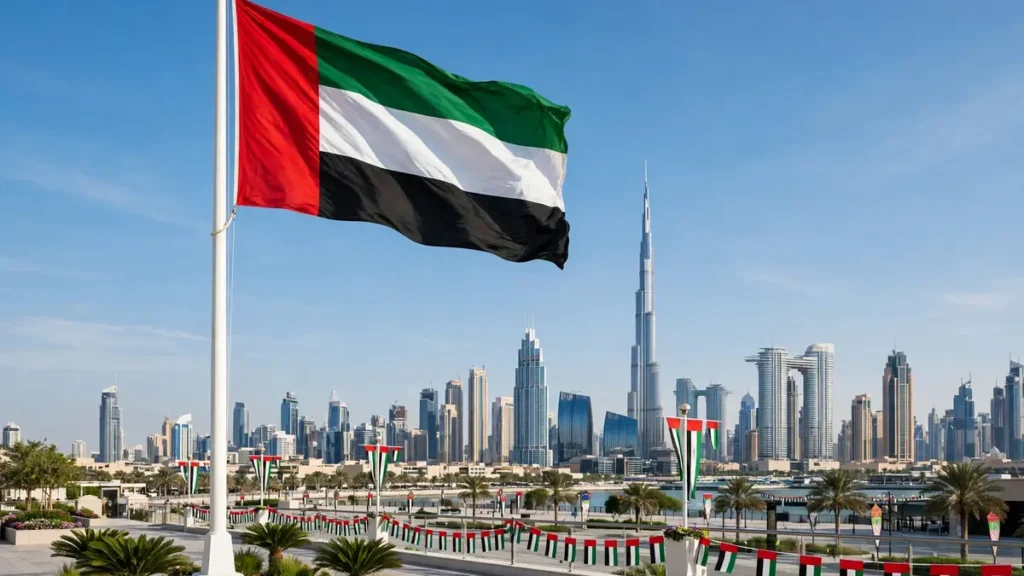
Federal Law No. 2 of 1971 governs the flag’s design, as amended by Federal Decree-Law No. 13 of 2019. The law sets the official design and the rules for its use. Under the official specifications, the flag is rectangular, with its length twice its height. A vertical red band occupies one-quarter of its length next to the flagpole. Three equal horizontal bands, green, white and black, cover the remaining area. The law fixes the proportions, and the flag should always be shown in the correct shape. If someone stretches or squeezes a flag out of shape, it does not meet the official standard. The Zayed the Founder Day guide gives more detail on the life and legacy of Sheikh Zayed, who raised the flag on that first day in 1971.
Who designed the UAE flag?
Abdullah Mohammed Al Maeena designed the UAE flag. Judges selected his entry following a competition announced through Al Ittihad newspaper shortly before the establishment of the UAE. The competition attracted around 1,030 designs, and judges shortlisted six of them before selecting the current flag. The number shows how much interest the competition drew, and how carefully officials made the choice. Al Maeena’s design stood out from more than a thousand entries, and it has lasted for over five decades. People now see the flag he designed across the country every day, on buildings, schools, cars and homes. People also see it around the world, wherever the UAE shows its flag.
Al Maeena drew inspiration from a verse by the Arab poet Safi Al Din Al Hilli. The verse linked colours to ideas, and those links shaped the flag. The verse linked white with good deeds, green with fertile lands, black with battles and red with swords. The four colours of the flag come from that verse, and each one carries a meaning that still holds today. The UAE Flag Guidebook issued in 2023 sets out the official meanings, and the next section explains them. The story of the design is a reminder that a public competition chose the flag. It came from a public competition, and it drew on Arab poetry. That history gives the flag a cultural depth that goes beyond its colours and shape.
What do the UAE flag’s four colours mean?
Each colour of the UAE flag carries a distinct meaning, according to the official UAE Flag Guidebook issued in 2023. Red honours the sacrifices of the generation that established the federation and those of the nation’s martyrs who gave their lives to protect its achievements. Green represents growth, prosperity, the natural environment and the country’s cultural and civilisational development. White symbolises charitable work, generosity and the UAE’s commitment to supporting peace and security around the world. Black represents the strength, determination and resilience of the UAE’s people, as well as their rejection of injustice and extremism. The four meanings together tell the story of the country, from its founding to its values today.
What does each colour mean at a glance?
The table below sets out the four colours and their meanings in one place. It is a useful guide for parents and teachers, who often explain the flag to children on Flag Day. The meanings are also worth knowing for new residents, who may see the flag every day without knowing what it stands for. The colours are not random, and officials chose each one with care. The red band is the vertical band next to the flagpole, while the green, white and black bands run across the rest of the flag. The table gives the meaning of each colour in the words of the official guidebook, so readers can trust that the detail is accurate.
| Colour | Position on the flag | Official meaning |
|---|---|---|
| Red | Vertical band next to the flagpole | Sacrifices of the founding generation and the martyrs |
| Green | Top horizontal band | Growth, prosperity, nature and cultural development |
| White | Middle horizontal band | Charity, generosity, peace and security worldwide |
| Black | Bottom horizontal band | Strength, determination, resilience, rejection of injustice |
How do the colours link to poetry?
The colours also link to the verse that inspired the design. The poet Safi Al Din Al Hilli linked white with good deeds, green with fertile lands, black with battles and red with swords. The official meanings build on those links, and they give each colour a modern meaning as well. Red still speaks of sacrifice, but it now honours the martyrs too. Green still speaks of fertile land, but it now covers growth and prosperity as well. White still speaks of good deeds, but it now covers charity and peace around the world. Black still speaks of battles, but it now stands for strength and resilience. The flag is a bridge between the poetry of the past and the values of the present day.
What are the official rules for displaying the flag?
The UAE government has issued guidelines that govern the flag’s display, maintenance and use. The aim is to ensure that people treat the flag with respect at all times. Under the official guidebook, people must keep flags clean and iron them properly. People must replace flags that are torn, faded or damaged. The flag must not touch the ground when people raise or lower it. People should also display it in its correct proportions, without altering its colours or design. These rules apply wherever people show the flag, from a government building to a family home. They are simple rules, but they matter, because the flag is a national symbol.
The guidelines also cover how people should hang the flag. For flags that hang vertically on buildings, the red section must be at the top, with the black section to the viewer’s left. The guidelines prohibit adding logos, emblems or decorative elements to the national flag, except for the official presidential flag. They also prohibit printing the flag on disposable materials or using it to decorate food items, including cakes and sweets.
People must inspect flags after strong winds or severe weather, and they should carefully lower damaged flags and replace them. The guidelines also specify that outdoor flagpoles should be white, and that the size of the flag should be proportionate to the pole and its location. The rules are part of wider measures to preserve the dignity of the national flag, which has stood as a symbol of the UAE’s independence, sovereignty and unity since the seven emirates established the federation in 1971.
What should residents check before raising a flag?
Residents should check their flag before raising it today. The check is quick, and it follows the official guidelines. First, look at the colours. Residents should replace a flag that has faded in the sun, because the colours should stay bright and clear. Second, look for tears, fraying or damage along the edges. Residents should replace a flag that is torn or worn, even when the damage appears minor. Third, check that the flag is clean. Residents should wash or replace a dirty flag, and iron it before raising it.
Fourth, check the size. The flag should be proportionate to the pole and its location, so a small flag on a tall pole will look wrong, and a large flag on a short pole will also look wrong. Abu Dhabi City Municipality made the same point in its reminder this year, and it urged residents to replace worn, faded flags before raising them on 3 November.
Residents should also check the pole and the fixings. Outdoor flagpoles should be white, according to the guidelines. The fixings should hold the flag firmly, so it does not slip or tangle in the wind. Raise the flag with care, and do not let it touch the ground at any point. If people display the flag vertically on a building, the red section must be at the top, with the black section to the viewer’s left. These details are easy to get wrong, so it is worth checking them before the flag goes up. Raising a flag correctly shows respect for the symbol. Raising a flag carelessly can make it look wrong, even when the intention is good. The check takes only a few minutes, and it is the right way to start Flag Day.
What happens at 11am?
At 11am, people across the country will raise the flag. The time is fixed, and the raising happens at the same moment in every emirate. Schools will gather pupils and staff for the ceremony, and many will sing the national anthem as the flag rises. Government departments will hold their own ceremonies, and businesses will gather their teams. Families at home can raise the flag in their garden or on their balcony at the same hour. The shared timing is the heart of the day, because it turns many separate acts into one national moment. The flag-raising is short, but it is the part of the day that most people remember. The rest of the day is a normal working day, with the flag flying as a reminder of the occasion.
The 11am ceremony is a tradition that has grown with Flag Day. Sheikh Mohammed introduced the occasion in 2013, and the shared raising has been part of it from the start. Schools play a large role, because they bring together pupils of many nationalities. The ceremony gives teachers a chance to explain the flag, its colours and its history. For pupils, the act of watching the flag rise is a direct lesson in national pride. For adults, the ceremony is a pause in the working day, and a chance to reflect on the country’s unity. The Global Village drone show at 8pm will close the day for many families. The show uses drones to form images in the sky, with flag-themed illuminations and special decorations around the venue.
Where can residents celebrate Flag Day?
Residents can celebrate Flag Day in many places today. The simplest place is home, by raising the flag at 11am. Schools and workplaces will hold their own ceremonies, and residents can join those if they are part of them. Public spaces across the emirates will also fly the flag, so a walk through a neighbourhood will show the day in full colour. The Global Village is the main evening venue, with its drone show at 8pm and flag-themed decorations. The venue is a popular place for families, and the show should draw a large crowd. Visitors should arrive early, because the evening is likely to be busy.
The weather today should suit an evening out, with warm temperatures and a chance of fog or mist overnight. The UAE weather update for 2 November reported the fog and rain pattern that continues into today, so residents should check the latest forecast before heading out.
Other venues will mark the day in their own way. Government buildings will fly the flag, and many malls and public spaces will carry flag decorations. The Dubai Fitness Challenge is also running, so residents can combine the day with 30 minutes of activity. Dubai Design Week runs from 3 to 8 November at Dubai Design District, and it offers another way to spend the day. The Dubai Ride 2026 took place on Sunday 1 November, with thousands of cyclists on a traffic-free Sheikh Zayed Road, and the Fitness Challenge continues until 29 November. The range of events shows that Flag Day sits in a busy month. Residents do not need a ticket or a booking to take part in the main act, which is raising the flag at 11am. That act is open to everyone, and it costs nothing.
How do schools mark Flag Day?
Schools mark Flag Day with ceremonies at 11am, when pupils and staff gather to raise the flag. Many schools also hold activities through the day, with lessons on the flag, its colours and its history. Pupils may make flags, learn the national anthem, or take part in art and writing activities. The day is a chance for teachers to explain the meaning of the flag to children of all ages. Khaleej Times reports that Indian schools across the UAE are also preparing for Diwali, which falls on Sunday 8 November, so the week has two celebrations for many pupils. Schools will observe Flag Day as a normal school day, with the ceremony fitted around lessons. Parents should send children to school as usual, and they should not expect a day off.
The school ceremonies matter because they reach the next generation. Pupils of many nationalities take part, and the day teaches them about the country they live in. The flag-raising is a simple act, but it carries a clear message about unity and pride. Teachers often use the day to explain the four colours, with the meanings from the official guidebook. The red band honours sacrifice, the green band stands for growth, the white band stands for charity and peace, and the black band stands for strength. The lesson is easy to remember, and it stays with pupils long after the day. The ceremonies also bring parents into the school, because many schools invite families to join the raising. The shared moment links the school, the family and the country in one act.
How is Flag Day different from National Day?
Flag Day and National Day are different occasions, and it is easy to confuse them. Flag Day falls on 3 November, and it honours the flag itself. National Day, known as Eid Al Etihad, falls on 2 December, and it marks the founding of the federation in 1971. Flag Day is not a public holiday, while National Day is an official public holiday. Sheikh Mohammed introduced the occasion in 2013, while people have observed National Day since the federation was founded. It marks the anniversary of Sheikh Khalifa becoming President in 2004, while National Day marks the day the seven emirates came together. The two days are a month apart, and they have different meanings, even though both celebrate the country.
The difference also shows in how people mark the days. Flag Day centres on a single act, the raising of the flag at 11am. National Day is a longer celebration, with fireworks, parades, shows and a public holiday.
Flag Day is a working day with a ceremony, while National Day is a day off with festivities across the country. The flag is central to both days, but it plays a different role in each. On Flag Day, the flag is the subject of the day. On National Day, the flag is part of a wider celebration of the founding. The Dubai World Trade Centre bridge opened on 30 October, and it is one of the recent changes in the city that residents will see as they travel to National Day events in December. The key point for today is simple. Flag Day is a working day, and National Day is the holiday that follows a month later.
What else is happening in the UAE this week?
Flag Day sits in a busy week for the UAE. ADIPEC, the energy exhibition, runs from 2 to 5 November at ADNEC Centre in Abu Dhabi. It is a record event, with 2,260 exhibiting companies, more than 40 government ministers and more than 239,000 attendees from more than 170 countries. The event is for industry professionals, so it will not affect most residents directly. It does bring many visitors to Abu Dhabi, and it adds to the traffic around the exhibition centre. Dubai Design Week runs from 3 to 8 November at Dubai Design District, with exhibitions and events across the creative industries. The Dubai Fitness Challenge runs from 31 October to 29 November, with 30 minutes of activity each day for 30 days. Diwali, the Festival of Lights, falls on Sunday 8 November, and schools across the UAE are already preparing for it.
The weather is also part of the week. The National Centre of Meteorology has issued red and yellow fog alerts for Tuesday morning, with thick fog in the southern parts of the country. Rain is possible in the east, in Fujairah, Kalba and Khor Fakkan, from convective clouds in the afternoon. The rain chances continue through Friday, with humidity rising to 90 per cent and fog or mist likely on several mornings. Temperatures will stay warm, with highs of 34°C to 38°C across the emirates. The November 2026 petrol and diesel prices took effect at the start of the month, and they affect every driver in the country. New speed limits on five Dubai roads also took effect on 1 November. The week is full of change, and Flag Day is the national occasion at its centre.
How can new residents take part?
New residents can take part in Flag Day in the same way as everyone else. The simplest step is to raise the flag at 11am. Residents can buy a flag from many shops across the UAE, and check it for damage before raising it. The flag should be clean, ironed and in the correct proportions. Raise it with care, and do not let it touch the ground. New residents who work in an office or study at a school can join the ceremony there. The shared raising at 11am is open to all, whatever their nationality. The day is a good chance to learn about the UAE, its history and its values. The four colours are a good place to start, because they tell the story of the country in a simple way.
New residents should also know the rules that apply to the flag. People should not print the flag on disposable materials, or use it to decorate food, including cakes and sweets. Adding logos or emblems to the flag is also banned, except for the official presidential flag. After strong winds or severe weather, check the flag, and carefully lower a damaged flag and replace it. The official guidebook sets out these rules, and they apply to everyone. The flight updates for 2 November covered the latest travel news for visitors, including airline changes and the new tourist visa route through Visit Dubai. New residents who have just arrived should check their flight and visa details, and they should take part in Flag Day as a first step in their new home.
Frequently asked questions?
Is UAE Flag Day a public holiday?
No. UAE Flag Day on Tuesday 3 November 2026 is not an official public holiday. Schools and workplaces will operate as usual. People will raise the flag at 11am across the country. The next public holiday is Eid Al Etihad, the National Day, on 2 December.
What time is the flag raised on Flag Day?
People raise the flag at 11am on Tuesday 3 November 2026. The raising happens at the same moment across all seven emirates, in government buildings, schools, universities, businesses and homes.
Why is Flag Day held on 3 November?
People hold Flag Day on 3 November to mark the anniversary of the late Sheikh Khalifa bin Zayed Al Nahyan becoming President of the UAE in 2004. Sheikh Mohammed introduced the occasion in 2013, and this year is the 14th edition.
What do the four colours of the UAE flag mean?
Red honours the sacrifices of the founding generation and the martyrs. Green stands for growth, prosperity, nature and cultural development. White stands for charity, generosity, peace and security. Black stands for strength, determination, resilience and the rejection of injustice and extremism.
Can a damaged flag be raised on Flag Day?
No. People must replace flags that are torn, faded or damaged, and they should not raise them. The official guidelines state that people must replace worn, damaged or discoloured flags and never raise them. Abu Dhabi City Municipality repeated this reminder before Flag Day 2026.
Who designed the UAE flag?
Abdullah Mohammed Al Maeena designed the UAE flag. Judges selected his entry from around 1,030 designs in a competition announced through Al Ittihad newspaper. The late Sheikh Zayed bin Sultan Al Nahyan first raised the flag on 2 December 1971.