
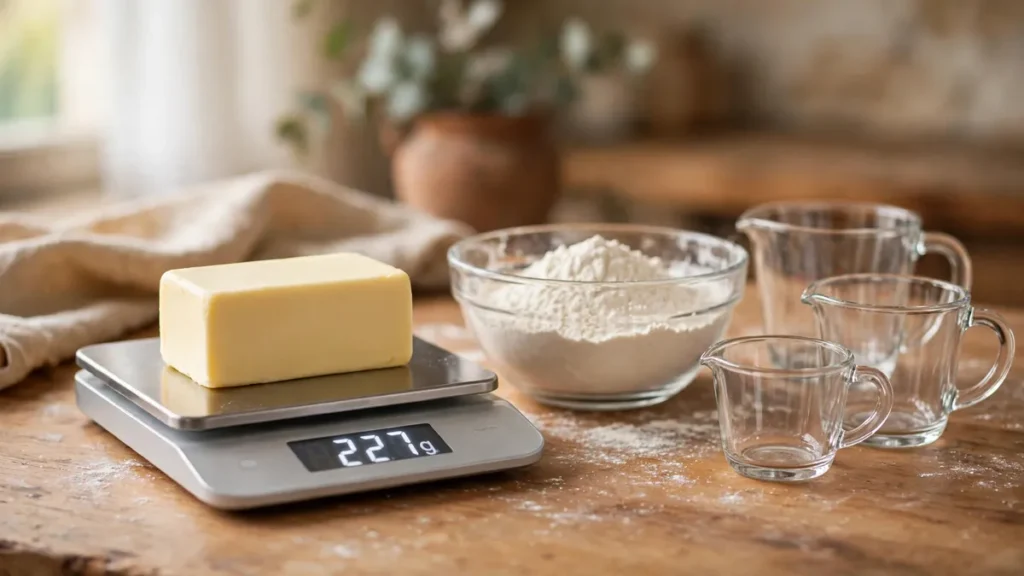
So your recipe calls for 1 cup of butter. The wrapper only shows grams. What do you do? Here is the answer for 1 cup butter in grams: exactly 227 grams. Now you can measure it in seconds. And you will use the 1 cup butter in grams conversion again and again.
Butter is one of those ingredients that looks simple. Then it starts causing confusion across recipes and countries. American recipes use cups. Most of the world uses grams. As a result, bakers everywhere keep converting back and forth. This guide ends that headache for good. So consider it your complete baking conversions companion.
You will find the exact figure for 1 cup butter in grams below. Then you will get full cups-to-grams tables for sugar, flour, and more. We cover rice to water ratios, egg protein content, and everyday kitchen measurements too. So keep this page bookmarked for your next baking session.
Why Weight Beats Volume in Baking?
Cups measure volume, not weight. And that difference matters more than most people think. A cup of flour can weigh anywhere from 110 to 140 grams. It depends on how you scoop it. So two bakers can follow the same recipe and get two different cakes. Weight removes the guessing completely.
Butter behaves the same way. A loosely packed cup weighs less than a firmly packed one. Cold butter and soft butter also pack differently. When a recipe asks for 1 cup butter in grams, it wants 227 grams exactly. So weighing 227 grams for 1 cup butter in grams beats packing cups every time. No packing, no guesswork, just the right amount every single time.
Professional bakeries weigh everything. That is how they make the same cake five hundred times in a row. Home bakers also get the same benefit from a small digital scale. So if you bake often, buy a scale first. Then every 1 cup butter in grams conversion takes two seconds. It costs little and pays off in every batch you make.
1 Cup Butter in Grams: The Exact Answer
One US cup of butter equals 227 grams. This number comes from the standard American butter stick. Two sticks make one cup. Each stick weighs 113.5 grams. That 227-gram figure is the 1 cup butter in grams answer you can trust. Together they weigh 227 grams on the nose.
However, some charts round this to 225 grams. Others say 230 grams. The true figure for 1 cup butter in grams is 227 grams though. For most baking, that small difference rarely matters. But knowing the exact number gives you real confidence. Here at gulflights.ae, we use the exact figure in all our kitchen guides.
Butter is the backbone of countless bakes. Our tres leches cake recipe, for example, relies on measured butter for a rich, even crumb. The same applies to our chocolate cake recipe, where the butter quantity decides the final texture. Get the grams right, and these cakes practically make themselves.
Butter Cups-to-Grams Conversion Table
Keep this table on your fridge or phone. It also covers every amount you will meet in American recipes. So the whole table builds on the 1 cup butter in grams anchor of 227 grams. Each line gives the cup measure and its exact gram weight. Then you never have to search for 1 cup butter in grams again.
- 1 tablespoon butter = 14.2 grams
- 2 tablespoons butter = 28.4 grams
- 1/4 cup butter = 56.7 grams
- 1/3 cup butter = 75.6 grams
- 1/2 cup butter = 113.5 grams
- 2/3 cup butter = 151.2 grams
- 3/4 cup butter = 170.1 grams
- 1 cup butter = 227 grams
- 1 1/2 cups butter = 340 grams
- 2 cups butter = 454 grams
1/2 Cup Butter in Grams and Other Handy Amounts
Many cooks search for “1 2 cup butter in grams” online. The answer is 113.5 grams. One full American stick also holds exactly this amount. So if your wrapper shows stick markings, you already have the measure.
Half-cup amounts show up everywhere. Cookies, frostings, and pan sauces use them all the time. So memorizing 113.5 grams saves you real time. A quarter cup weighs 56.7 grams. Three-quarters of a cup weighs 170.1 grams. Two tablespoons weigh 28.4 grams. So the 1 cup butter in grams figure helps you halve or double any recipe.
A classic pound cake is the perfect example of why grams win. The old formula uses equal weights of butter, sugar, eggs, and flour. You cannot do that with cups alone. Weight keeps the balance perfect, and the cake comes out right every time.
How to Measure Butter Without a Scale
No scale on hand? Do not worry. Butter is one of the easiest ingredients to measure by hand. Pick the method that matches your butter. Each one gets you close to the 1 cup butter in grams target of 227 grams.
- Read the wrapper first. Most butter prints tablespoon markings right on the foil. Then cut exactly along those lines.
- Use the water displacement trick. Fill a measuring jug with one cup of cold water. Next, add butter until the water reaches two cups. The butter equals one cup.
- Soften and pack for accuracy. Let cold butter soften at room temperature first. Then press it firmly into a dry measuring cup with a spoon. Level the top with a knife.
- Cut by weight with a ruler. A 250-gram block is easy to divide. Mark it into quarters for roughly 62.5 grams each. Three and a half quarters give you about 219 grams, very close to a cup. That is just 8 grams under the 1 cup butter in grams standard.
The wrapper method wins for speed. Displacement wins for odd amounts. However, a cheap digital scale still beats both methods. It removes all the cutting and math. So grab one when you can.
1 Cup Sugar in Grams and Other Baking Staples
Butter is only half the story. Once you switch to grams, you will want every ingredient in grams too. The question “what is 1 cup sugar in grams” comes up just as often. Here is the answer, plus the other staples you use daily.
- 1 cup granulated sugar = 200 grams
- 1 cup packed brown sugar = 220 grams
- 1 cup powdered sugar = 120 grams
- 1 cup all-purpose flour = 125 grams
- 1 cup whole wheat flour = 120 grams
- 1 cup cocoa powder = 100 grams
- 1 cup rolled oats = 90 grams
- 1 cup honey = 340 grams
- 1 cup milk = 240 grams
- 1 cup vegetable oil = 224 grams
Notice how much these numbers vary. A cup of honey weighs almost three times a cup of flour. Butter sits in the middle: 1 cup butter in grams is 227, heavier than sugar but lighter than honey. This is why volume alone misleads you. A solid set of baking conversions fixes the problem for every ingredient at once.
Flour deserves extra care. So never scoop it straight from the bag with your cup. That packs it down and adds up to 30 extra grams. Instead, spoon flour into the cup first. Then level it off with a straight knife. Even a simple banana bread recipe turns out better when you weigh the flour and butter properly.
Rice to Water Ratio: A Simple Reference
Conversions are not only for baking. Rice is another place where the right ratio saves dinner. Too much water gives you mush. Too little leaves hard grains. So use these rice to water ratios as your starting point.
- White long-grain rice: 1 cup rice to 2 cups water
- Basmati rice: 1 cup rice to 1.5 cups water
- Jasmine rice: 1 cup rice to 1.5 cups water
- Brown rice: 1 cup rice to 2.25 cups water
- Sticky or sushi rice: 1 cup rice to 1.25 cups water
- Wild rice: 1 cup rice to 3 cups water
Rinse the rice first to remove extra starch. Then bring the water to a boil before you add the rice. Next, lower the heat and cover the pot tightly. Let white rice rest for ten minutes after cooking. It firms up and tastes much better.
These ratios work on the stove and in most rice cookers. However, high altitudes and old rice may need a splash more water. So treat the numbers as a base, not a law. Taste as you go and adjust for your own kitchen.
Egg Protein: What One Egg Gives You
Eggs pop up in nearly every baking recipe. They also pack a surprising amount of protein. So knowing the egg protein content helps you plan meals as well as bakes. One large egg gives you about 6.3 grams of protein.
- 1 medium egg (44 g): about 5.5 grams of protein
- 1 large egg (50 g): about 3.6 grams of protein
- 1 extra-large egg (56 g): about 7 grams of protein
- 1 egg white only: about 3.6 grams of protein
- 1 egg yolk only: about 2.7 grams of protein
- 1 cup of liquid egg (about 5 large eggs): about 31 grams of protein
Most of the protein also sits in the white. The yolk carries most of the fat and vitamins. So whole eggs give you the best of both worlds. Pair them with vegetables and whole grains for a balanced diet that keeps you full for hours.
Egg size matters in baking too. Most recipes assume large eggs. If you use medium eggs instead, your batter may turn out dry. As a rule, swap three medium eggs for two large ones. Then your cakes and custards stay on track.
Your Everyday Kitchen Measurement Guide
Beyond cups and grams, a few spoon and liquid measures cover almost everything. Memorize these once and you will rarely reach for your phone. This mini kitchen measurement guide handles the small stuff.
- 1 teaspoon = 5 ml
- 1 tablespoon = 3 teaspoons = 15 ml
- 1/4 cup = 4 tablespoons = 60 ml
- 1/3 cup = 5 tablespoons plus 1 teaspoon = 80 ml
- 1/2 cup = 8 tablespoons = 120 ml
- 1 cup = 16 tablespoons = 240 ml
- 1 fluid ounce = 2 tablespoons = 30 ml
- 1 pint = 2 cups = 480 ml
- 1 quart = 4 cups = 950 ml
- 1 liter = about 4.2 cups = 1000 ml
Oven temperatures need converting too. Fahrenheit dominates American recipes. However, Celsius rules everywhere else. So 350°F equals 175°C, 375°F equals 190°C, and 400°F equals 200°C. Gas mark 4 sits around 175°C as well.
A pinch means about 1/16 of a teaspoon. A dash means roughly 1/8 of a teaspoon. These are not exact, and that is fine. Seasoning tolerates guesswork far better than baking does. So save your precision for the flour, sugar, and butter.
Baking in Dubai and the UAE: Metric Notes
Here is where things get practical for local bakers. Butter in the UAE usually comes in 250-gram blocks, not 227-gram sticks. So one full cup of butter in grams (227 g) is a little less than a block. In other words, 1 cup butter in grams means 227 grams even here. Cut off about 23 grams, roughly two tablespoons, and you are there.
Honestly, many recipes forgive the difference. Using the whole 250-gram block adds only 10 percent more butter. Cakes, cookies, and pastry handle that easily. So do not stress if your knife work is not perfect. Your bake will still taste great. So you can skip the math and still come close to the 1 cup butter in grams target.
Local supermarkets also sell great baking tools. Digital scales are also cheap and widely available. Measuring jug sets cost very little too. Once you own both, every American recipe becomes easy. You can also explore more kitchen references in our food section. And if you want to try Emirati cooking, start with the national dish of the UAE and its classic flavors.
Conversion Mistakes to Avoid
Even careful bakers slip up. For example, guessing at 1 cup butter in grams instead of weighing it tops the list. Fix these mistakes and your results get steadier overnight.
- Scooping flour straight from the bag, which packs in extra grams.
- Treating US and metric cups as the same; a metric cup holds 250 ml.
- Measuring brown sugar loosely instead of packing it firmly.
- Using a liquid jug for dry goods, which invites uneven leveling.
- Forgetting to tare the scale, so the bowl weight sneaks in.
- Melting butter when the recipe wants it softened; they behave differently.
- Rounding every number down, which slowly starves the recipe.
For example, the melted-versus-softened mistake deserves a spotlight. Melted butter makes cookies spread wide and thin. Softened butter creams with sugar and traps air. So read that one word twice. It changes the whole bake.
Frequently Asked Questions
- Is 1 cup butter in grams always 227? Yes, for US cups and standard butter. A metric cup of butter would weigh about 237 grams instead.
- How many sticks make 1 cup of butter? Two American sticks make one cup. Each stick is 8 tablespoons or 113.5 grams. Together they make the 1 cup butter in grams total of 227.
- How do I remember the 1 cup butter in grams number? Think of two sticks and 227 grams. Then halve or double from there.
- What is 1/2 cup butter in grams? It is 113.5 grams, exactly one stick. This is one of the most searched conversions after the full cup.
- What is 1 cup sugar in grams? Granulated sugar weighs 200 grams per cup. Brown sugar weighs 220 grams packed, and powdered sugar weighs 120 grams.
- Can I use 250 grams of butter instead of 227 grams? Yes, for most recipes. The extra 23 grams rarely hurts cakes, cookies, or pastry.
- Do I really need a kitchen scale? You do not, but it helps a lot. It is the fastest way to get exact grams and repeatable results. So weighing 1 cup butter in grams takes five seconds flat.
- Why do my cakes differ from the recipe photos? Volume measuring is the usual cause. Switch to grams and your results will match much more closely.
That is the full picture. One cup of butter in grams is 227 grams. Half a cup is 113.5 grams, and a tablespoon is 14.2 grams. Keep the tables above close and weigh where you can. As a result, your baking will get easier every week. Happy baking, and may your next cake rise tall.