Dubai is one of the best cities in the world for street food, and it is also one of the cheapest places to eat well. For example, a chicken shawarma can cost less than a metro ride across town. A cup of karak chai can cost less than a bottle of water in a mall. Yet the food is fresh, filling, and full of flavour. Overall, this guide shows you where to go, what to order, and what it should cost.
We focus on the food that residents eat every day. That means small cafeterias in Karama, bakeries in Satwa, night markets in Deira, and the food stalls of Global Village in winter. However, you will not find fine dining in this guide. You will find the meals that taxi drivers, shopkeepers, students, and families queue for. In fact, every place and price below comes from sources checked in November 2026, and every price is marked as approximate.
What Makes Dubai Street Food So Special?
Dubai sits at a crossroads of the world, and its street food shows it. For instance, Levantine shawarma stands next to South Asian chaat. Emirati luqaimat shares a street with Persian kebabs. Filipino, Ethiopian, and East African stalls fill the same lanes. Overall, few cities pack so many food cultures into such a small area.
The second reason is price. Street food in Dubai is honest food at honest prices. In general, most dishes cost between Dh5 and Dh25. A full evening of grazing across three or four stops usually costs Dh25 to Dh50 per person. In other words, that is less than one main course in many mall restaurants.
The third reason is timing. Dubai eats late. Cafeterias in Satwa and Deira stay open until 2am or later, and the streets around them stay busy long after midnight. For visitors, that means dinner never has to end early. Similarly, for residents, a hot meal is always close by.
What Should You Eat First in Dubai?
Start with the classics below. Each one is cheap, easy to find, and loved across the city. Next, try them in this order on your first food walk, and you will cover the main flavours of Dubai street food in one evening.
Why Is Shawarma the First Stop?
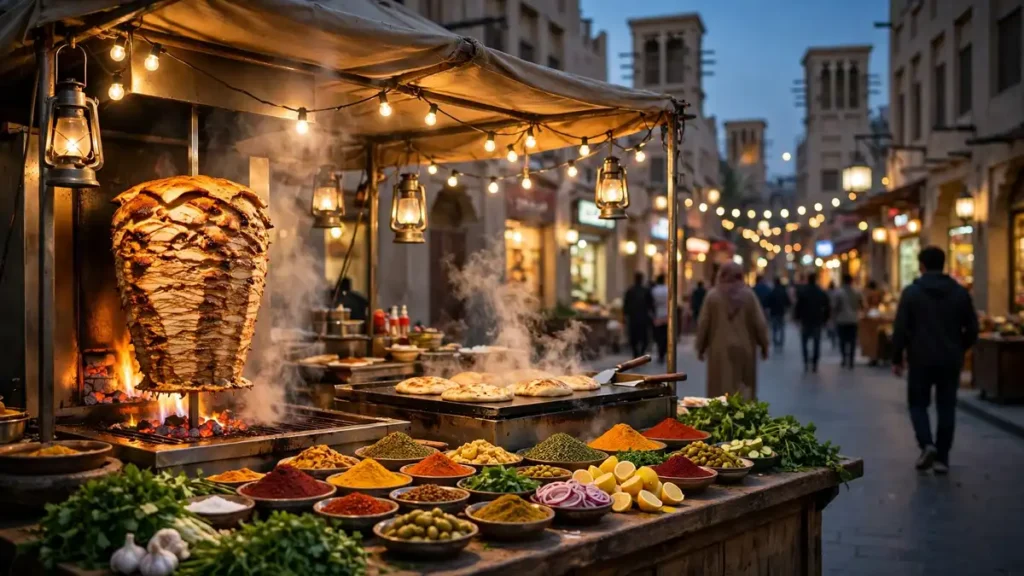
Shawarma is the dish that defines Dubai street food. Chicken or meat turns slowly on a vertical spit, and the cook shaves thin slices to order. The meat goes into flatbread with garlic sauce, pickles, and chilli. In addition, some shops add fries inside the wrap. As a result, the dish is hot, salty, and deeply satisfying.
A chicken shawarma usually costs around Dh9 to Dh18, depending on the shop and the size. In general, meat shawarma costs a little more. The best-known spot is Al Mallah on 2nd December Street in Satwa, a local favourite since 1979. Its chicken shawarma costs around Dh9, and the pavement seating fills up after dark. Ashwaq Cafeteria near the Gold Souk in Deira is another busy choice. Our full guide to shawarma in Dubai covers the dish in more depth.
Order it spicy with extra garlic sauce and pickles if you like heat. Eat it straight away, while the bread is still warm. A shawarma is street food, so do not expect a plate or a knife and fork. The wrap is the whole point.
What Is Karak Chai and Why Does Everyone Drink It?
Karak chai is the drink that runs Dubai. Black tea boils hard with milk, cardamom, and sugar, and many shops add saffron or ginger. The result is strong, sweet, and orange in colour. For example, taxi drivers drink it between fares. Meanwhile, office workers drink it at 4pm. Finally, families drink it after dinner.
A small cup usually costs around Dh1 to Dh5 from a roadside cafeteria. Filli Cafe, which started in Al Qusais, made its saffron karak famous across the city, and a cup there costs around Dh8 to Dh10. Project Chaiwala in Satwa serves a sit-down version for around Dh8 to Dh15. In contrast, Al Farwania in Umm Suqeim has sold karak for Dh1 for decades.
Karak is also the cheapest way to start a morning in Dubai. Pair it with a cheese manakish from a bakery, and you have a full breakfast for under Dh10. In short, that is the breakfast that many residents eat every day.
What Is Manakish and When Should You Eat It?
Manakish is a flatbread baked with a topping, and it is the breakfast of the Levant. The classic version uses zaatar, a herb and spice mix, with olive oil. Cheese manakish uses white cheese, often akkawi. Labneh, minced meat, and egg are also common. Meanwhile, bakers stretch the dough by hand and bake it in a stone oven.
A manakish usually costs around Dh4 to Dh17, depending on the topping. In general, zaatar is the cheapest, and cheese costs a little more. Neighbourhood bakeries in Satwa and Karama bake them from early morning, and they taste best hot from the oven.
Manakish works at any time of day, but it shines as breakfast. Buy one with a karak, find a bench, and eat it while it is still warm. Overall, the bread is crisp at the edges and soft in the middle, and the topping is simple and fresh.
What Is Falafel and Where Is It Best?
Falafel is the vegetarian hero of Dubai street food. Chickpeas or fava beans mix with herbs and spices, then fry into crisp golden balls. Then shops serve them in flatbread with tahini, tomato, pickles, and salad. Overall, the wrap is light, cheap, and filling.
A falafel wrap usually costs around Dh5 to Dh10 from a street cafeteria. Parisian Cafeteria in Meena Bazaar sells a falafel sandwich for around Dh3.50, with falafel at Dh1 each. In addition, Sultan Dubai Falafel in Satwa has a loyal following for its Egyptian-style version. However, polished chains such as Operation Falafel charge more, with wraps usually around Dh22 to Dh30.
Falafel also pairs well with hummus, and the two dishes share the same Levantine roots. If you want to try hummus at home after your trip, our hummus recipe shows how simple it is to make. On the street, though, order the wrap and eat it fresh.
What Are Luqaimat and Regag?
Luqaimat are small golden dough balls, fried crisp and soaked in date syrup. They are the signature sweet of Emirati food, and almost every visitor ends up trying them. A box usually costs around Dh15 to Dh35, depending on where you buy it. At Global Village, a portion costs Dh35, according to Gulf News reporting on Season 31.
Regag is a thin crisp bread, cooked on a hot plate and often filled with cheese, egg, or honey. In fact, it is a traditional Emirati snack, and it appears at heritage stalls, winter markets, and Global Village. A piece usually costs around Dh5 to Dh17.
Both dishes connect to the wider story of Emirati cooking. Our guide to the national dish of the UAE explains how luqaimat, machboos, and harees fit together. Dates also play a part, since date syrup gives luqaimat its sweetness, and the benefits of dates go far beyond dessert.
What South Asian Snacks Should You Try?
South Asian food is the second backbone of Dubai street food. Samosas fry fresh in Meena Bazaar, where some tea shops sell two for Dh1. Meanwhile, chaat stalls serve pani puri, bhel puri, and aloo tikki with tamarind and yoghurt. Finally, dosa counters in Karama pour thin crisp pancakes with chutney and sambar.
Karama is the best area for this food, and Meena Bazaar in Bur Dubai runs close behind. For example, Saravanaa Bhavan serves a South Indian thali for around Dh30, and the street stalls around it sell snacks for a few dirhams each. Similarly, Calicut Paragon in Karama is famous for Malabar biryani and Keralan fish curry, with mains usually around Dh30 to Dh55.
If you love biryani, the street version is a full meal in itself, and our biryani recipe lets you cook a version at home. For sit-down South Asian meals, our guide to the best Indian restaurants in Dubai covers the top choices across the city.
Where Is the Best Street Food in Dubai?
The best street food in Dubai lives in the older neighbourhoods, not in the malls. Deira, Bur Dubai, Karama, and Satwa hold most of it, and each area has its own character. Use the Metro to reach them, then walk and follow the crowds.
Why Is Karama the Street Food Capital?
Karama is a dense residential neighbourhood packed with shawarma shops, manakish bakeries, falafel counters, karak stalls, and juice bars. South Asian, Levantine, and Filipino food sit side by side on the same streets. Overall, you can eat a full meal here for around Dh25 to Dh50 per person.
Start at the main streets in the early evening, when the shutters go up and the grills light. Try a shawarma, then a dosa, then a karak. In addition, the area is easy to reach by Metro. The food sits in a small area, so you can cover a lot on foot.
What Can You Eat in Deira After Dark?
Deira comes alive after dark. The streets around the Gold Souk, the textile souk, and Naif fill with samosa fryers, karak shops, and grill restaurants. Many places stay open until 2am or later. As a result, the area draws workers and families from across the city.
Aroos Damascus on Al Muraqqabat is a Syrian institution, with grills and shawarma for around Dh40 to Dh60 per person. In addition, Al Safadi runs popular Lebanese grills in the area. Beirut Restaurant on Al Rigga serves big plates, with a shawarma platter for around Dh30. Finally, for a cheaper night, the cafeterias near the souks sell shawarma and falafel for under Dh15.
What Makes Satwa Special for Late Night Food?
Satwa is the late-night heart of Dubai street food. The 2nd December Street strip, once called Al Dhiyafah Road, is lined with cafeterias that stay open until 2am or later. Meanwhile, Al Mallah anchors the strip, and the smaller shops around it serve falafel, juices, and grills through the night.
Ravi Restaurant is the other Satwa legend. The Pakistani institution serves daal, chicken handi, and naan, with a full meal for around Dh30 to Dh40. So come hungry, pay cash, and do not judge a place by its plastic chairs. The food is the point.
What Will You Find in Bur Dubai and Meena Bazaar?
Bur Dubai holds the oldest street food in the city. Meena Bazaar is a knot of lanes with mithai shops, dosa counters, and curry houses that have fed the community for decades. Samosa fryers and sugarcane presses take over the lanes in the late afternoon, and the area peaks between 4pm and 8pm.
Al Ustad Special Kebab near Meena Bazaar has served the same charcoal-grilled kebab recipe since 1978. Similarly, Sind Punjab has served North Indian classics for 47 years. Parisian Cafeteria fries falafel and samosas a few streets away. Overall, the area rewards slow walking and a willingness to try small stalls.
What About Global Village in Winter?
Global Village is the seasonal capital of Dubai street food. Season 31 opened on 14 October 2026 and runs until May 2027. It has more than 250 food outlets across 29 pavilions. Entry costs Dh25 on weekdays and Dh30 on Fridays and Saturdays, according to Gulf News.
The Floating Market sits beside the water and serves Asian street food, seafood, and quick bites. Dishes there usually cost around Dh25 to Dh50. For example, a chicken bun costs Dh25, dumplings cost around Dh40, and butterfly shrimp costs Dh50, according to Gulf News reporting on Season 31. In general, a meal with drinks for two usually costs around Dh90 to Dh120.
The Indian Chaat Bazaar serves pani puri and aloo tikki, and Happiness Street has snacks to eat on the go. A lobster roll there cost Dh40 last season, and luqaimat cost Dh35. Prices change between seasons, so check the menu before you order.
How Much Does Street Food Cost in Dubai?
Street food is the cheapest way to eat well in Dubai. The table below shows the usual price range for the main dishes, based on sources checked in November 2026. Prices vary by shop and area, so treat these as a guide, not a fixed menu. Our guide to prices in Dubai for food covers the wider cost of eating across the city.
| Dish | Where to try it | Usual price |
|---|---|---|
| Karak chai | Roadside cafeterias citywide | Dh1 to Dh5 |
| Chicken shawarma | Al Mallah, Satwa | Dh9 to Dh18 |
| Falafel wrap | Meena Bazaar, Satwa | Dh5 to Dh10 |
| Manakish | Neighbourhood bakeries | Dh4 to Dh17 |
| Luqaimat | Global Village, Al Seef | Dh15 to Dh35 |
| Regag | Global Village stalls | Dh5 to Dh17 |
| South Indian thali | Saravanaa Bhavan, Karama | Around Dh30 |
| Floating Market dishes | Global Village | Dh25 to Dh50 |
A good rule is to budget Dh25 to Dh50 per person for a full street food evening. For example, that buys a shawarma, a snack, a karak, and a sweet. In fact, if you stick to cafeterias in Karama or Deira, you can eat well for even less. Cash helps, since many small shops prefer it. Bring small notes, because change for large bills is not always easy.
How Can You Eat Street Food Like a Local?
First, follow the queues. A busy cafeteria with a line of taxi drivers is almost always a good sign. Second, eat where the food is cooked in front of you. In fact, fresh bread from the oven and meat shaved to order taste far better than food that has sat under a lamp.
Third, order in small amounts and graze. Street food works best as a walk, not a single meal. Try one dish at one shop, then move on. As a result, you can taste five dishes in one evening without feeling full after the first stop.
Fourth, keep it simple. The best street food has few ingredients and no fuss. For example, a shawarma needs meat, bread, garlic sauce, and pickles. Similarly, a karak needs tea, milk, cardamom, and sugar. Overall, if a menu has fifty dishes, the shop is probably not great at any of them.
Finally, balance the rich food with lighter days. Street food is delicious, but it is also salty, fried, and sweet. Our guide to a balanced diet has practical tips for keeping your everyday eating on track while you enjoy the good stuff.
What About Food Safety and Dietary Needs?
Dubai has strict food safety rules, and licensed cafeterias follow them. Still, a few habits help. Eat at busy places with high turnover, since food there is cooked fresh all day. Also, drink bottled water, and skip ice from a stall you do not trust. Wash your hands before you eat, since street food is finger food.
Vegetarians eat very well in Dubai. Falafel, hummus, manakish, dosa, chaat, and samosas are all meat-free, and South Indian restaurants serve full vegetarian thalis. Vegans should ask about ghee and dairy, since both appear in many dishes. Halal food is the norm across the city, so that is one thing you do not need to check.
If you have an allergy, say so clearly and simply. Nut and sesame allergies matter here, since tahini and sesame appear in many dishes. Finally, carry a card with your allergy written in English and Arabic if it is severe.
| Area | What it is known for | Budget per person |
|---|---|---|
| Karama | Shawarma, dosa, chaat, karak | Dh25 to Dh50 |
| Deira | Night markets, grills, samosas | Dh25 to Dh50 |
| Satwa | Late-night shawarma, Pakistani grills | Dh25 to Dh60 |
| Bur Dubai and Meena Bazaar | Indian snacks, kebabs, falafel | Dh20 to Dh50 |
| Global Village | World street food, sweets | Dh60 to Dh120 |
What Are the Most Asked Questions About Street Food in Dubai?
Is Street Food in Dubai Safe to Eat?
Yes, street food in Dubai is generally safe. In fact, licensed cafeterias follow strict food safety rules, and the busiest places cook fresh food all day. Also, eat at busy shops, drink bottled water, and choose food cooked in front of you.
How Much Money Do You Need for Street Food in Dubai?
Budget Dh25 to Dh50 per person for a full evening of street food. For example, a shawarma costs around Dh9 to Dh18, a karak costs around Dh1 to Dh5, and a falafel wrap costs around Dh5 to Dh10. In addition, cash in small notes helps at small shops.
Where Is the Best Area for Street Food in Dubai?
Karama is the best all-round area, with shawarma, dosa, chaat, and karak on the same streets. Meanwhile, Deira is best after dark, Satwa is best late at night, and Bur Dubai is best for Indian snacks and old-style kebabs.
What Is the Most Famous Street Food in Dubai?
Shawarma is the most famous street food in Dubai, followed closely by karak chai. In fact, both are cheap, easy to find, and loved by residents. Finally, luqaimat is the most famous sweet, and manakish is the classic breakfast.
Can Vegetarians Eat Street Food in Dubai?
Yes, vegetarians have plenty of choice. Falafel, hummus, manakish, dosa, chaat, samosas, and South Indian thalis are all meat-free. In addition, many cafeterias in Karama and Meena Bazaar serve full vegetarian meals.
When Is the Best Time to Try Street Food in Dubai?
Evenings are the best time, from around 6pm onwards. First, the grills light up, the night markets open, and the streets fill with people. In fact, winter is the best season, when Global Village is open and outdoor eating is comfortable. Finally, many cafeterias stay open until 2am or later.
What Is the Best Way to Plan Your First Street Food Evening?
Start in Karama in the early evening. Eat a shawarma, then a dosa, then a karak. Walk to a bakery for a manakish, and finish with luqaimat. Overall, the whole evening should cost less than Dh50 per person, and you will have tasted the main flavours of the city.
On your next outing, try Deira after dark or Satwa after midnight. Finally, in winter, add a night at Global Village. In short, Dubai street food rewards curiosity, and the best meals often come from the smallest shops. So go hungry, bring cash, and follow the crowds.