If you drive in Dubai, one date matters more than almost any other on your calendar: the expiry date on your Mulkiya. That small card is your vehicle registration, and every year it needs renewing. Miss the date and life gets expensive fast, with late fees, a blocked traffic file and a heavy fine if you are caught driving on expired papers. The good news is that renewing your car registration in Dubai is one of the simplest government jobs you will ever do. For most drivers it takes a few minutes online, and you never have to visit a counter at all. This guide walks you through the whole process as it works in late 2026, from the documents and fees to the grace period, the technical test and what to do when something goes wrong.
You will find the exact steps for renewing online and in person, the costs you should expect, and the mistakes that catch people out every year. All fees in this guide are approximate, because the RTA updates its charges from time to time, so always confirm the final figure in the RTA Dubai app or on the RTA website before you pay. The rules quoted here were checked against RTA service pages and reputable UAE guides in November 2026.
What Is Car Registration Renewal in Dubai?
Car registration renewal is the yearly process of extending your Mulkiya, the vehicle ownership certificate issued by the Roads and Transport Authority, the RTA. In everyday conversation everyone calls it the Mulkiya, while the RTA calls the service Renew and Amend Vehicle Data Ownership. Whatever name you use, it is the same job: proving that your car is insured, roadworthy and free of unpaid fines, and paying the renewal fee so your registration stays valid for another year.
A Dubai registration lasts for a maximum of 12 months. When you renew, the RTA checks three things automatically: your insurance is valid, your car has passed its technical inspection if one is needed, and every traffic fine on the vehicle has been paid. If all three are clear, the renewal goes through instantly and you receive a digital Mulkiya, an electronic card sent by email and SMS that also lives in the RTA Dubai app and can be added to Apple Wallet or Samsung Wallet. You do not need a paper card any more, although you can still order a printed one if you prefer it.
Renewal is not the same as registration. Registration is the first time a car gets plates and a Mulkiya, usually handled by the dealer when you buy a new car or at a testing centre when you buy a used one. Renewal is the annual repeat of that paperwork, and it is far simpler, because the RTA already holds your car and your details in its system.
When Do You Need to Renew Your Car Registration?
Your registration expires on the date printed on your Mulkiya, and the same date shows in the RTA Dubai app. The RTA allows you to renew well before that date, up to 150 days early according to its own service guidance, so there is no reason to leave it to the last day. There is one catch worth knowing: when you renew before expiry, the new 12 months are calculated from the date you apply, not from the old expiry date. Renew three months early and you effectively give away three months you already paid for, so the smart move for most drivers is to renew inside the last month, when everything is fresh and you lose almost nothing.
Set a reminder for two weeks before expiry. That gives you time to sort out insurance, book a test if your car needs one, and clear any fines without rushing. If you travel often, renew before a long trip rather than trusting yourself to remember it from abroad, because an expired registration while you are away still gathers late fees.
If your car is brand new, there is another reason to renew on time. New cars skip the technical test for their first three years, but the RTA says the exemption only holds when you renew before the expiry date. Renew a new car late and you may find yourself booking a test you could have avoided, so the calendar reminder pays for itself twice over.
What Do You Need Before You Renew Your Car Registration?
Online renewal needs no paper documents, because the RTA checks everything electronically against your traffic file. Even so, have these ready before you start, because each one can block the renewal if it is missing or out of date.
- Your Emirates ID and a way to sign in. Use UAE Pass, your RTA account, or your Emirates ID, driving licence or plate number to log in on the RTA website or in the RTA Dubai app.
- Your traffic file number or plate number. This is how the system finds your vehicle, so keep it handy.
- Valid car insurance. Your policy must be active and linked electronically to your car, and it must stay valid for at least six months from the renewal date.
- A passed technical test, if your car needs one. The result links to your traffic file automatically, so you do not upload anything yourself.
- Zero unpaid fines. Every traffic fine and every unpaid Salik toll on the vehicle must be settled first.
- Your current Mulkiya. You need the expiry date from it, and you will need it at a testing centre if you renew in person.
If any of these is not ready, fix that item first. The renewal screen will simply refuse to move forward until the system shows everything as clear, and there is no way around it.
Do You Need Car Insurance Before You Renew Your Car Registration?
Yes, and this is the step that trips up the most people. The RTA will not renew a registration without valid motor insurance, and the policy must stay valid for at least six months at the moment you renew, including the 30-day grace period. If your insurance expires on the same week as your registration, renew the insurance first and give your insurer a day for the new policy to appear in the RTA system.
Both third-party and comprehensive insurance satisfy the RTA, so the choice is about how much protection you want rather than about compliance. Comprehensive cover makes sense for a newer or financed car, while third-party cover is the legal minimum for an older car you would not repair after a serious accident. Either way, check that the policy details match your car exactly, because a mismatch in the plate number or chassis number will hold up the renewal until it is corrected.
Does Your Car Need a Technical Test Before Renewal?
It depends on the age of your car. Cars in their first three years are exempt from testing, provided the car was bought new from an authorised dealer, has no mileage history and is still with its first owner. The three years count from the year of manufacture or the year of registration, whichever comes first. Once the car passes its third birthday, it needs a technical inspection every year before the registration will renew.
There are two exceptions to the exemption. Every change of ownership needs a test, whatever the age of the car, so if you have just bought a nearly new used car you will still visit a testing centre. If you are planning that purchase, our guide on how to buy a used car in Dubai explains the transfer process step by step. Motorcycles always need a test at renewal, even when new.
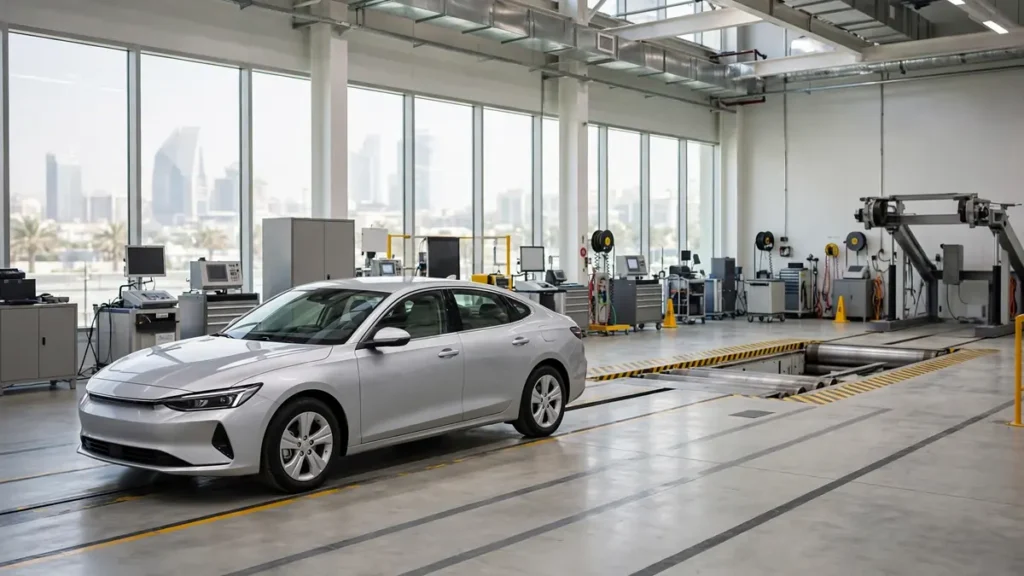
The test itself takes around half an hour at an RTA-approved centre such as Tasjeel, Shamil or Wasel, and booking an appointment has been mandatory at Dubai testing centres since June 2025. Book through the RTA Dubai app or the RTA website, and arrive with your Emirates ID, your current Mulkiya and your insurance details. The inspectors check brakes, lights, tyres, emissions, the chassis and the body, and the passing certificate they issue is valid for 30 days, so finish your renewal inside that window or you will be testing twice. Keeping up with routine car maintenance through the year is the simplest way to walk in confident, because most failures are small things that a regular service would have caught.
How Do You Renew Your Car Registration Online?
Online renewal is the fastest option, and it is the one most Dubai drivers use. If your car does not need a test, or the test is already passed and in the system, the whole job takes a few minutes. Follow these steps in order.
- Clear your fines first. Open the RTA Dubai app or the Dubai Police channels and check for outstanding fines on the vehicle, including Salik. Pay everything, because the renewal will not complete while a single fine is open.
- Check your insurance. Make sure the policy is active, covers at least the next six months, and matches your car details in the RTA system.
- Pass the test, if your car needs one. Book a slot, visit the centre, and wait for the pass result to link to your traffic file.
- Sign in to the RTA website or the RTA Dubai app. Log in with UAE Pass, your RTA account, or your Emirates ID, driving licence or plate number.
- Select your vehicle. Choose the car due for renewal from your list of vehicles.
- Choose the renewal service. Select Renew and Amend Vehicle Data Ownership from the vehicle licensing services, and let the RTA verify your insurance and test result automatically.
- Pay the fees by card. The app shows the exact total before you pay, so check it against the approximate figures in this guide.
- Receive your new Mulkiya. The digital ownership certificate arrives by SMS and email, and you can add it to Apple Wallet or view it in the RTA Dubai app straight away.
You can also renew through the Dubai Now app, the Mahboub chatbot on the RTA website, or a self-service machine. The steps are the same on every channel, because they all talk to the same RTA system. If the app shows an error, read it carefully before trying again: it is usually telling you exactly which item is blocking you, whether that is a fine, an insurance gap or a missing test.
How Do You Renew Your Car Registration at a Testing Centre?
If your car needs a test, renewing at the testing centre is often the easiest route, because you finish everything in one visit. Book your test slot in the RTA Dubai app or on the RTA website first, since walk-in slots are limited and can cost extra at centres that still accept them.
Drive to the centre with your Emirates ID, your current Mulkiya and your insurance details. The car goes through the inspection lane, and if it passes, the result links to your traffic file immediately. You can then complete the renewal at the same centre, pay the fees, and walk out with the job done. If you would rather renew online afterwards, that works too, because the pass result is already in the system and the online renewal will go straight through.
Customer happiness centres also handle renewals in person for drivers who prefer face-to-face service, and they are the right place to go if your case is unusual, for example if your car is registered under a company, carries consulate plates, or needs a mortgage amendment. Bring the same documents, and expect the same checks on fines, insurance and testing.
How Much Does It Cost to Renew Car Registration in Dubai?
Fees depend on the type of vehicle, and every figure below is approximate. The RTA publishes its fee schedule, but charges can change, so treat these numbers as a budgeting guide and confirm the exact total in the RTA Dubai app before you pay.
For a private light vehicle, the renewal fee is around AED 350, plus around AED 20 in Knowledge and Innovation fees, making a total of roughly AED 370. Motorcycles cost less, at around AED 200 plus the same AED 20 in fees, while heavier vehicles cost more, rising to around AED 400 for a private vehicle between 3 and 12 tonnes and around AED 800 or more above that weight. Company and public vehicles follow their own fee bands, so check the RTA schedule for your exact category.
If your car needs a technical test, add around AED 150 for the test plus AED 20 in fees, a total of roughly AED 170. That means a typical renewal for a car older than three years costs about AED 540 all in, before insurance and before any fines. If the car fails the test, a re-test usually costs around AED 50 for a light vehicle, although the exact figure can vary by centre, so confirm it when you book. Delivery of a physical Mulkiya card is optional and costs roughly AED 20 to AED 50 depending on the speed you choose, while the digital card costs nothing.
Insurance is a separate cost and is not included in any of these figures, and neither are unpaid fines, which must be settled in full before the renewal can complete. Budget for the renewal fee, the test if one is due, and your insurance premium together, and you will not be surprised at the payment screen.
What Happens If You Renew Your Car Registration Late?
Life gets busy, and plenty of drivers miss their renewal date. The consequences build in stages, so it is worth knowing exactly where you stand at each point.
What Is the 30-Day Grace Period for Car Registration Renewal?
After your Mulkiya expires, the RTA gives you a 30-day grace period to renew without late fees. The grace period is confirmed in the RTA service rules and in current UAE guides, so you can rely on the 30 days, but do not misunderstand what it means. The grace period is a window to renew, not a free month of driving. Driving with an expired registration is still a traffic offence even inside the grace period, and if police stop you, you can still be fined. Use the 30 days to get the renewal done, not as an excuse to put it off.
Your insurance must stay valid across the grace period too, which is one reason the RTA asks for at least six months of cover at renewal. If your insurance lapses while your registration is expired, you are driving uninsured as well as unregistered, and that is a far worse position to be in after an accident.
What Happens After the Grace Period Ends?
Once the 30 days are over, late fees start to build. The RTA adds a monthly late fee of roughly AED 20 to AED 35 depending on the vehicle type, and the exact figure is shown in the RTA app when you renew, so check it there rather than guessing. The amount is small at first, but it keeps growing every month you wait.
Two months after expiry, the RTA blocks your traffic file and notifies you by SMS. A blocked file stops almost every other RTA transaction until you fix it, so you cannot renew a licence, transfer a vehicle or complete other services while the block is in place. The only way to clear it is to renew the registration and settle everything the system asks for.
The real cost, though, is being caught driving. Under the federal traffic rules, driving with an expired registration carries a fine of AED 500 and 4 black points, and Dubai Police can impound the vehicle for 7 days. Dubai Police confirmed these penalties in a statement in November 2026, and the impoundment can extend further if the registration has been expired for more than three months. The UAE traffic rules for 2027 set out how these penalties fit into the wider system, and they are a reminder that the renewal fee is always cheaper than the fine. Keep an eye on the new speed limits in Dubai at the same time, because fines stack up quickly when more than one rule is broken on the same drive.
What Happens If Your Car Fails the Technical Test?
A failed test is common, and it is not the end of the process. You receive a fail report that lists every fault by area, so photograph it and keep the paper copy for the re-test. The usual failures are the ones drivers overlook: tyres that are worn or older than five years from their date of manufacture, brakes that pull to one side, lights that do not work, a cracked windscreen in the driver line of sight, and window tint darker than the legal limit. Tyre age catches the most people, because a tyre with plenty of tread can still fail if it is more than five years old.
Fix every item on the report, not just the easy ones, because fixing one fault and ignoring another usually means a second fail. Ask the workshop to quote the full list in writing before the work starts, so there are no surprises on the bill. Most minor faults, like a blown bulb or a worn wiper, can be fixed in under an hour at a garage near the test centre.
Then return to the same centre for a re-test. The re-test for a light vehicle usually costs around AED 50, and you generally have about 30 days to return at the re-test price, so do not sit on the fail report. Confirm the window printed on your report, because returning late can mean paying for a full test again. If the car fails on something serious, like chassis damage, the centre may flag it for an engineering report and RTA approval before it can be registered again, but that is rare and usually involves cars that have been in serious accidents or badly repaired.
Can You Renew Your Car Registration If You Have Unpaid Fines?
No, and this is the single most common reason renewals fail. The RTA will not complete a renewal while any traffic fine is unpaid on the vehicle, and that includes fines from other emirates and unpaid Salik tolls, which are linked to your traffic file number. The renewal screen will simply refuse to advance until the balance is zero.
Check your fines before you start the renewal, not during it. You can check RTA fines by plate number in a few minutes, and the same check will show Salik violations. If you use the toll roads every day, read our Salik toll gates guide for Dubai so you know which gates you pass and how the charges work. Pay everything you owe, give the system a short while to update, and then start the renewal. If a fine you have already paid still shows as open, keep the payment receipt and contact the RTA or Dubai Police with it, because a stuck fine is usually fixed quickly once you can prove payment.
Can You Renew Your Car Registration While Your Car Is Under Finance?
Yes, you can renew normally while your car is under a bank loan, and most financed cars are renewed every year without any trouble. When a bank finances your car, it keeps a legal claim on it called a mortgage, and the bank name shows on your Mulkiya. That claim does not stop you driving the car or renewing it. You still need valid insurance, cleared fines and a passed test if your car is more than three years old, exactly like any other owner.
Insurance is where financed cars are different. Banks usually require comprehensive cover for the full loan term, because the car is the security for their money, and the policy needs a mortgagee clause, a note on the policy that protects the lender if the car is badly damaged or stolen. Check with your insurer that the clause names your bank correctly, because a missing or wrongly worded clause can hold up the renewal.
There is one exception to watch for. If your loan payments are overdue and the bank has placed a flag on the vehicle, the RTA system may stop your renewal until the bank clears it. If that happens, call your bank first, bring the payments up to date, and then try again. When you finally pay off the loan, the bank must release the mortgage, and in Dubai this is done electronically between the bank and the RTA, so ask your bank to confirm the release and check that the bank name has been removed from your Mulkiya.
How Do You Get Your New Mulkiya After Renewal?
Once you pay, the RTA issues your new Mulkiya straight away. The service time is listed as instantly, and in practice the digital ownership certificate arrives by SMS and email within minutes. It appears in the RTA Dubai app under your documents, and you can add it to Apple Wallet or Samsung Wallet so it is always on your phone at the roadside.
If you want a physical card, you can order one for delivery at roughly AED 20 to AED 50 depending on the speed, or print it through the RTA Document Validation service on the RTA website. The digital card is fully recognised by the authorities, so a printed copy is a personal preference rather than a legal need. Keep a screenshot of the digital card on your phone as a backup, and check that the new expiry date, the plate number and the insurance details on it are all correct before you drive away.
How Can You Avoid Renewal Problems Next Year?
Renewal is easy when it is planned and painful when it is not, so build a small routine around it. Put two reminders in your phone, one a month before expiry and one a week before, and renew in that last month so you keep the full value of the new year. Renew your insurance in the same week, and check that the new policy runs for at least a year so it comfortably covers the six-month rule.
If your car is more than three years old, book the test early in the final month, and give the car a quick check before you go: lights, tyres, wipers, horn and dashboard warning lights. A ten-minute check at home saves a failed test and a second trip to the centre. Keep your fines clear through the year by checking them every month or two, rather than discovering a forgotten fine on renewal day.
If your household runs more than one car, keep a simple calendar with every expiry date on it, and renew each car in its own final month. Households with several vehicles should also keep an eye on the postponed five-vehicle limit for UAE households, so a future rule change never catches you by surprise. A little planning once a year is all it takes to make renewal a ten-minute job instead of a stressful one.
Frequently Asked Questions About Renewing Car Registration in Dubai?
How long does it take to renew car registration in Dubai?
Online renewal takes a few minutes once your fines, insurance and test are all clear, and the RTA lists the service time as instantly. The digital Mulkiya arrives by SMS and email within minutes of payment. If your car needs a test, allow an extra hour for the visit to the testing centre, including the drive there and the wait for your slot.
Can I renew my car registration before it expires?
Yes, the RTA allows renewal up to 150 days before expiry, so you can renew early if you are travelling or want the job done. Remember that the new 12 months run from the date you apply, not from the old expiry date, so renewing in the final month is usually the best value.
Do I need a vehicle test every year?
Only if your car is more than three years old. New cars bought from an authorised dealer are exempt for their first three years, as long as the car is still with its first owner. Every change of ownership needs a test whatever the age of the car, and motorcycles always need a test at renewal.
What happens if I drive with an expired registration?
You risk a fine of AED 500, 4 black points on your licence, and your vehicle being impounded for 7 days. Dubai Police confirmed these penalties in November 2026. The 30-day grace period only lets you renew without late fees, so it does not make driving on expired papers legal.
Can I renew online if my car needs a test?
Yes, but you must pass the test first. Book a slot at an approved centre such as Tasjeel or Shamil, pass the inspection, and the result links to your traffic file automatically. Once it is in the system, the online renewal on the RTA website or in the RTA Dubai app will go straight through.
What should I do if I am outside the UAE when my registration expires?
Renew before you travel if you can, because that is the simplest option. If your car is already abroad, the RTA accepts a ratified inspection certificate from the country where the car is, so check the RTA service page for the exact documents it asks for. Keep your insurance valid while you are away, and renew as soon as you return, because late fees still apply during the time you are gone.
Explore more guides on Gulf Lights UAE.