What happened to the tankers near the UAE coast?
Today is Friday 13 November 2026. The Strait of Hormuz is back at the centre of world news for the second day in a row. Since Monday 10 November, projectiles and explosions have struck several oil tankers in and around the narrow waterway. In fact, one attack happened in waters off the UAE coast near Ras Al Khaimah. The UAE Coast Guard brought all 22 crew members of a burning tanker to safety. Finally, every person on board survived. Above all, the minister who reported the rescue said the crew suffered no injuries.
Still, the full picture is far from clear. Different sides describe the events in different ways. However, no one has produced proof of who fired the projectiles. In short, this article brings together everything confirmed so far. It also separates fact from claim. It also explains what the attacks mean for people living in the UAE. In particular, every fact below comes from a source checked on 13 November 2026. Similarly, every claim carries the name of the source that made it.
Which tankers were hit and when did it happen?
Three separate incidents involving named tankers have been reported since Monday 10 November 2026. Iran has also claimed that four tankers in total were hit. That claim gets its own section below. The table gives the week at a glance.
| Date | Tanker | What happened | Source |
|---|---|---|---|
| Monday 10 November 2026 | Liberia-flagged tanker, name not given | A projectile struck the tanker in the Arabian Gulf. Six Indian seafarers served on board. | Khaleej Times |
| Wednesday 11 November 2026 | MT DOMINICA PROSPERITY, Liberia-flagged crude oil tanker | A projectile struck the tanker off Mina Saqr. The site sits about 14 nautical miles northwest of Ras Al Khaimah. Fire broke out in the engine room. | UKMTO Warning 204-26 and the Indian shipping minister |
| Wednesday 11 November 2026 | NCC FAJR, Saudi-flagged tanker | The tanker faced a possible attack in the Strait of Hormuz. All three Indian seafarers on board stayed safe. | The Indian shipping minister |
| Wednesday 11 November 2026 | Two supertankers, names not given | Iran said explosions disabled the two tankers. The tankers had ignored warnings about an unauthorised route. | Iran’s Revolutionary Guards Navy, claim only |
| Thursday 12 November 2026, afternoon | Two tankers, names not given | Iran said the two tankers hit mines. The mines sat in the eastern Strait of Hormuz. | Iran’s army, claim only |
What happened on Wednesday 11 November?
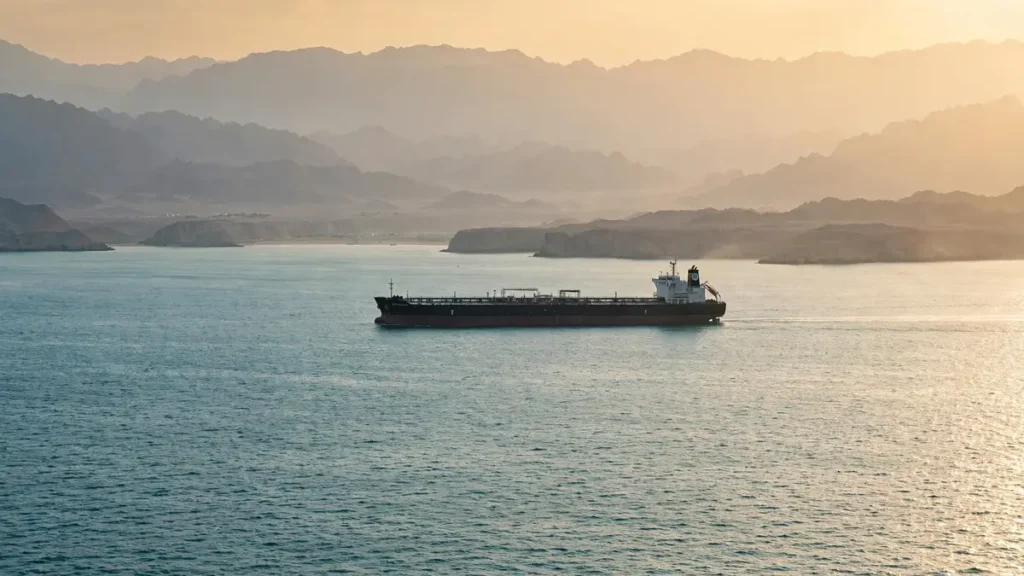
First, Wednesday brought the most serious incident of the week. The Liberia-flagged crude oil tanker MT DOMINICA PROSPERITY drifted off Mina Saqr. In fact, the site sits about 14 nautical miles northwest of Ras Al Khaimah. Then a projectile struck the vessel. As a result, fire broke out in the engine room. The crew of 22 faced a dangerous situation at sea. Meanwhile, UKMTO, the United Kingdom Maritime Trade Operations centre, recorded the incident in Warning 204-26. The warning went out at 1800 UTC on 11 November. It described the projectile as unidentified.
In the meantime, India’s Minister for Ports, Shipping and Waterways gave the fullest public account of the rescue. His name is Sarbananda Sonowal. He spoke on Thursday 12 November. In his account, the UAE Coast Guard evacuated all 22 crew members from the tanker. The group included 19 Indian nationals. Indeed, he reported no injuries among them. Khaleej Times reported the minister’s account on 12 November at 16:06 GST. At the same time, the paper noted openly that no UAE confirmation was immediately available. For that reason, the rescue details rest on the minister’s statement and the UKMTO warning. Until then, readers should treat them as reported, not as officially confirmed by the UAE.
On the same day, the Saudi-flagged tanker NCC FAJR faced a possible attack. The incident happened while the vessel crossed the Strait of Hormuz. Meanwhile, the same ministerial statement covered this incident too. It said all three Indian seafarers on board stayed safe. The wording matters here. However, officials called it a possible attack, not a confirmed strike. No damage report has appeared for this vessel so far.
What happened on Monday 10 November?
The week started with an earlier incident. Still, it received less attention at the time. On Monday 10 November, a projectile struck a Liberia-flagged tanker in the Arabian Gulf. Six Indian seafarers served on board. Meanwhile, Khaleej Times reported the incident in its coverage of the shipping attacks. The same ministerial statement later confirmed the number of Indian seafarers on board. However, no source checked today has published an injury report for this vessel. This article makes no claim about the crew, because the public record stays silent on that point.
What do we know about the crew on board?
The human side of the story has a better outcome than many feared. All 22 crew members of MT DOMINICA PROSPERITY reached safety. Next, the UAE Coast Guard evacuated them from the burning tanker. Nineteen of them were Indian nationals. Indeed, the Indian shipping minister reported no injuries among the group. In fact, an engine-room fire on a crude oil tanker can turn deadly within minutes. On top of that, a fast rescue in open water takes real skill, and this one worked.
On NCC FAJR, the picture is also reassuring. Meanwhile, the minister said all three Indian seafarers on board stayed safe through the possible attack on Wednesday. Many of these seafarers serve on tankers that cross the Gulf. The three incidents together involved 28 Indian crew members in total.
Still, the crew story is not complete. The six Indian seafarers on the tanker hit on Monday have no published injury report in the sources checked today. However, that gap does not mean anyone was hurt. Nor does it mean everyone was safe. In short, it means the public record is silent on that point. This article will not fill the silence with a guess.
What has Iran said about the attacks?
Iran’s military has given its own account of the week. In fact, it claims a larger number of tankers than the named incidents cover. Then, on Thursday 12 November, Iran’s military said explosions had hit four oil tankers in the Strait of Hormuz. Indeed, the claim came in two parts. Two different branches of the armed forces made them, so each part needs reading on its own terms.
First, the Revolutionary Guards Navy said explosions disabled two supertankers on Wednesday 11 November. The Guards said the tankers had ignored warnings about an unauthorised route. However, no vessel names appeared in the reporting checked today. The Guards also published no proof of the explosions. Second, Iran’s army said two more tankers hit mines on Thursday afternoon. The mines sat in the eastern Strait of Hormuz, according to the army. Similarly, no vessel names and no independent evidence appeared in the reporting checked today.
These are claims, not confirmed facts. Because of that, this article treats them that way. No independent source has verified the four-tanker figure. In contrast, the named incidents reported by UKMTO and the Indian shipping minister cover three tankers, not four. The gap between the two accounts may close when more information appears. It may also stay open. Until independent evidence arrives, the honest position is clear. First, report what Iran said. Second, label it as Iran’s claim. Finally, keep it separate from the incidents that other sources have confirmed.
Similarly, the question of who fired the projectiles stays open for the same reason. UKMTO described the projectile that struck MT DOMINICA PROSPERITY as unidentified. Still, no official body has published evidence that names an attacker. This article makes no claim about who carried out the attacks. In short, the sources checked today do not support one.
What is confirmed and what is still unconfirmed?
Indeed, fast-moving stories like this one mix solid facts with rumour. As a result, the mix can confuse readers in a single day. Because of that, the table below draws a firm line between the two. First, it shows at a glance what rests on solid ground. It also shows what still needs proof.
| Confirmed by the sources checked today | Still unconfirmed or claimed only |
|---|---|
| A projectile struck MT DOMINICA PROSPERITY off Ras Al Khaimah on Wednesday 11 November 2026. Fire broke out in the engine room. | Who fired the projectile that struck the tanker |
| UKMTO recorded the incident as Warning 204-26. The warning went out at 1800 UTC on 11 November 2026. | Whether the NCC FAJR incident caused any damage to the vessel |
| The Coast Guard evacuated all 22 crew members of MT DOMINICA PROSPERITY. The group included 19 Indian nationals. The minister reported no injuries. | The safety of the six Indian seafarers on the tanker hit on Monday 10 November 2026 |
| NCC FAJR faced a possible attack on Wednesday 11 November 2026. Its three Indian seafarers stayed safe. | Iran’s claim that four tankers were hit in total. It covers two supertankers disabled on Wednesday and two tankers that hit mines on Thursday. |
| Attacks hit at least 10 ships in the first 10 days of November 2026. October 2026 saw 37 attacks. | The exact number of attacks in November beyond that count |
| Brent crude settled at around 96 dollars a barrel on Thursday 12 November 2026. | Whether oil prices will keep rising in the days ahead |
Why does the Strait of Hormuz matter so much?
The Strait of Hormuz is a narrow stretch of water between the Arabian Gulf and the Arabian Sea. In fact, it ranks among the most important shipping lanes on the planet. Meanwhile, tankers carrying crude oil from Gulf producers must pass through it. As a result, any threat to safe passage there sends a shock through energy markets within hours. Meanwhile, the UAE sits on the southern shore of the strait. Ras Al Khaimah and the Musandam coast face directly onto its waters. Because of that, an attack near Mina Saqr feels close to home for residents here.
However, geography alone does not explain the current danger. In fact, the strait has become a flashpoint in a wider war. The attacks on tankers form part of that conflict. For residents, the key point is simple. After all, a narrow waterway carries a large share of world oil trade. At the same time, an active war now threatens it. As a result, risk can change quickly there, and each new incident draws global attention.
How did the current round of attacks begin?
First, the war began on 28 February 2026 with Israeli and US strikes on Iran. Khaleej Times gives that date. Since then, attacks on shipping have grown into a steady campaign. They are no longer a series of one-off incidents. In particular, data from the Washington Institute for Near East Policy shows the scale clearly. Attacks hit at least 10 ships in the first 10 days of November 2026. Before that, October 2026 saw 37 attacks.
How have oil prices reacted to the attacks?
Meanwhile, oil traders watched the tanker news closely. As a result, Brent crude moved on the headlines. Brent settled at around 96 dollars a barrel on Thursday 12 November 2026. Then it traded at 95.95 dollars in early Asian hours on Friday 13 November 2026. CNBC TV18 reported both figures. In fact, the price level is high by the standards of recent months. In short, it reflects fear that attacks in the strait could disrupt supply.
At the same time, the market picture is more mixed than a single price suggests. Despite that, Brent stayed on course for a second weekly loss. The broader trend through the week still pointed down, despite the attack news. In particular, traders weigh two forces against each other. Supply fears push prices up. At the same time, worries about demand and diplomacy pull them down. On the diplomatic side, US President Donald Trump said the United States does not need a deal with Iran. As a result, that comment dimmed hopes of a breakthrough, according to CNBC TV18.
What does this mean for people living in the UAE?
For most residents, daily life in the UAE has not changed because of the attacks. Shops are open, for example. Still, the effects sit one step removed. In particular, they show up in fuel prices, flight schedules, and business costs. Instead, they build up over weeks rather than hitting in a single day. Because of that, this section takes each one in turn.
Will petrol prices in the UAE go up because of the attacks?
Officials set the November petrol prices in the UAE earlier in the month, before the incidents. As a result, the attacks this week cannot change what drivers pay at the pump right now. Those prices stay in place until the end of the month. In contrast, December prices are a different matter. Next, officials announce them at the end of November. No December price has appeared yet. Any figure you see online before the official announcement is a guess, not a fact.
In fact, oil at around 96 dollars a barrel does put upward pressure on fuel costs. As a result, that pressure could show up in the December announcement if prices stay high. Still, one week of trading does not decide a monthly price on its own. In particular, the fuel price committee looks at the full month. The attacks form only part of that picture. Because of that, residents who want to plan ahead should wait for the official December announcement at the end of November. Instead, they should not act on rumours.
What does the surge in tanker rates mean for UAE businesses?
The shipping market has reacted far more strongly than the oil price, and the numbers are striking. Meanwhile, The National reported on 12 November 2026 that ADNOC Logistics and Services raised its profit forecast again. It was the fourth rise this year. As a result, the company now expects 4 billion dollars in full-year profit as tanker rates surge. In fact, third-quarter earnings more than quadrupled. At the same time, revenue rose 244 percent to 5.09 billion dollars in the first nine months of the year, up from 1.48 billion dollars a year earlier. On top of that, tankers brought in 4.15 billion dollars, up 249 percent.
In particular, the rates behind those figures show how sharply the market has moved. For example, daily rates for very large crude carriers on the Gulf-to-Asia route reached about 1.4 million dollars in early October 2026. Rates stood at about 30,000 to 45,000 dollars before the war began in February 2026. Bloomberg data cited by The National gives both figures. In plain terms, moving oil through the Gulf now costs many times more than it did before the war. Because of that, ship owners charge a premium for the risk.
However, ADNOC Logistics and Services has not escaped the danger itself. The National reported that projectiles struck some of its owned and chartered vessels while they crossed the Strait of Hormuz after the quarter ended. On Tuesday, the company said an attack in UAE territorial waters damaged one vessel. The company did not identify the ship. It also gave no detail on the extent of the damage. In short, the statement shows that even the largest UAE shipping operator faces the same risk as the rest of the fleet. It also shows how little detail companies release while incidents are still fresh.
Are UAE beaches and coastal areas affected by the attacks?
However, no beach closures or coastal warnings have appeared in connection with this week’s tanker attacks in the sources checked today. That point is worth stating clearly. In fact, an earlier incident did close beaches, and the two events are easy to confuse. In October 2026, the Umm Al Quwain oil spill led the authorities to close beaches. The beaches closed after the October oil spill stayed shut while clean-up teams worked. In contrast, that spill was a separate incident with its own cause. As a result, it has no link to the projectile attacks this week.
Residents who use the coast near Ras Al Khaimah should still stay alert to official notices. Meanwhile, maritime authorities may issue guidance for small boats in the area. In the meantime, the sensible step is to follow notices from the UAE Coast Guard and local authorities. In contrast, social media posts are not a reliable source. Treat any claim about closed beaches as unconfirmed until an official source confirms it.
How are UAE flights affected by the situation?
Meanwhile, air travel has felt the wider conflict more directly than daily life on the ground. The picture has shifted day by day. In fact, Khaleej Times reported on its homepage on 12 November 2026 that Etihad resumed Abu Dhabi to Jeddah flights. Riyadh and Dammam flights stayed cancelled until 19 November. In short, the mix of resumed and cancelled routes shows how airlines adjust route by route. However, they are not stopping all services at once. The mix also shows why travellers need to check the latest status before they head to the airport.
Meanwhile, our coverage has tracked the flydubai and Etihad flight changes in November through the month. The UAE flight updates from 9 November give the earlier picture for the same routes. As a result, they show a pattern of short suspensions and quick restarts. In particular, Saudi routes have seen the most disruption. At the same time, they affect travellers in different ways. Each one needs its own check before travel.
Should travellers change their plans?
In short, most travellers do not need to cancel. Every traveller should still check. Meanwhile, airlines update their schedules as the security picture changes. For example, a route that ran yesterday can face suspension today. The practical steps are simple. First, check your flight status on the airline website on the day of travel. Look at it again before you leave for the airport. Next, keep your booking flexible where the fare allows it. Keep the airline app on your phone so schedule changes reach you fast.
In particular, anyone flying to Saudi Arabia should pay extra attention. Riyadh and Dammam services stayed cancelled until 19 November. In contrast, Jeddah services resumed. For example, if your trip can wait, a short delay may save you a cancelled flight and a rebooking scramble. On the other hand, if your trip cannot wait, speak to the airline first. Finally, confirm the operating status of your exact flight, not just the route in general.
What should residents watch for in the coming days?
The next few days will bring more information, and the story will change as it arrives. Three things deserve your attention. First, watch for an official UAE statement on the rescue and the tanker. Indeed, Khaleej Times noted that no UAE confirmation was immediately available. As a result, an official account would fill the biggest gap in the story. Second, watch the December petrol price announcement at the end of November. In particular, it will show whether the high oil price has fed through to pump prices. Third, watch UKMTO warnings. Indeed, new warnings are often the first public sign of a fresh incident at sea.
Beyond the headlines, life in the UAE carries on. Meanwhile, long-term plans have not stopped. In fact, the country keeps building for the future. For example, the Dubai Metro extension to Al Maktoum International Airport is one sign of that steady pace. If you are planning travel or time off around the end of the year, check the next public holiday in the UAE now. As a result, early booking can keep fares reasonable. Above all, the attacks matter, and they deserve close attention. However, they do not stop the country. In short, the best response is to stay informed, stay calm, and rely on official sources.
Frequently Asked Questions?
Was anyone hurt in the tanker attacks?
First, the minister reported no injuries among the 22 crew members of MT DOMINICA PROSPERITY. He also said all three Indian seafarers on NCC FAJR stayed safe. However, no injury report has appeared for the six Indian seafarers on the tanker hit on Monday 10 November 2026. Because of that, this article makes no claim about their condition.
Who attacked the tankers?
Still, no official body has named an attacker in the sources checked today. UKMTO described the projectile that struck MT DOMINICA PROSPERITY as unidentified. At the same time, Iran has claimed that four tankers were hit. However, it has published no proof of who struck them. Any name you see online before official evidence appears is speculation, not fact.
Is it safe to travel by air from the UAE right now?
Airlines are still flying. Meanwhile, they adjust routes day by day as the security picture changes. Etihad resumed Abu Dhabi to Jeddah flights. Riyadh and Dammam services stayed cancelled until 19 November. In fact, Khaleej Times reported those details on 12 November 2026. Travellers should check the status of their exact flight with the airline before they travel.
Will petrol prices rise in December?
No December price has appeared yet. Meanwhile, officials announce December prices at the end of November. Brent crude settled at around 96 dollars a barrel on Thursday 12 November 2026. As a result, that level puts upward pressure on fuel costs. However, a single week of trading does not decide the monthly price on its own. Instead, residents should wait for the official announcement rather than acting on rumours.
Are UAE beaches affected by the tanker attacks?
In short, no beach closures have appeared in connection with this week’s attacks in the sources checked today. In contrast, the beach closures in October 2026 came from a separate oil spill off Umm Al Quwain. As a result, that incident has no link to the projectile attacks. Meanwhile, residents should follow official notices from the UAE Coast Guard and local authorities for any coastal guidance.
Where can residents get reliable updates?
First, UKMTO warnings give the earliest public record of incidents at sea. Next, Khaleej Times and The National carry the fullest UAE coverage. Similarly, airline websites give the latest flight status. Finally, the official fuel price announcement at the end of November will settle the December petrol question. Above all, official sources should come first. Social media claims need an official source behind them before you trust them.