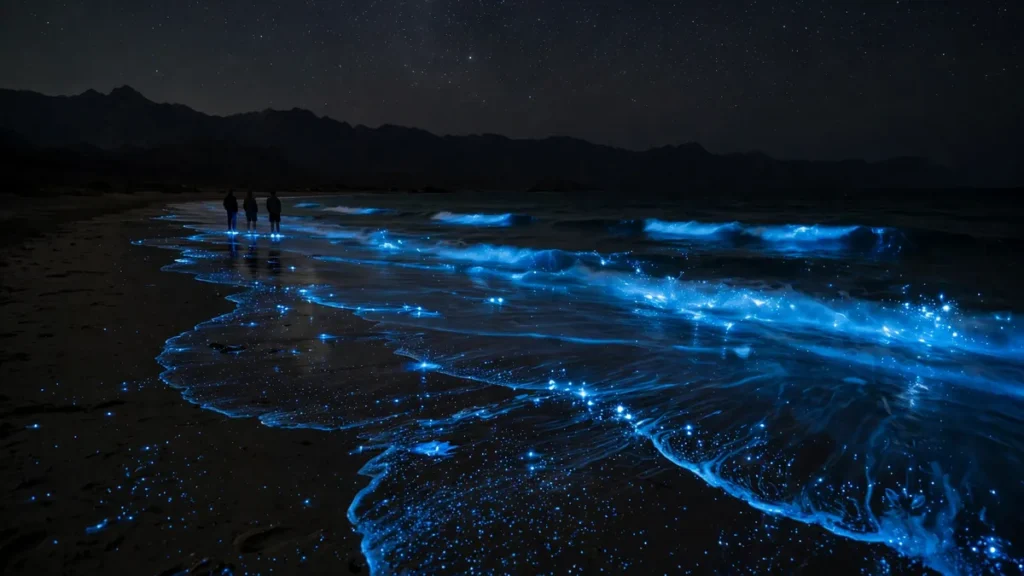
The sea is glowing blue on the east coast of the UAE. Waves rolling onto Al Aqah beach in Fujairah are lighting up with a bright blue shimmer. The same glow has been seen at Khorfakkan beach and at Dibba Al Fujairah. People who drove out late at night say the light clings to their feet and hands as they walk along the shore. It looks, in the words of one visitor, like something straight out of a movie.
Today is Thursday 19 November 2026. The glow was reported in the early hours of this week and is still being seen. Khaleej Times called it one of the most spectacular displays of the phenomenon the country has ever seen. Emirates 24/7 reported the same blue waves at Khor Fakkan and Dibba Al Fujairah on the same morning. This guide explains what the glow is, where to see it, when to go, and how long it may last.
Everything in this guide comes from the sources named in the text. They include Khaleej Times, Emirates 24/7, the University of Khorfakkan, the University of Sharjah, and people who made the trip this week. The glow is a natural event. It can fade from one night to the next. Nothing here promises that you will see it on a given night. Read the timing section before you set off.
What Is Happening on the UAE Coast Right Now?
Bright blue light is appearing in the waves along parts of the east coast. Khaleej Times reported on 19 November 2026 that bioluminescence is lighting up the shores of Fujairah’s Al Aqah beach. Similar sightings were reported along Khorfakkan beach. Emirates 24/7 reported on the same day that the beaches of Khor Fakkan and Dibba Al Fujairah have shown blue waves in recent days. Photos and videos of the glow have been shared widely on social media this week.
The glow appears as blue streaks that run along the shore as the waves arrive. It fades as the water pulls back. In footage shared by Dubai-based photographer Rami Dibo, the light clings to his feet and hands as he walks along the beach. It leaves a trail of bluish light in his wake. Other visitors have posted about driving to the beach late at night to enjoy the sight.
Who Has Made the Trip to See It?
Indian expat Arun Ajith Nair set off for Fujairah a little past midnight on Monday with his friends. He told Khaleej Times that the group reached Fujairah at around 3am and spent around an hour there. It was his first time seeing bioluminescence in the UAE. He had seen it once before in his hometown of Kerala. He said the drive to Fujairah was totally worth it.
Rami Dibo works in Dubai. The trip to Fujairah was a special one for him, made after he saw the phenomenon on social media. In his words, it was a mission, and he went after work even though it was a long drive. Once you get close to the beach, the glow is very easy to spot on the waves with the naked eye, he said. You can try to put it on your hands, he added, and it shows up even if you step on it. In all his years here, he has seen nothing of its kind in the UAE.
What Is Bioluminescence, and Why Does the Sea Glow?
Bioluminescence is light made by living organisms. In the sea, tiny plankton produce a blue flash when the water around them is disturbed. A wave breaking on the shore is enough. So is a footstep in shallow water, or a hand trailing through a wave. The light is a chemical reaction inside the organism. It lasts for a short moment and then fades.
The organism behind this week’s display is Noctiluca scintillans. It is a microscopic organism commonly known as sea sparkle. The Sharjah Marine Science Research Centre at the University of Khorfakkan captured a microscopic image of its cells. The image shows round and semi-transparent cells. Dr Silvana Birchenough is an Associate Professor at the University of Khorfakkan. She explained that Noctiluca scintillans is occasionally found in the coastal waters of the UAE and across the Arabian Gulf. When it is present in large numbers, it can change the colour of the water and produce glowing blue flashes at night.
What Did the Second Expert Say?
Emirates 24/7 gave the same explanation with a second expert. Dr Mashhour Al Wardat is a Professor of Astrophysics at the University of Sharjah. He also serves as Director of Academic Affairs at the Sharjah Astronomy and Space Complex. The blue waves seen on Khor Fakkan beach are most likely caused by bioluminescence, also called sea glow, he said. The light comes from microscopic marine organisms, especially the luminous plankton known as dinoflagellates, he explained. These organisms emit a blue light for a short time when waves break on the shore, or when the water is disturbed by swimming or movement.
Emirati researcher and writer Fatima Al Hantoubi specialises in environmental and sustainability issues. She explained that the glow is not a change in the colour of the seawater itself. It is light produced by microscopic organisms when they are disturbed. She also stressed that the mere appearance of the glow is not enough to judge the quality or safety of the seawater. The glow tells you that the organisms are present in large numbers. It tells you nothing else about the water.
Has the Glow Appeared in the UAE Before?
The glow is not new to the UAE coast. It has been seen here before, including at Dibba in Fujairah in 2018. That earlier sighting was reported by Gulf News. Professor Aaron Bartholomew of the American University of Sharjah confirmed at the time that the organisms are not dangerous. Dinoflagellate species are present in the Arabian Gulf throughout the year in high densities. What makes this week different is the scale of the display, not the organism itself.
Where Can You See the Glow in the UAE?
Three locations have confirmed sightings this week. Al Aqah beach in Fujairah is the main one. Khaleej Times named it first in its report of 19 November 2026. Khorfakkan beach in Sharjah is the second. Dibba Al Fujairah is the third, named by Emirates 24/7 in its report of the same morning. All three sit on the east coast, on the Gulf of Oman side of the country. That is where the organisms are showing in large numbers right now.
Al Aqah is a long public beach in Fujairah, south of Dibba and north of Fujairah city. It is the beach most visitors named this week. Rami Dibo and Arun Ajith Nair both went to Fujairah for the glow. Khorfakkan is a town and beach in Sharjah, further north along the same coast. It has been known for this phenomenon for years. Travel guides have described its glowing water in the past, and it remains one of the finest places in the UAE to look for it.
Dibba Al Fujairah sits at the northern end of the Fujairah coast. It has also had glowing water in the past. The 2018 sighting reported by Gulf News was at a beach in Dibba. Visitors there saw thousands of twinkling blue specks along the shore at around midnight. Within 30 minutes, the whole beach was glowing blue.
The glow does not appear evenly along the coast. Emirates 24/7 reported that its intensity and visibility vary from location to location. The glow may appear in a limited area of the coastline and then diminish or disappear as marine conditions change. That means one beach can be glowing while another a few kilometres away shows nothing. It also means the same beach can glow one night and stay dark the next.
Which Beach Should You Pick First?
If you go, pick one beach and commit to it. Al Aqah is the safest first choice this week because it has the most reports. Khorfakkan is the best backup if you are coming from Sharjah or northern Dubai. Check social media for fresh sightings on the day you plan to go, and look for posts from the same evening rather than older ones.
These beaches are open again after a difficult few weeks. Several east coast beaches were closed after an oil spill in late October. Seven beaches in Ras Al Khaimah reopened on 11 November and beaches in Sharjah reopened on 12 November, according to Khaleej Times. You can read about the closures in our report on the UAE beaches closed after the October oil spill. The glow is arriving just as the coast is welcoming visitors back.
How Long Will the Glow Last?
There is no fixed end date for the glow. Muhammed Sajjad is known on social media as the UAE weatherman. He has tracked bioluminescence along the UAE coast for years. He told Khaleej Times that he expects the glow to remain visible along parts of the UAE coast for three weeks or more, depending on local conditions. That is an expectation based on ocean maps and past patterns. It is not a guarantee.
The glow can also vanish from one night to the next. Emirates 24/7 reported that the phenomenon could disappear from the same location the following night, even after a clear display the night before. Its appearance depends on changing natural conditions. The density of the organisms, the movement of the water, and the level of ambient light all play a part. A windy night or a change in currents can end it at one beach while it continues at another.
The season helps your chances. Sajjad said sightings typically occur during two windows of the year. The first window is October to November. The second window is March to May. This week’s display sits inside the first window. The water is still warm, and the nights are getting darker and cooler. That combination is what the organisms need.
Put simply, the glow may last for weeks, but it may also end without warning. If you want to see it, go sooner rather than later. Do not plan a trip for the end of the month and assume the glow will wait for you. The best approach is to watch for fresh reports during the day and head out the same night.
When Is the Best Time to Go and See It?
Go late at night, and go when it is properly dark. The visitors who saw the glow this week went after midnight. Arun Ajith Nair set off a little past midnight and reached Fujairah at around 3am. The 2018 visitors at Dibba saw the first twinkles at around midnight, and the whole beach was glowing within 30 minutes. Late night is when the display is at its best.
Darkness matters as much as the hour. The effect occurs when the water is warm and calm and in pitch darkness, usually away from city lights. That is the condition Muhammed Sajjad named. Street lights, car headlights, and phone screens all make the glow harder to see. Your eyes need time to adjust to the dark. Give yourself at least 15 minutes on the beach before you decide the glow is not there.
Does the Moon Affect the Glow?
A moonless night is better than a bright one. A full moon washes out the faint blue light, just like a street light does. If you can choose your night, pick one with little or no moon. If you cannot choose, go anyway and walk away from the brightest lights on the beach. The glow is brightest where the water is darkest.
Calm water helps too. The glow shows best when the sea is gentle and the waves roll in slowly. Rough water can still glow, but the light is scattered and harder to follow. The National Centre of Meteorology has forecast rain and strong winds for parts of the east coast this week, so check the sea conditions before you drive out. A rough sea is also a safety risk at night.
Winter is the right season for a night trip to the east coast. The days are warm and the nights are mild, so standing on a beach at 2am is comfortable. This is also the best time to visit Dubai and the wider UAE. The cooler months run from November to March, and they suit outdoor plans that would be hard in summer.
How Do You Get to Fujairah and Khorfakkan from Dubai?
You need a car. There is no metro or public bus that will drop you at Al Aqah beach in the middle of the night. Drive east from Dubai toward Fujairah on the main highway. Arun Ajith Nair left Dubai a little past midnight and reached Fujairah at around 3am, so plan for around two hours each way at night. Traffic is light after midnight, which keeps the drive smooth.
Leave early enough to arrive before the best viewing hours. If you leave Dubai at midnight, you will reach the coast at around 2am. That leaves you a good window before dawn. If you leave at 10pm, you will arrive earlier and can wait for the darkest hours on the beach. Either plan works. The mistake is leaving so late that you arrive as the sky is already lightening.
Fuel up before you leave Dubai. Petrol stations are open along the highway, but it is simpler to start with a full tank. You can check the latest prices in our guide to UAE petrol prices for December 2026. A night trip uses little fuel, but a full tank removes one worry from the plan.
Drive carefully on the way home. You will be driving back in the early hours after a late night. Tired driving is a real risk. Share the driving if you can, and take a break at a petrol station on the return leg. Remember the Dubai speed limits and the limits on the highways to Fujairah. A fine is a poor souvenir from a beautiful night.
What If You Do Not Own a Car?
If you do not own a car, rent one for the night or go with a friend who drives. Car rental desks at the airport and in the city offer day rentals. Taxis and ride-hailing cars can take you to Fujairah, but the return trip at 3am is harder to arrange. Agree the return fare before you set off, or book a car that waits for you.
What Should You Take With You for a Night Visit?
Pack light, but pack for the dark. A small torch is useful for the walk from the car park to the water. Use it sparingly on the beach itself, because bright light spoils the glow for everyone. A torch with a red light mode is ideal. Red light affects your night vision far less than white light.
Bring water and a snack. You will be out for several hours, and the shops near the beach may be closed after midnight. A bottle of water each is enough. If you want a proper meal before or after, stop on the way. You can find the best street food in Dubai before you leave, or eat in Fujairah city on the way home.
What Should You Wear for a Night Visit?
Wear shoes you can get wet. The glow shows best at the waterline, and you will want to step into the shallow water. Sandals or old trainers are fine. Bring a towel and a dry change of clothes for the drive home. A light jacket is worth packing too. The night air on the east coast can feel cool after midnight, even in November.
Bring a power bank for your phone. You will use the phone for maps, for photos, and for checking fresh sightings. A dead battery at 3am on a dark beach is a problem you do not need. Keep the phone brightness low while you watch the glow. A bright screen ruins your night vision just like a torch does.
Take a bag for your rubbish. The beaches are public and the glow draws crowds this week. Leave the beach as clean as you found it. The organisms are part of a living coastline, and the beach is used by families during the day. A clean beach keeps the experience open for the next visitors.
Can You Swim in the Glowing Water?
The organisms behind the glow are not dangerous. Professor Aaron Bartholomew of the American University of Sharjah confirmed in 2018 that the dinoflagellates seen at Dibba are harmless. The glow itself is light from tiny plankton. It is not a chemical spill and it is not pollution. Touching the glowing water is safe, and visitors this week have put it on their hands and stepped in it without harm.
That does not mean you should swim far out at night. Night swimming is risky for reasons that have nothing to do with the glow. You cannot see the depth, the currents, or other swimmers. The sea can be rougher than it looks from the shore. Stay in the shallows where you can stand. Wade in to your knees, not to your chest. Never swim alone at night.
Fatima Al Hantoubi made an important point about the water. She said the appearance of the glow is not enough to judge the quality or safety of the seawater. A glowing beach can still have rough water or strong currents. A dark beach can still be perfectly safe to paddle in. Judge the water by the conditions, not by the light. If the waves are strong or the water is murky, stay on the sand.
If you do go in the water, protect your skin. Salt water and sun are a hard combination during the day, and the same care applies at night. Read our guide on how to protect your skin while swimming before you go. Rinse off with fresh water after your visit and change into dry clothes for the drive home.
What Should Children Do Near the Water?
Children should stay with an adult at all times. The dark beach, the water, and the excitement of the glow are a lot for a young child. Hold their hand near the waterline and keep them in the shallows. The glow is just as visible from the sand, where it is safest for them.
How Do You Photograph the Glow at Night?
Photographing the glow is harder than seeing it. A phone camera on automatic mode will usually show a black beach and nothing else. The light is faint and it moves. You need a long exposure to capture it. That means a tripod, or a steady surface such as a rock or a bag, and a camera that lets you control the shutter speed.
Set your phone or camera to night mode if it has one. Turn off the flash. A flash kills the glow in the frame and lights up the sand instead. Use the longest exposure your phone allows, and keep the camera still for the whole shot. Ask your friends to stay still too. Movement blurs the light into streaks, which can look good, but only if the camera itself does not move.
Take a test shot first. Look at the result and adjust. If the frame is too dark, lengthen the exposure. If the glow is a blur, shorten it. The best photos this week came from people who took their time. Rami Dibo is a photographer, and his footage shows the glow clinging to his hands and feet. That kind of shot needs patience and a steady hand.
Do not let photography spoil the night. The glow is best enjoyed with your own eyes. Put the camera down after a few shots and watch the waves. The light moves with every wave, and no photo captures the feeling of standing in it. Your memory of the night will last longer than the photos.
Why Is This Year’s Display Getting So Much Attention?
The glow is not new, but this year it is stronger than usual. Muhammed Sajjad has tracked bioluminescence along the UAE coast for years. He told Khaleej Times that this is the first time in his experience tracking the phenomenon that he has seen the most spectacular display along the UAE coast. Every year, he said, people in the UAE see videos from Oman and wish they could experience the same here. This year, he added, the country is lucky.
Why Is Social Media Talking About It?
Social media has played a big part in the excitement. Photos and videos of the glow spread quickly this week. People saw the blue waves on their feeds and drove to the coast the same night. Rami Dibo went after seeing it on social media. Arun Ajith Nair went with friends after the posts spread. Each new video brings more visitors, and each visitor posts more video. The glow has become a shared event, not just a natural one.
The timing helps too. November is the start of the outdoor season in the UAE. The heat has eased and the evenings are pleasant. People are looking for reasons to get out of the city. A glowing beach on the east coast is a strong reason. It is free, it is close, and it is unlike anything else on offer this week.
The display also comes at a good moment for the east coast. The beaches reopened this month after the October oil spill. Hotels in Sharjah and Ras Al Khaimah are seeing bookings recover as the beaches reopen. A natural wonder on the same coastline gives people one more reason to visit. The glow is a reminder that the east coast has its own beauty, separate from the cities.
What Else Can You Do Around Fujairah and Khorfakkan?
Do not drive two hours for one sight and then drive straight home. The east coast rewards a longer visit. Fujairah and Khorfakkan have beaches, mountains, forts, and food that are worth a full day. Plan your trip so the glow is the finale, not the only event.
Start with the daytime. Khorfakkan beach is a wide sandy beach with clear water and mountain views. Al Aqah beach is quieter and longer, with space to walk. Both are good for a swim and a picnic during the day. Fujairah city has a fort and a museum, and the mountains behind the coast are worth a drive. The road from Dubai to Fujairah passes through desert and mountain scenery that is a change from the city.
December is a strong month for a longer trip. The UAE National Day holidays fall on 2 to 4 December 2026, and Dubai government employees get a five-day long weekend. That is a perfect window for a night on the east coast, with the glow as the highlight. You can find more ideas in our guide to things to do in Dubai in December 2026.
Eat well on the trip. The east coast has fish restaurants and small cafes that serve fresh seafood. Fujairah city has restaurants along the corniche. Khorfakkan has cafes near the beach. A meal after a swim, or before the night drive, is part of the trip. Save the best street food for the return to Dubai, or try the local restaurants on the coast itself.
Should You Stay Overnight on the Coast?
Stay overnight if you can. A hotel in Fujairah or Khorfakkan lets you enjoy the glow without a tired drive home at 4am. You can sleep in, have breakfast by the sea, and drive back in daylight. The hotels are recovering after the oil spill closures, and a night on the coast supports the local businesses there.
| Beach | Emirate | What to Expect |
|---|---|---|
| Al Aqah beach | Fujairah | Main sighting this week, long public beach, best first choice |
| Khorfakkan beach | Sharjah | Known for the glow in past years, mountain views, easy day trip |
| Dibba Al Fujairah | Fujairah | Northern coast, glowing water seen here in 2018 and again this week |
Frequently Asked Questions About the Glowing Beaches?
What causes the blue glow on UAE beaches?
The glow comes from microscopic plankton called Noctiluca scintillans, also known as sea sparkle. When the water is disturbed by waves or movement, the organisms produce a blue light through a chemical reaction. Experts at the University of Khorfakkan and the University of Sharjah confirmed this explanation for the November 2026 display.
Where is the glow happening right now?
The glow has been reported at Al Aqah beach in Fujairah, at Khorfakkan beach in Sharjah, and at Dibba Al Fujairah. All three are on the east coast. Al Aqah has the most reports this week, so it is the best first choice for a visit.
How long will the glow last?
There is no fixed end date. Muhammed Sajjad, who tracks the phenomenon, expects it to remain visible along parts of the UAE coast for three weeks or more, depending on local conditions. The glow can also disappear from one beach overnight, so go sooner rather than later and check for fresh reports on the day.
Is the glowing water safe to touch?
The organisms behind the glow are not dangerous, according to marine experts. Visitors this week have put the glowing water on their hands and stepped in it. The glow itself does not tell you whether the water is safe for swimming, so judge the sea by its conditions and stay in the shallows at night.
What is the best time to see the glow?
Go late at night, after midnight, when it is properly dark. The glow needs warm, calm water and pitch darkness away from city lights. A moonless night is best. Give your eyes at least 15 minutes to adjust to the dark before you decide the glow is not there.
Can I see the glow from Dubai?
The glow has not been reported on Dubai beaches this week. The sightings are on the east coast, at Fujairah and Khorfakkan. You need to drive east for around two hours to reach the glowing beaches. The trip is worth it for the scale of the display.
Do I need to pay to see the glow?
The beaches named in this guide are public beaches. There is no ticket to see a natural phenomenon. Your only costs are fuel, food, and your time. If you stay overnight, you will pay for a hotel like any other trip.
The glow will not wait for you. It may last three weeks, and it may end tomorrow night. If you want to see the sea light up in blue, check the latest reports today and drive east tonight. The east coast is open, the nights are cool, and the water is glowing.