Learning how to boil eggs with complete scientific precision is the ultimate foundation of culinary competence. Across commercial restaurant kitchens worldwide, executive chefs evaluate incoming line cooks solely on their egg technique. The humble egg appears deceptive in its simplicity. However, mastering its delicate chemistry unlocks an entire universe of gourmet dining. At Gulf Lights, we deliver verified culinary guides to elevate everyday home dining across the United Arab Emirates and beyond.
Cooking flawless eggs does not require specialized kitchen gadgets or electronic timers. In fact, achieving restaurant-worthy results depends entirely on heat thermodynamics, protein coagulation thresholds, and rapid cooling. Furthermore, mastering fundamental egg techniques allows you to conquer morning centerpieces like silky scrambled curds, poached Benedicts, and vibrant shakshuka. Consequently, you can transform simple pantry staples into luxurious brunch feasts effortlessly. Explore our complete culinary archive through our food category hub.
The Culinary Significance of the Egg Across Gastronomy
The chicken egg represents one of nature’s most extraordinary biological and gastronomic miracles. For centuries, classical French chefs celebrated the egg as the cornerstone of haute cuisine. In fact, traditional chef hats (toques) historically featured one hundred pleats. Each pleat symbolized a distinct method the chef had mastered to prepare an egg.
Furthermore, eggs perform vital functional roles across every international culinary culture. They act as emulsifiers in delicate sauces, structural binders in baked goods, and velvety coatings for noodles. You can review regional household grocery budgets and dining benchmarks in our guide to prices in dubai for food.
Moreover, comforting egg traditions unite breakfast tables across the globe. From Spanish tortillas to spiced Arabian egg bakes, eggs provide wholesome morning fuel. You can explore traditional Gulf grain and meat stews in our comprehensive guide to the national dish of uae. Mastering egg cookery represents the ultimate bridge between culinary science and domestic artistry.
The Food Science of Eggs: Albumen, Yolk, and Protein Coagulation
Cooking eggs with consistent perfection requires understanding their underlying cellular chemistry. An egg consists of two distinct biological components: the white (albumen) and the yolk. Each component reacts to thermal energy at entirely different temperatures.
First, egg albumen contains roughly ninety percent water and ten percent diverse proteins, primarily ovalbumin. These white proteins begin to denature and thicken at 62°C (144°F). However, the whites set firmly into a solid, opaque gel only when they reach 82°C (180°F). If cooked beyond this temperature, the protein matrix tightens aggressively, expelling trapped water and turning rubbery.
Second, egg yolk consists of concentrated fats, emulsifying lecithins, and heat-sensitive proteins. Yolk proteins begin setting at 65°C (149°F), transforming into a tender, jammy custard around 70°C (158°F). Cooking the yolk beyond 77°C (170°F) turns it chalky and dry. If you enjoy precision searing on thick beef cuts, check our classic steak recipes. Understanding these thermal thresholds prevents dry yolks and rubbery whites forever.
Mastering How to Boil Eggs: The Hot-Water Start vs Cold-Water Myth
For decades, traditional cookbooks instructed home cooks to place eggs in cold water and bring the pot to a boil. However, modern culinary food science has proven that this old cold-water method is fundamentally flawed.
When you start eggs in cold water, the temperature rises slowly. This gradual warming gives the egg’s inner membrane proteins time to fuse tightly to the delicate egg white. Consequently, when you attempt to peel cold-water boiled eggs, the shell clings stubbornly, tearing away chunks of white meat. Furthermore, timing a cold-water pot is inconsistent because different stoves and cookware heat at unpredictable speeds.
In contrast, lowering cold eggs directly into boiling water (100°C / 212°F) creates an immediate thermal shock. This sudden heat causes the outer layer of egg white to shrink rapidly away from the shell membrane. As a result, the shell detaches effortlessly every single time. Moreover, boiling water provides an absolute, repeatable temperature benchmark. You can review corporate regulatory standards and safety practices in our legal and government services directory. The hot-water start guarantees foolproof peeling and exact timing.
The Boiling Time Matrix: Soft-Boiled, Jammy, and Hard-Boiled
Achieving your exact desired yolk texture requires strict adherence to digital timing. Always lower large eggs straight from the refrigerator into boiling water, reduce heat to a gentle simmer, and set your timer immediately.
- 6 Minutes (Soft-Boiled): Yields liquid, warm runny yolks with barely set whites. Ideal for dipping buttered toast soldiers.
- 7 Minutes (The Classic Jammy Yolk): Produces firm, tender whites and a thick, fudge-like, jammy golden yolk. This represents the gold standard for gourmet ramen bowls and artisan toasts.
- 8 Minutes (Firm yet Creamy): Yields fully set whites with a creamy, custard-like yolk that does not run. Perfect for grain bowls and sandwiches.
- 10 Minutes (Classic Hard-Boiled): Produces completely set, firm yolks that remain bright yellow without chalkiness. Ideal for classic egg salads and deviled eggs.
Never boil eggs past eleven minutes. Boiling too long triggers a chemical reaction between iron in the yolk and sulfur in the white. This reaction creates an unsightly green-gray ring of ferrous sulfide around the yolk, accompanied by an unpleasant sulfurous odor. If you love fluffy morning griddle bakes, explore our celebrated pancake recipe guide. Precision timing keeps yolks golden, creamy, and fragrant.
The Ice Bath Shock and Effortless Peeling Physics
Timing your boiling water accurately is only half the battle. The final secret to effortless peeling is the mandatory ice bath shock.
Prepare a large bowl filled with cold tap water and plenty of ice cubes before your timer rings. The moment boiling concludes, use a slotted spoon to transfer the hot eggs directly into the ice water. This sudden temperature drop halts carryover cooking instantly, preserving your exact target yolk texture.
Furthermore, rapid cooling causes the interior egg white to contract slightly within the rigid shell. This physical contraction creates a microscopic pocket of steam and water beneath the shell membrane. Let the eggs rest in the ice bath for at least fifteen minutes. When you tap the egg gently on the counter, water slips beneath the shell, allowing the shell to slide off in two large pieces. You can verify dairy baking measurements in our kitchen reference guide on 1 cup butter in grams.
Silky French Decadence: The Ultimate French Omelette Technique
While American diner omelettes feature browned folded envelopes stuffed with cheese, a classic french omelette represents the pinnacle of refined culinary technique. It should display a smooth, pale yellow exterior without a speck of browning, concealing a creamy, custardy interior.
Whisk three large eggs vigorously with a fork until the whites and yolks are completely homogenous. Season with fine sea salt. Melt twenty grams of unsalted butter in an eight-inch non-stick skillet over medium-low heat until foaming. Pour the eggs into the skillet immediately.
Shake the pan rapidly in a circular motion with one hand while stirring the eggs vigorously in small circles with a silicone spatula using your other hand. This rapid agitation breaks up large curd formations, creating microscopic curds resembling soft scrambled eggs. The moment the top looks glossy and slightly wet, smooth the surface flat. Roll the egg blanket into a neat cylinder, tipping it onto a warm plate seam-side down. Brush the warm surface with melted butter for a glossy sheen. If you love burger patties, explore our skillet techniques in our smash burger recipe guide.
Velvety Clouds: Restaurant-Style Scrambled Eggs Recipe
Many home cooks inadvertently ruin scrambled eggs by cooking them over aggressive high heat. High heat squeezes moisture from egg proteins, leaving behind watery puddles and rubbery curds. In contrast, an authentic scrambled eggs recipe relies on low heat and cold butter.
Whisk four fresh eggs in a bowl until smooth. Pour into a cold, heavy saucepan with thirty grams of cold diced butter. Place the pan over medium-low heat, stirring constantly with a rubber spatula, scraping the bottom and sides continuously.
As the butter melts, it emulsifies into the warming eggs, coating protein strands and preventing them from bonding tightly. When the eggs begin to thicken into soft curds, lift the pan off the heat for twenty seconds while continuing to stir. Alternate on and off the heat for four minutes until curds form soft, velvety ribbons. Remove from heat while the eggs still look slightly wet, and stir in a spoonful of crème fraîche and chopped chives. Residual heat will finish cooking them to luxurious perfection. If you prefer lean white poultry on busy weeknights, explore our tender chicken breast recipes.
Vortex Precision: The Art of the Perfect Poached Egg
A pristine poached egg features a firm, teardrop-shaped white envelope enclosing a warm, liquid golden yolk. Achieving this delicate balance intimidates many home cooks, but simple physics makes it foolproof.
First, always crack your egg into a fine-mesh sieve over a small bowl. Raw eggs contain a loose, watery outer white and a thick inner white. The sieve drains away that watery outer liquid, which is the primary cause of messy, wispy foam in the pot. Second, bring a deep pot of water to a gentle simmer (85°C / 185°F), where small bubbles rise occasionally from the bottom.
Add one tablespoon of white vinegar to the water. The gentle acid lowers the water’s pH, accelerating the coagulation speed of the outer albumen so it sets before dispersing. Create a gentle circular vortex in the water using a wooden spoon. Slide the strained egg into the center of the vortex; the spinning water wraps the white neatly around the heavy yolk. Simmer undisturbed for exactly three minutes. Lift with a slotted spoon and drain on paper towels. If you love quick shellfish preparations, explore our ten-minute shrimp recipes.
Brunch Royalty: Classic Eggs Benedict Recipe and Hollandaise Sauce Recipe
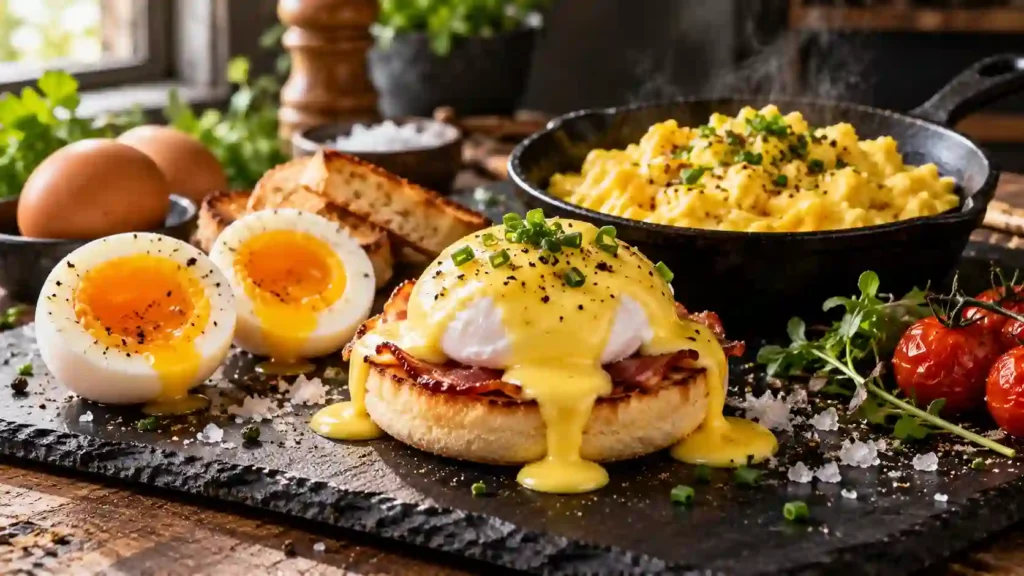
First popularized in historic Manhattan hotels in the late nineteenth century, a luxurious eggs benedict recipe remains the undisputed crown jewel of weekend brunch dining. It combines toasted English muffins, seared Canadian bacon, poached eggs, and silky hollandaise.
The foundation of this masterpiece is an authentic hollandaise sauce recipe. Hollandaise is a warm, delicate emulsion of egg yolks, lemon juice, and melted butter. In a metal bowl set over simmering water (a double boiler), whisk two egg yolks with one tablespoon of lemon juice until pale and thickened.
Slowly drizzle in one hundred grams of warm melted butter in a thin, continuous stream, whisking vigorously. The natural lecithin in the egg yolks encapsulates microscopic fat droplets, creating a thick, glossy sauce. Season with cayenne pepper and salt. Assemble by placing seared meat and a warm poached egg on toasted muffin halves, smothering generously in warm hollandaise. Slicing through the egg allows liquid yolk to mingle with buttery sauce. If you love slow-cooked shredded meats, check our classic pulled pork recipe guide.
Mediterranean Simplicity: Vibrant Baked Shakshuka Recipe
Hailing from the sun-drenched coastal communities of North Africa and the Levant, a comforting shakshuka recipe transforms eggs into a vibrant communal feast. Shakshuka features whole eggs gently poached inside a spiced tomato-bell pepper stew.
Sauté diced yellow onions, red bell peppers, and garlic in extra virgin olive oil until caramelized. Stir in ground cumin, smoked paprika, ground coriander, and crushed San Marzano tomatoes. Simmer the sauce gently for fifteen minutes until thick and aromatic. Explore foundational Italian tomato reductions in our specialized homemade spaghetti sauce guide.
Use a wooden spoon to create small wells in the bubbling sauce. Crack fresh eggs directly into each hollow space. Cover the skillet tightly with a lid and simmer over low heat for six minutes until egg whites set firmly while yolks remain runny. Garnish with crumbled feta cheese, fresh cilantro leaves, and cracked black pepper. Serve the bubbling skillet directly at the table with crusty bread for dipping. Pair this comforting classic with artisanal flatbreads from our naan bread recipe collection.
Cast-Iron Versatility: Hearty Oven-Baked Frittata Recipe
When hosting large brunch gatherings, a colorful frittata recipe provides outstanding convenience. Unlike individual omelettes that require active attention, a frittata bakes effortlessly in a single skillet.
Whisk eight large eggs with a quarter cup of whole milk or heavy cream, kosher salt, and black pepper. The dairy prevents egg proteins from shrinking tightly in the dry oven heat, ensuring a custardy crumb. In an oven-safe cast-iron skillet, sauté baby spinach, roasted red peppers, diced potatoes, and goat cheese until warm.
Pour the egg mixture over the cooked vegetables, stirring gently over medium-low heat for two minutes until the bottom edges set. Transfer the skillet to a preheated oven at 180°C (350°F) and bake for fifteen minutes until puffed and lightly golden on top. Slicing into a warm frittata reveals tender vegetables suspended in fluffy eggs. If you enjoy layered baked casseroles, explore our celebrated best lasagna recipe. Frittatas can be served warm, at room temperature, or chilled for meal prep.
Freshness Physics: The Float Test and Egg Sizing
Evaluating egg freshness before cooking prevents culinary failure. Because eggshells are porous, water evaporates from the egg over time, causing the internal air cell at the wide base to expand.
To test egg freshness, gently place an intact egg into a tall glass of cold water. A farm-fresh egg sinks horizontally to the bottom, indicating a tiny air pocket. An older egg stands upright on its pointed end, remaining safe and ideal for boiling because the enlarged air pocket aids peeling. However, if an egg floats completely to the surface, its air pocket has expanded drastically through moisture loss; discard floating eggs immediately.
Furthermore, standard international recipes strictly call for Large eggs, which weigh roughly fifty grams out of the shell. Using medium or extra-large eggs alters liquid ratios significantly in delicate baking and custards. You can explore artisanal bread dough hydration in our master guide to pizza dough recipe crusts. Always verify egg sizing to guarantee consistent baking results.
Nutritional Powerhouse: Choline, Complete Protein, and Lutein
Registered dietitians universally celebrate eggs as one of the most nutrient-dense whole foods on earth. Savoring well-prepared eggs delivers comprehensive biological nourishment.
A single whole egg supplies six grams of complete dietary protein containing all nine essential amino acids in optimal human ratios. Furthermore, egg yolks are one of the richest dietary sources of choline. Choline is a vital micronutrient essential for neurotransmitter synthesis, memory consolidation, and fetal brain development.
In addition, yolks contain potent carotenoid antioxidants like lutein and zeaxanthin. These fat-soluble antioxidants accumulate in retinal tissue, protecting eyes from blue light damage and age-related macular degeneration. Discover how whole-food lifestyle frameworks support lifelong vitality in our comprehensive guide to a balanced diet. You can also explore nutrient-dense natural superfoods in our analysis of dates benefits. Whole eggs support comprehensive physical vitality.
Side Dish Symphony: Crusty Breads, Greens, and Fresh Citrus
Because eggs are naturally rich and savory, thoughtful side dish pairings complete the brunch experience. Crisp greens and acidic fruits provide essential balance against rich yolks.
A crisp romaine salad tossed with our zesty caesar salad recipe dressing cuts through rich egg yolks and butter sauces effortlessly. In addition, serving warm sourdough toast or roasted asparagus spears provides wonderful dipping vehicles. If you enjoy slow-simmered beef comfort, explore our homestyle beef stew recipe guide.
Furthermore, pair savory eggs with royal tandoori appetizers from our authentic tandoori chicken recipe collection for vibrant fusion dining. For delicate ocean seafood variations, explore our comprehensive guide on tender fish recipes. Harmonious accompaniments elevate casual morning cooking into an unforgettable culinary celebration.
Commercial Hospitality Careers in Breakfast Stations and Brunch Service
Mastering egg cookery under high volume is one of the most rigorous tests evaluated across the global hospitality sector. In luxury hotel resorts and boutique brunch cafes, short-order cooks execute hundreds of personalized egg orders during intense morning rushes.
Talented breakfast chefs, line cooks, and kitchen managers enjoy robust recruitment demand across major gastronomic hubs like Dubai. If you are exploring professional vocational paths in gastronomy, review our comprehensive guide on hospitality tourism jobs. In addition, executive chefs and restaurant operations directors command prestigious compensation packages. Explore executive salary scales in our guide to the highest paying jobs.
Furthermore, restaurant networks rely on temperature-controlled warehousing to store fresh dairy and eggs safely. Candidates interested in supply logistics can explore opportunities in our guide on dubai warehouse logistics jobs. Dedicated culinary staff can advance into corporate leadership roles through strategic career change growth. Many international culinary talents relocate using our guide to work abroad. You can study statutory labor standards in our analysis of the labour law uae.
Frequently Asked Questions About Cooking Eggs
Why do boiled eggshells sometimes tear the egg white when peeling?
Shells tear egg whites when eggs are started in cold water, or when fresh eggs are used without an ice bath shock. Lower eggs directly into boiling water, and shock them in ice water for fifteen minutes to release the membrane cleanly.
How do I fix a broken hollandaise sauce?
If your hollandaise separates into oily liquid, whisk one fresh egg yolk with a teaspoon of warm water in a clean bowl. Slowly whisk the broken sauce into the fresh yolk one spoonful at a time to re-establish the emulsion.
Is it safe to eat soft-boiled or runny poached egg yolks?
Yes, consuming pasteurized or fresh high-quality eggs with runny yolks is considered safe for healthy adults. However, pregnant women and immunocompromised individuals should consume fully cooked yolks.
Should I add milk or cream to scrambled eggs?
Adding too much milk dilutes egg proteins, causing them to weep water onto the plate. Instead, use cold whole butter and finish with a single spoonful of thick crème fraîche or sour cream right as you pull them from the heat.
Mastering this essential guide on how to boil eggs gives you the culinary confidence to prepare tender, jammy, and restaurant-quality breakfast feasts right in your own kitchen. By respecting protein coagulation science, embracing the boiling-water shock, and mastering classic emulsions, you can create extraordinary culinary feasts that bring loved ones together. For additional culinary tutorials, kitchen advice, and verified lifestyle guides, connect with our specialist team via the Gulf Lights contact page. Discover more inspirational cooking articles on the Gulf Lights blog.